Field Sweeping with the SDA-5000: Considerations for Sweep in the Field
72
4
Wiring and Levels: Reverse Sweep (SDA-5000 OPT1)
You can use several connection methods for reverse sweep, depending on
system engineering methods and equipment.
• Split band networks: Most networks are split band network
architectures, where one set of frequencies is used for forward signals
(typically the higher frequencies above 50-80MHz), and another set is
used for reverse path signals (typically the lower frequencies from 5MHz
to below the start of forward path signals at 30-65MHz). These signals
are combined on the same piece of coax, and special amplifiers increase
selected bands in different directions. In a split band system, the most
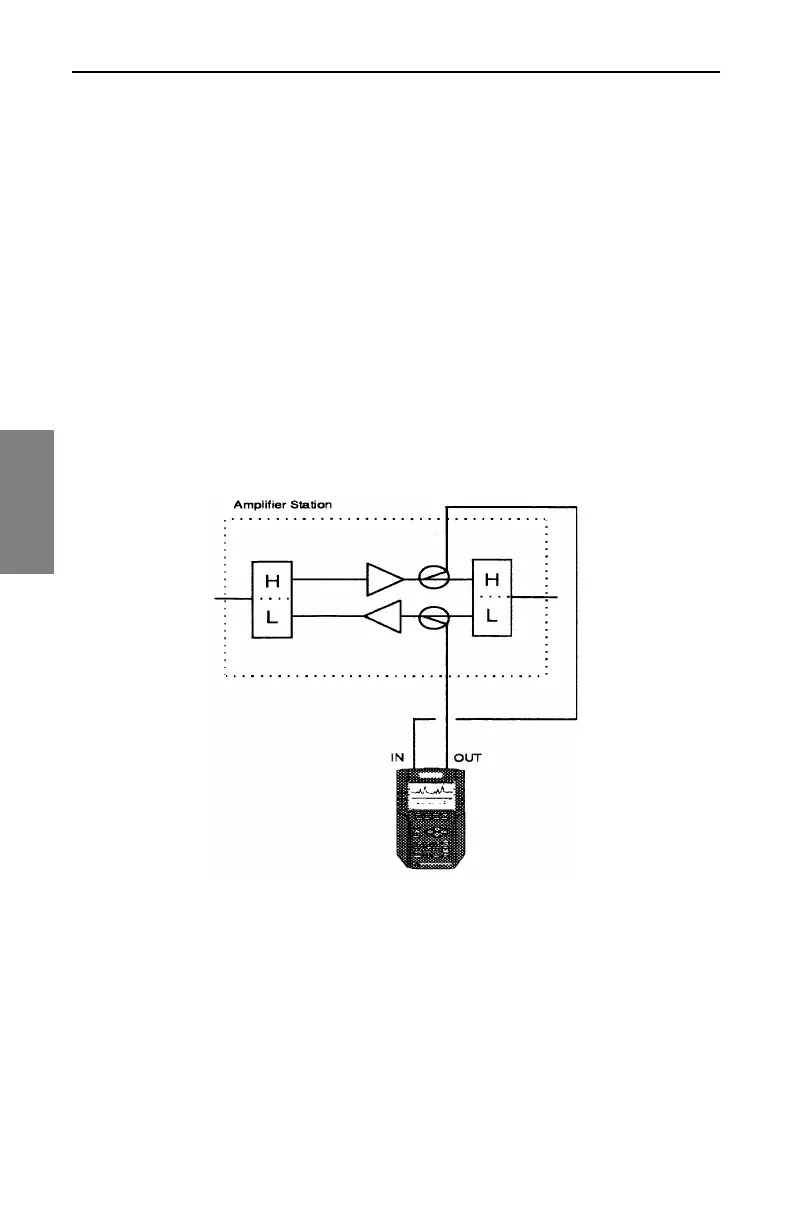
reliable and accurate method is to use two test points, one for forward
path signals (to receive the sweep telemetry signal), and a second for
reverse path signal injection. An example of this connection is shown in
Fig. 4-6.
Fig. 4-6 SDA-5000 Connected in a Network with Two Test Points
When two separate test points are not available, you can use a splitter or
diplex filter to combine the two SDA field unit ports and connect them to a
single point. An example of this connection is shown in Fig. 4-7.
It is important to use a directional test point of some sort for reverse sweep
injection. False standing waves and level inaccuracies can result from trying
to sweep with resistive reverse test points. This is not a sweep system


 To Next Page