Measuring System Performance: Modem Carrier-to-Noise Measurements
122
6
as trigger level threshold, sweep time, measurement bandwidth, video
bandwidth, and resolution bandwidth. You must also be proficient at RF
signal evaluation in the time-domain mode (versus the standard frequency
domain mode).
To overcome the confusing test equipment set-up process, Acterna has
introduced a new instrument feature that allows technicians at all skill levels
to perform accurate return-path cable modem C/N measurements.
Why Measure Cable Modem C/N?
The modem C/N of the return cable plant can determine whether the return
network is capable of reliably carrying cable modem traffic. The US DOCSIS
standard states that the C/N for upstream (return) digital signal types is 15
dB for QPSK and 25 dB for QAM-16. Although most QPSK and QAM-16
signals are robust enough to transmit through noisier return path
environments, complying with the DOCSIS C/N standard will ensure that
cable modems will reliably operate on the return network.
Measuring Modem Carrier-to-Noise
From the Sweep & Spectrum tab in the Navigator, select the Modem C/N
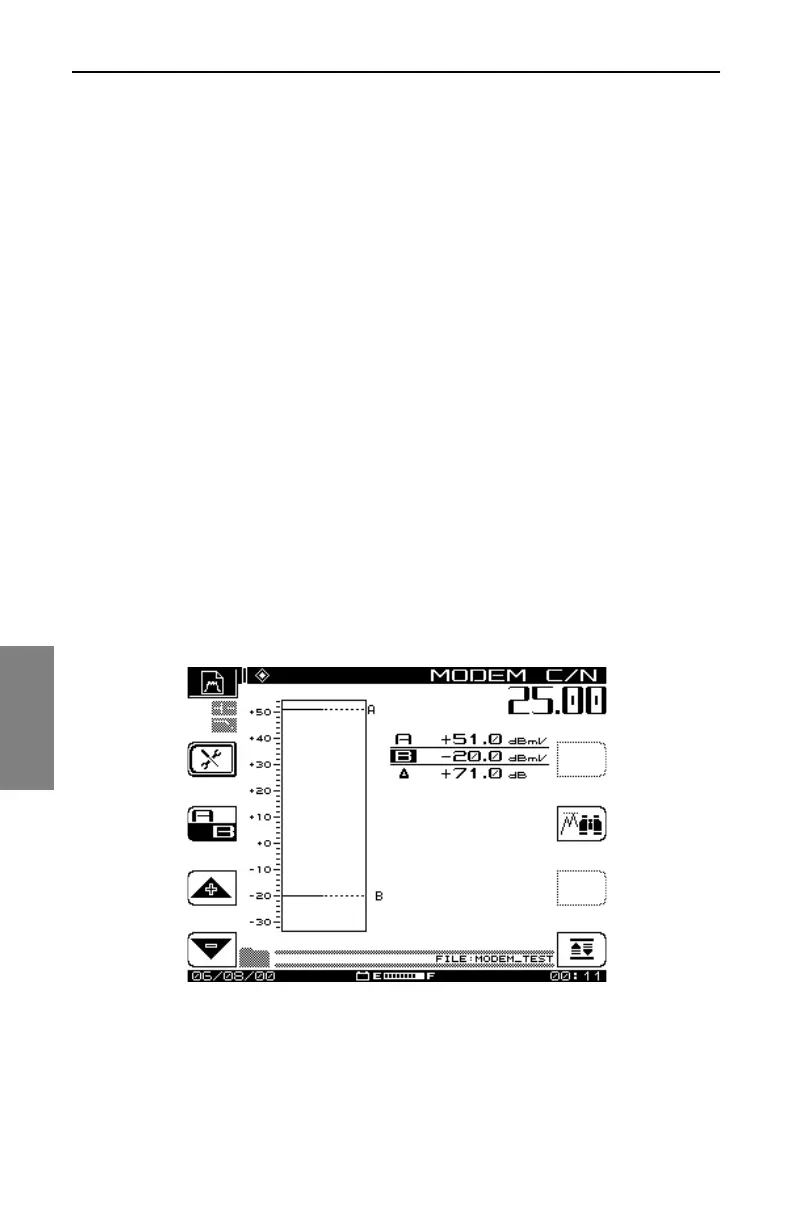
icon. The screen shown in Fig. 6-7 will appear
.
Fig. 6-7 The Modem C/N main screen
There are four items that you can set up for the measurement: Center
Frequency, Pre-Amp state, Low Pass Filter State, and Measurement


 To Next Page