152 D90
PLUS
LINE DISTANCE PROTECTION SYSTEM – INSTRUCTION MANUAL
DIRECT INPUTS AND OUTPUTS CHAPTER 6: COMMUNICATIONS
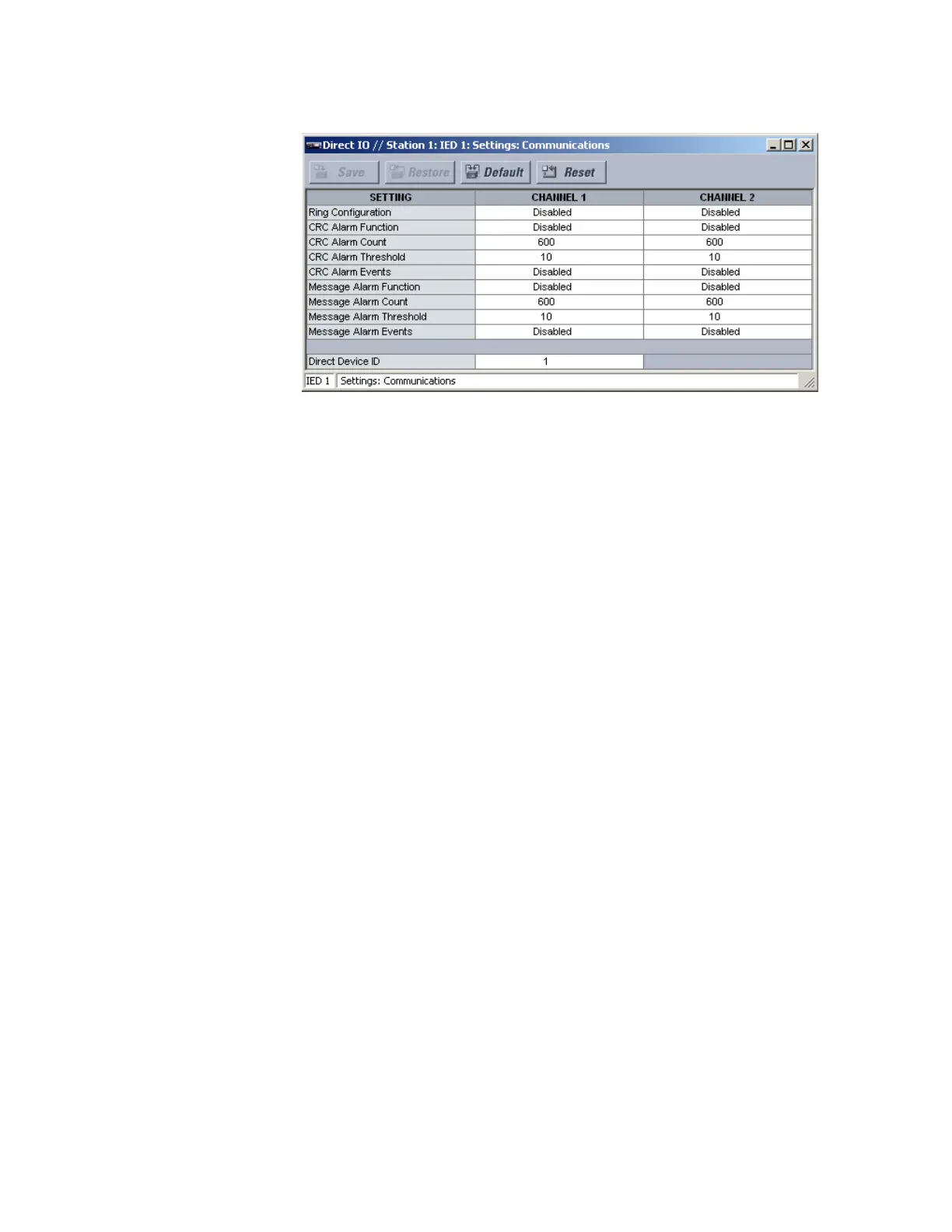
Figure 123: Direct inputs/outputs configuration settings
The following setting is available and applicable to both channels in all direct inputs and
direct outputs.
Direct Device ID
Range: 1 to 16 in steps of 1
Default: 1
This setting identifies the D90
Plus
in all direct output messages. Assign a unique number
to each UR
Plus
-series IEDs in a ring. Each ID is used to identify the sender of the direct
input/output message.
The following settings are available for each channel and are applicable to all direct inputs
and direct outputs.
Ring Configuration
Range: Enabled, Disabled
Default: Disabled
These settings configure the direct input/output scheme to operate in a ring. If set to
“Enabled,” all direct output messages are received back. If not, the direct input/output
ring break self-test is triggered. The self-test error is signaled by the CH1 DIR IO RING BRK
and CH2 DIR IO RING BRK FlexLogic operands.
CRC Alarm Function
Range: Enabled, Disabled
Default: Disabled
The D90
Plus
checks integrity of the incoming direct input/output messages using a 32-bit
CRC. The CRC alarm function is available for monitoring the communication medium
noise by tracking the rate of messages failing the CRC check. The monitoring function
counts all incoming messages, including messages that failed the CRC check. A
separate counter adds up messages that failed the CRC check.
The CRC check can fail if one or more bits in a packet are corrupted. Therefore, an exact
correlation between the CRC fail rate and the bit error rate (BER) is not possible. Under
certain assumptions an approximation can be made as follows. A direct input/output
packet containing 20 bytes results in 160 bits of data being sent and therefore, a
transmission of 63 packets is equivalent to 10000 bits. A BER of 10
–4
implies 1 bit error
for every 10000 bits sent/received. Assuming the best case of only 1 bit error in a failed
packet, having one failed packet for every 63 received is about equal to a BER of 10
–4
.
The CRC alarm function is available on a per-channel basis. The total number of direct
input/output messages that failed the CRC check is available as an actual value.


 To Next Page