388 D90
PLUS
LINE DISTANCE PROTECTION SYSTEM – INSTRUCTION MANUAL
PROTECTION INPUTS AND OUTPUTS CHAPTER 7: PROTECTION
Status
Range: On, Off
This value indicates the logic state of the protection virtual output.
Contact input configuration
The D90
Plus
can monitor the status of up to 115 field contacts. Each input can be wetted
from the D90
Plus
48 volt auxiliary supply or from an external power supply. Each contact
input has a dedicated delay timer for filtering of contact bouncing. The D90
Plus
can also
detect an oscillating input via the chatter feature. Each contact input has active
impedance circuitry to provide security against false turn-on of an input due to excessive
stray capacitance of field wiring.
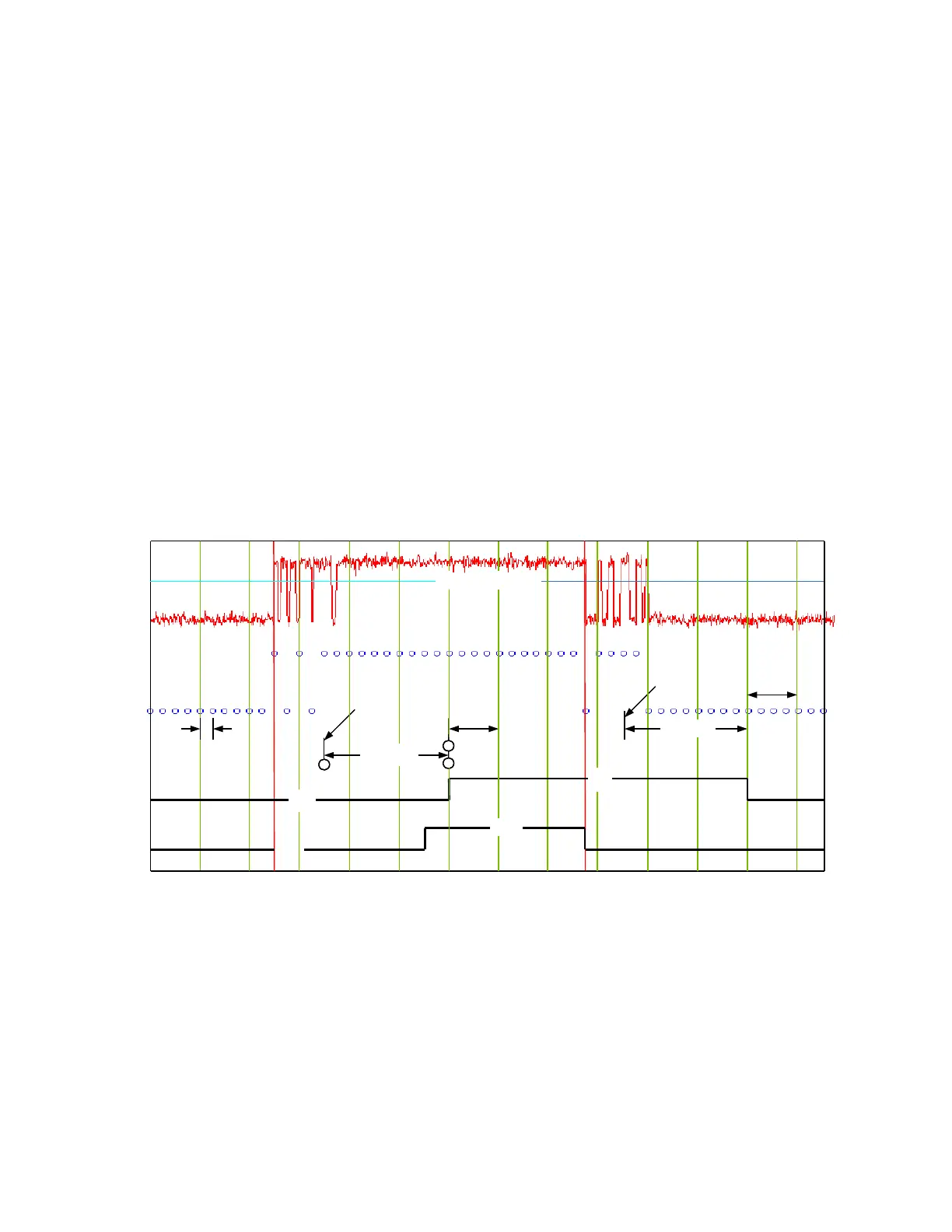
A raw status is scanned synchronously for all contact inputs at the rate of 0.25 ms, as
shown in the following figure. A new contact input state must be maintained for a user-
programmable debounce time for the D90
Plus
to validate the new contact state. The
debounce time is set at 2.0 ms in the figure. As such, the eighth sample validates the
change of state (mark 1 in the figure). Once validated (de-bounced), the contact input
asserts a corresponding FlexLogic operand and logs an event (if event logging is enabled).
A time stamp of the first sample in the sequence that validates the new state is used when
logging the change of the contact input into the event recorder (mark 2 in the figure).
Figure 329: Contact input debouncing mechanism and time-stamping
Protection elements, as well as FlexLogic equations and timers, are executed 16 times in a
power system cycle. The protection pass duration is controlled by the frequency tracking
mechanism. The FlexLogic operand reflecting the debounced state of the contact is
updated at the protection pass following the validation (mark 3 in the figure). The update is
performed at the beginning of the protection pass so all protection functions and
protection FlexLogic equations are fed with the updated states of the contact inputs.
The FlexLogic operand response time to the contact input change is equal to the debounce
time setting plus a maximum of one protection pass (depending on system frequency if
frequency tracking is enabled). If the change of state occurs just after a protection pass,
the recognition is delayed until the subsequent protection pass (that is, by the entire
duration of the protection pass). If the change occurs just prior to a protection pass, the
$&'5
9DOLGDWLRQWKUHVKROG
GHERXQFH
GHERXQFH
3URWHFWLRQ
SDVV
VFDQ
WLPH
7LPHVWDPS
DSSOLHG
7LPHVWDPS
DSSOLHG
2))
21
/2:
+,*+
,QSXW
YROWDJH
5DZ
FRQWDFW
VWDWH
)OH[/RJLF
RSHUDQG
$FWLYH
LPSHGDQFH
3URWHFWLRQ
SDVV


 To Next Page