CHAPTER 2: PRODUCT DESCRIPTION PRODUCT DESCRIPTION
D90
PLUS
LINE DISTANCE PROTECTION SYSTEM – INSTRUCTION MANUAL 11
Distance elements on page 1
Application to series-compensated lines
The D90
Plus
provides enhanced stability and security by employing an adaptive distance
reach control to cope with the overreaching and sub-synchronous oscillations when
applied to, or in the vicinity of, series compensated lines. For directional integrity, the relay
uses memory voltage polarization, and a multi-input comparator is used to deal with
current inversion issues in series compensated lines.
For additional information, refer to:
Series compensated line protection application guidelines
on page 227
Series compensated lines
on page 649
In-zone transformer compensation
Phase distance elements in the D90
Plus
can be used to detect faults through different types
of three-phase wye or delta transformers, allowing application of the D90
Plus
for backup
protection on generators. VTs and CTs can be installed independently of each other on
either side of the power transformer. The relay automatically compensates for transformer
connections, to guarantee accurate reach for any type of fault.
For additional information, refer to:
Phase distance
on page 190
Phase distance applied to power transformers
on page 642
Load encroachment
The reliable load encroachment feature offers excellent discrimination between keep
loading conditions and fault conditions especially for long lines under heavy loads by
supervising the distance elements or any overcurrent element. This prevents unwarranted
tripping under heavy line load conditions and enables optimum operation of the line while
meeting regulatory requirements for the loading.
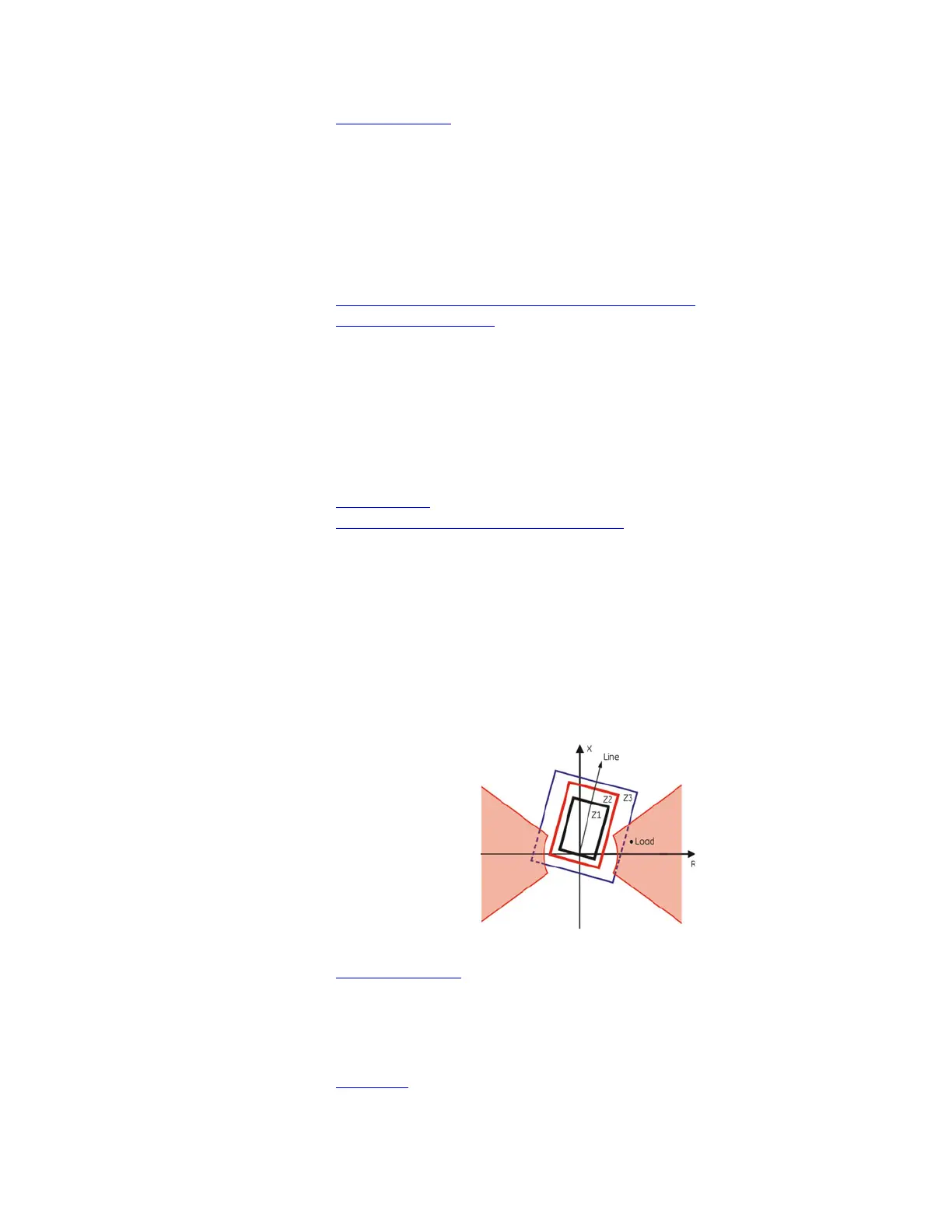
The figure illustrates distance quadrilateral characteristics supervised by the load
encroachment function.
Figure 8: Load encroachment characteristic example
For additional information, refer to:
Load encroachment
on page 220
Fault locator
The integrated fault locator provides the distance to the fault in kilometers or miles.
For additional information, refer to:
Fault report
on page 506


 To Next Page