CHAPTER 7: PROTECTION GROUPED PROTECTION ELEMENTS
D90
PLUS
LINE DISTANCE PROTECTION SYSTEM – INSTRUCTION MANUAL 223
Reset Delay
Range: 0.000 to 65.535 seconds in steps of 0.001
Default: 0.000 seconds
This setting specifies a delay for the reset of the load encroachment element between
the operate output state and the return to logic 0 after the input passes outside the
defined pickup range. It is normally set to zero.
Block
Range: any FlexLogic operand
Default: Off
Assertion of the FlexLogic operand assigned to this setting blocks operation of the load
encroachment element.
Events
Range: Enabled, Disabled
Default: Enabled
This setting enables and disables the logging of load encroachment events in the
sequence of events recorder.
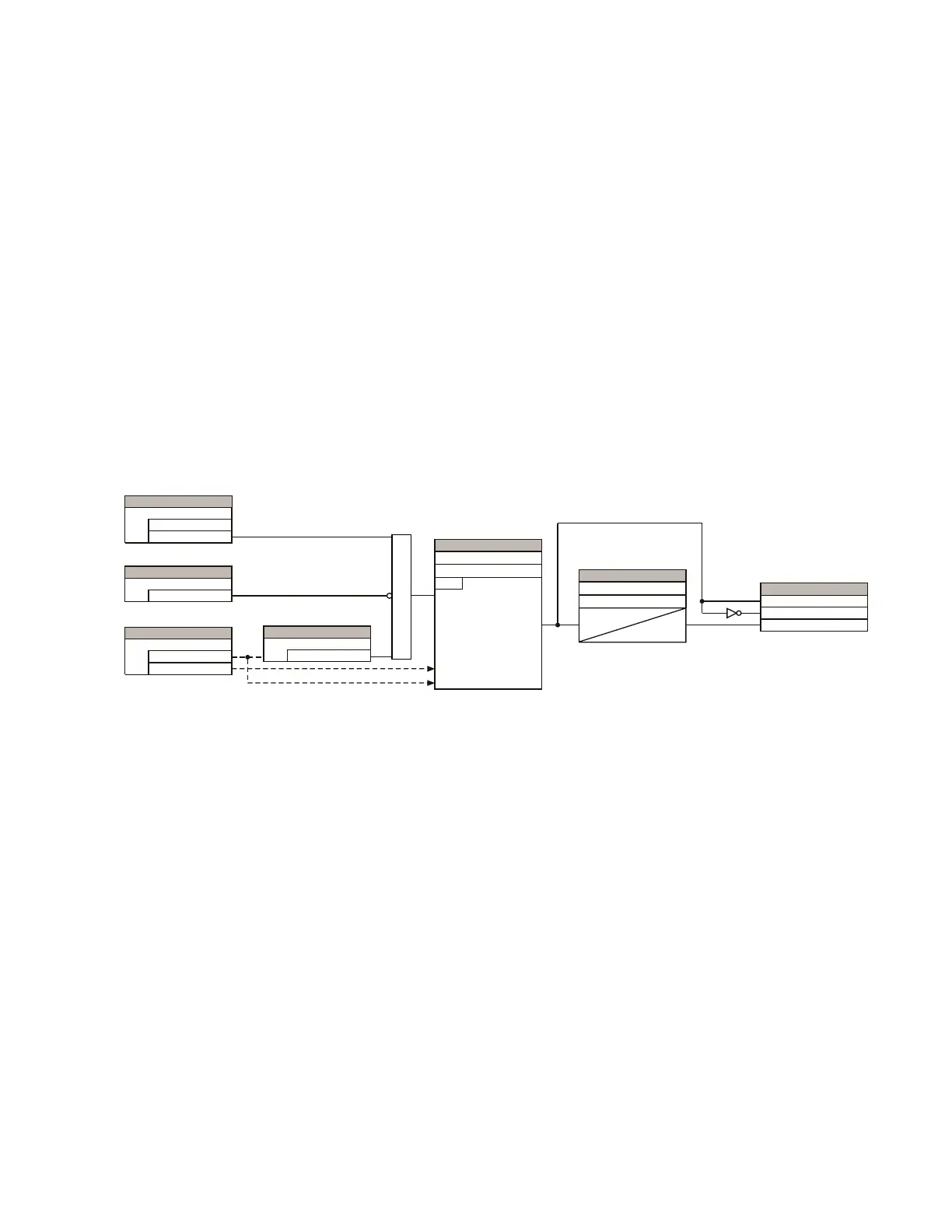
The following figure shows the logic for the load encroachment scheme.
Figure 198: Load encroachment logic
Stepped distance scheme application guidelines
This section provides general application guidelines for implementing stepped distance
schemes with the D90
Plus
.
Phase current supervision and fuse failure for stepped distance
The phase-to-phase (delta) current is used to supervise the phase distance elements,
primarily to ensure that in a de-energized state the distance elements are not picked up
due to noise or induced voltages on the line.
However, this supervision feature can also be employed to prevent operation under fuse
failure conditions. This obviously requires that the setting must be above maximum load
current and less than the minimum fault conditions for which operation is expected. This
potential problem can be avoided by the use of a separate fuse fail function, which means
that the phase current supervision can be set much lower, typically two times the
capacitance charging current of the line.
The usage of the fuse fail function is also important during double-contingency events,
such as an external fault during fuse fail conditions. The current supervision alone does not
prevent misoperation in such circumstances.
Keep in mind that the fuse failure element provided on the D90
Plus
needs time to detect
fuse fail conditions. This can create a race between the instantaneous zone 1 and the fuse
failure element. Therefore, for maximum security, it is recommended to set the current
supervision above the maximum load current and use the fuse failure function as well. The
$&'5
$1'
)XQFWLRQ
6(77,1*
'LVDEOHG
(QDEOHG
%ORFN
6(77,1*
2II
6RXUFH
6(77,1*
9B
,B
0LQLPXP9ROWDJH
6(77,1*
_9B_!3LFNXS
5HDFK
6(77,1*6
$QJOH
5XQ
/2$'(1&52$&+0(17
&+$5$&7(5,67,&
7
SLFNXS
7
UHVHW
5HVHW'HOD\
6(77,1*6
3LFNXS'HOD\
/2$'(1&+53.3
)/(;/2*,&23(5$1'6
/2$'(1&+5'32
/2$'(1&+523


 To Next Page