7. Cues - Page 149
TitanUniversal_Man_v10_QU.doc 15 March 2016
7. Cues
So you’ve set up a great look on the stage, and you want to save it to
use in your show.
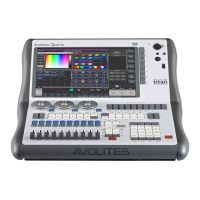
There are three ways of saving looks on the Quartz .
Cue: Thi
s is a single look. It may contain movement in the form of
shapes, and have fade in and fade out times.
Chase: This is a timed sequence of cues, often used for an individual
effect.
Cue List: This is a linked sequence of cues, usually used to store and
replay an entire show or an element of a show from a “go” button.
Chases and Cue Lists are covered in more detail in the following
chapters.
When a Cue, Chase or Cue List is stored on a control, the control is
called a Playback. You can store in several places:
• On any fader handle - the fader controls the intensity of
fixtures (you can make the fader control other things using
Playback Options).
• On a touch button in the Playbacks window – you can set
whether the button latches or flashes the cue using Key Profiles
• On a Macro/Executor button – again you can use Key
Profiles to set latch or flash.
Quartz has 600 playback faders, in 60 pages of 10. The optional fader
wing can be added to give additional playback faders.
The cue functions on the Quartz are very powerful; the first part of
this section explains the basics of how the console uses cues.
7.1 Creating a cue
7.1.1 How the Quartz works when programming
When you select one or more dimmers or fixtures for control, they
are loaded into the Editor. You can then use the wheels and palettes
to change the settings on the fixture. You can also apply shapes to it.
If a fixture is selected after you have changed some attributes then
the current list of fixtures in the Editor is emptied and a new list is
started.
All fixtures and attributes that have been edited since the last Clear
are stored in the Programmer. The order in which you selected the
fixtures is also stored, and is used with shapes and the Fixture
Overlap function. When you record a cue, the contents of the
Programmer are saved into the cue.
When you press Clear (by the numeric keypad), the programmer and
editor are emptied. This makes sure you don’t record fixtures you
don’t want. You also need to press Clear when you finish


 To Next Page