S0309000
Page 9
Standard Torques
Return to Master Table of Contents
TORQUE WRENCH EXTENSION TOOLS
Very large diameter, high grade fasteners (nuts, bolts, cap screws, etc.) require a great deal of turning
force to achieve recommended tightening torque values.
Common problems that could occur as a result are:
• Recommended torque exceeds the measuring capacity of the torque wrench.
• Specialized sockets do not fit the adapter on the front end (nose) of the torque wrench.
• Generating adequate force on the back end (handle) of the wrench is difficult or impossible.
• Restricted access or an obstruction may make use of the torque wrench impossible.
• A unique application requires fabrication of an adapter or other special extension.
Most standard torque wrenches can be adapted to suit any one of the proceeding needs or situations, if
the right extension tool is used or fabricated.
TORQUE MULTIPLICATION
A wrench extension tool can be used to
increase the tightening force on a high capacity
nut or bolt.
For example, doubling the distance between the
bolt and the back (handle) end of the torque
wrench doubles the tightening force on the bolt.
It also halves the indicated reading on the scale
or dial of the torque wrench. To accurately
adjust or convert indicated scale or dial
readings, use the following formula:
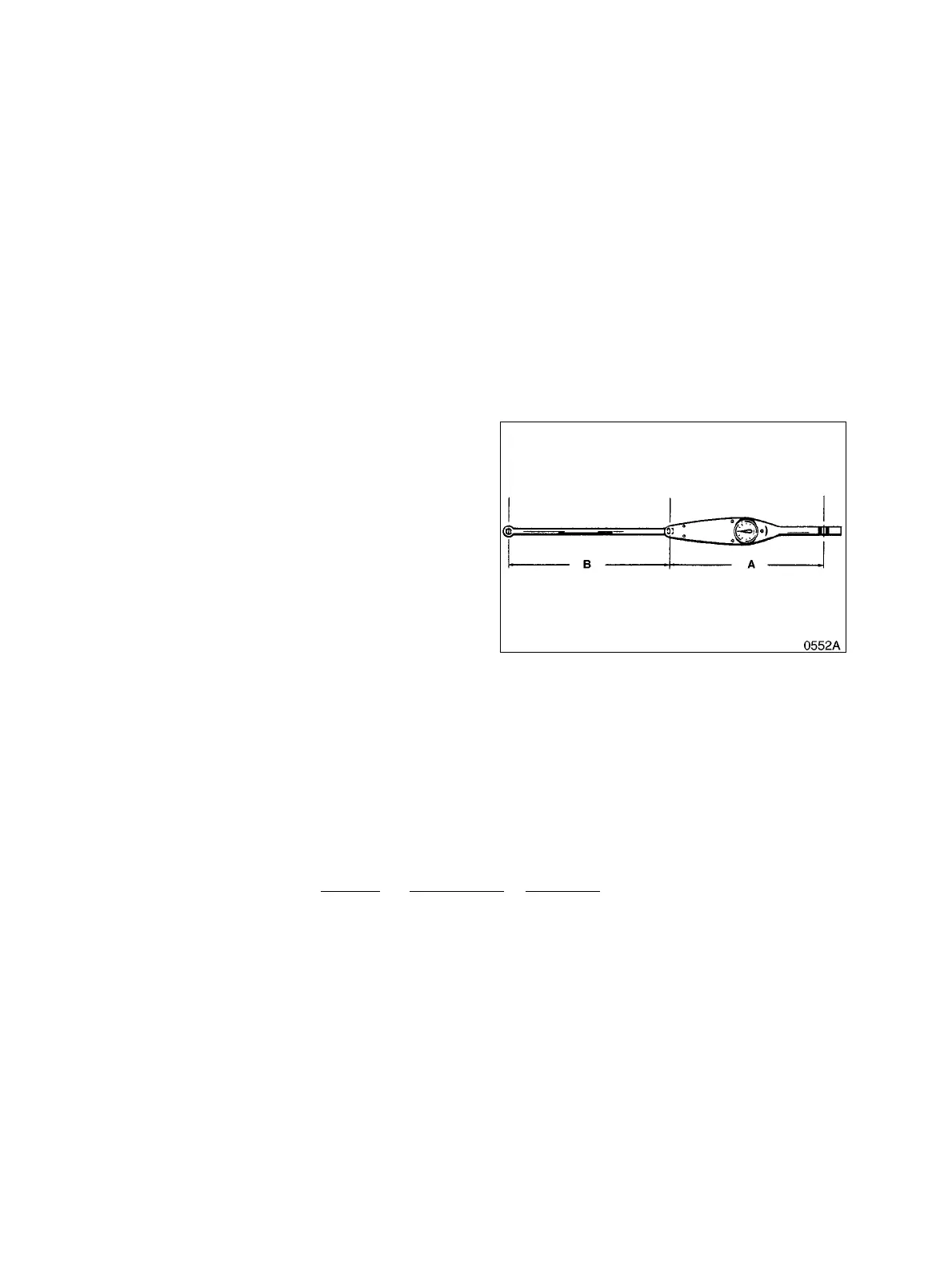
I = A x T / A + B where:
I = Indicated force shown on the torque wrench
scale or dial.
T = Tightening force applied to the nut or bolt (actual Torque).
A = Length of the torque wrench (between the center of the nut or bolt and the center of the handle).
B = Length of the extension.
As an example, if a 12" extension is added to a 12" torque wrench, and the indicated torque on the dial
reads "150 ft lb," the real force applied to the bolt is 300 ft lb:
NOTE:
The formula assumes that there is no added deflection or "give" in the joint between the
extension and torque wrench. Readings may also be inaccurate:
• If the extension itself absorbs some of the tightening force and starts to bend or bow out.
• If an extension has to be fabricated that is not perfectly straight (for example, an extension
made to go around an obstruction, to allow access to a difficult to tighten fastener), the
materials and methods used must be solid enough to transmit full tightening torque.
I =
A x T
=
12 x 300
=
3600
= 150
A + B 12 + 12 24
Figure 1



 To Next Page