Appendix
User Manual corpuls
3
288 ENG - Version 2.1 – P/N 04130.2
Energy management/power supply
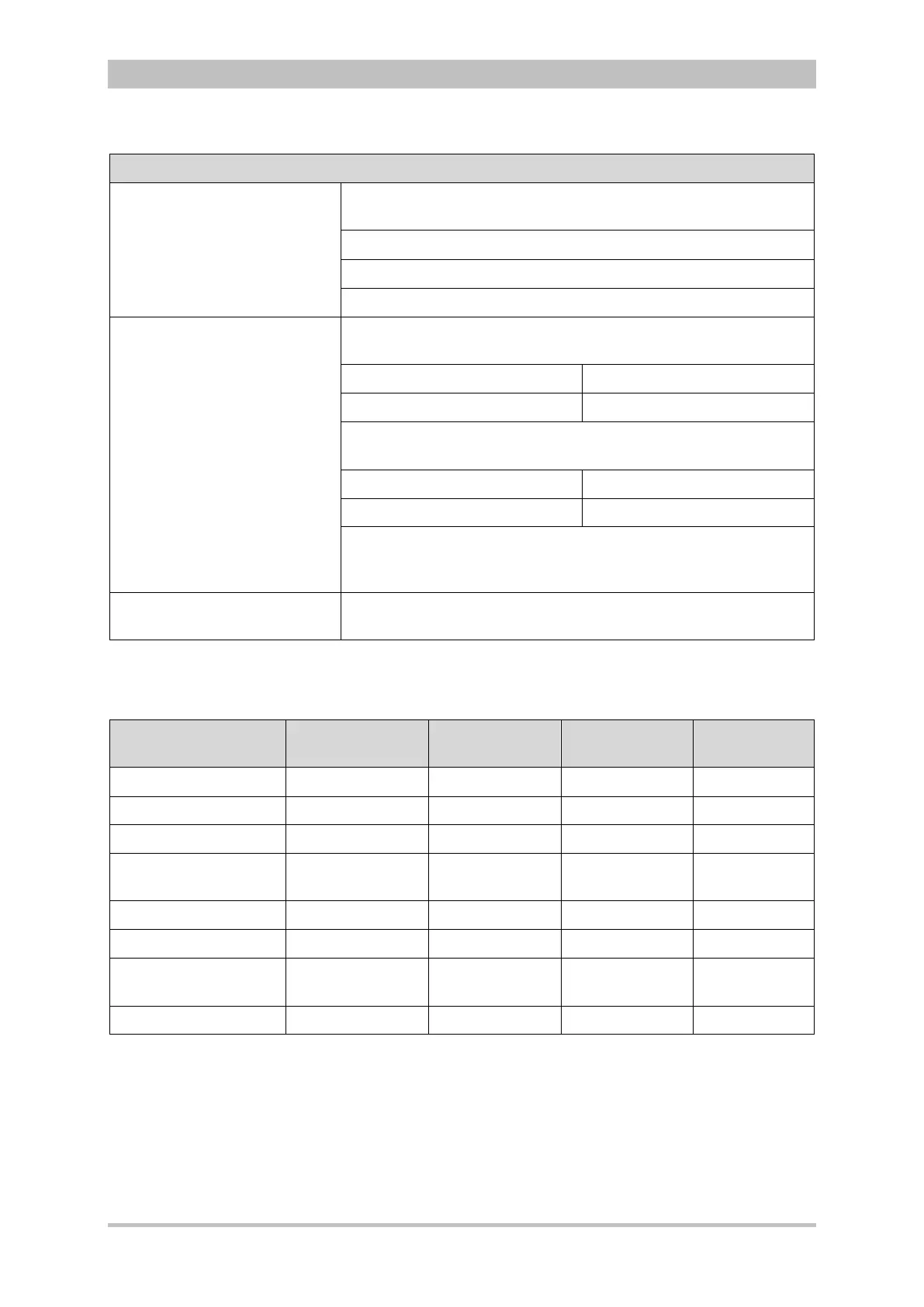
Operating time Compact device: 7 - 10 h (depending on settings and
operational demands)
Patient box: approx. 4 - 6 h
Monitor unit: approx. 4 h
Defibrillator: approx. 200 shocks at 200 Joules
Maximum storage period for
new rechargeable batteries (in
days)
At 30% battery capacity before storage
and within a temperature range from 10 °C – 30 °C
Battery in module Battery outside of module
20 400
At 100% battery capacity before storage
and within a temperature range from 10 °C – 30 °C
Battery in module Battery outside module
60 550
These are the optimum storage conditions for the rechargeable
battery. If storage conditions differ, this may result in a reduction
in the capacity of or damage to the rechargeable battery.
Recommended periodic
battery exchange
Every 3 years
-9 Energy management/power supply
Alarm management
Characteristic of
alarm signal
High priority Medium
priority
Low priority Reminder
signal
Number of impulses 10 3 2 1
Duration of impulses 90ms 130ms 190ms 110ms
Interval of impulses 50ms (190ms) 250ms 250ms n/a
Frequency of impulses 523Hz,659Hz,784
Hz,1047Hz
523Hz,659Hz,7
84Hz
659Hz,523Hz 3.5kHz
Interval 10 s 20 s n/a 60 s
Colour of LED Red Yellow Cyan White
Flashing frequency of
LED
2 Hz 0.5 Hz n/a n/a
Duty cycle of the LED 40% on 40% on 100% on 110ms
Table A-10 Alarm management
The maximal delay until alarming for ECG, pulse oximetry, NIBP, IBP and CO
2
is 5 s; for temperature
and perfusion index 30 s.
The maximal delay until alarming for loose ECG electrodes is 30 s.


 To Next Page