Measuring
General principles for adjusting a measurement channel
130 A0534-30.0 HBM: public MGCplus
Low pass
Low-pass filters are used to suppress unwanted higher frequency
interference that lies above a specific cut-off frequency.
Amplitude response, runtime and step response are dependent on the filter
characteristic. You can select between the Butterworth characteristic and
the Bessel characteristic.
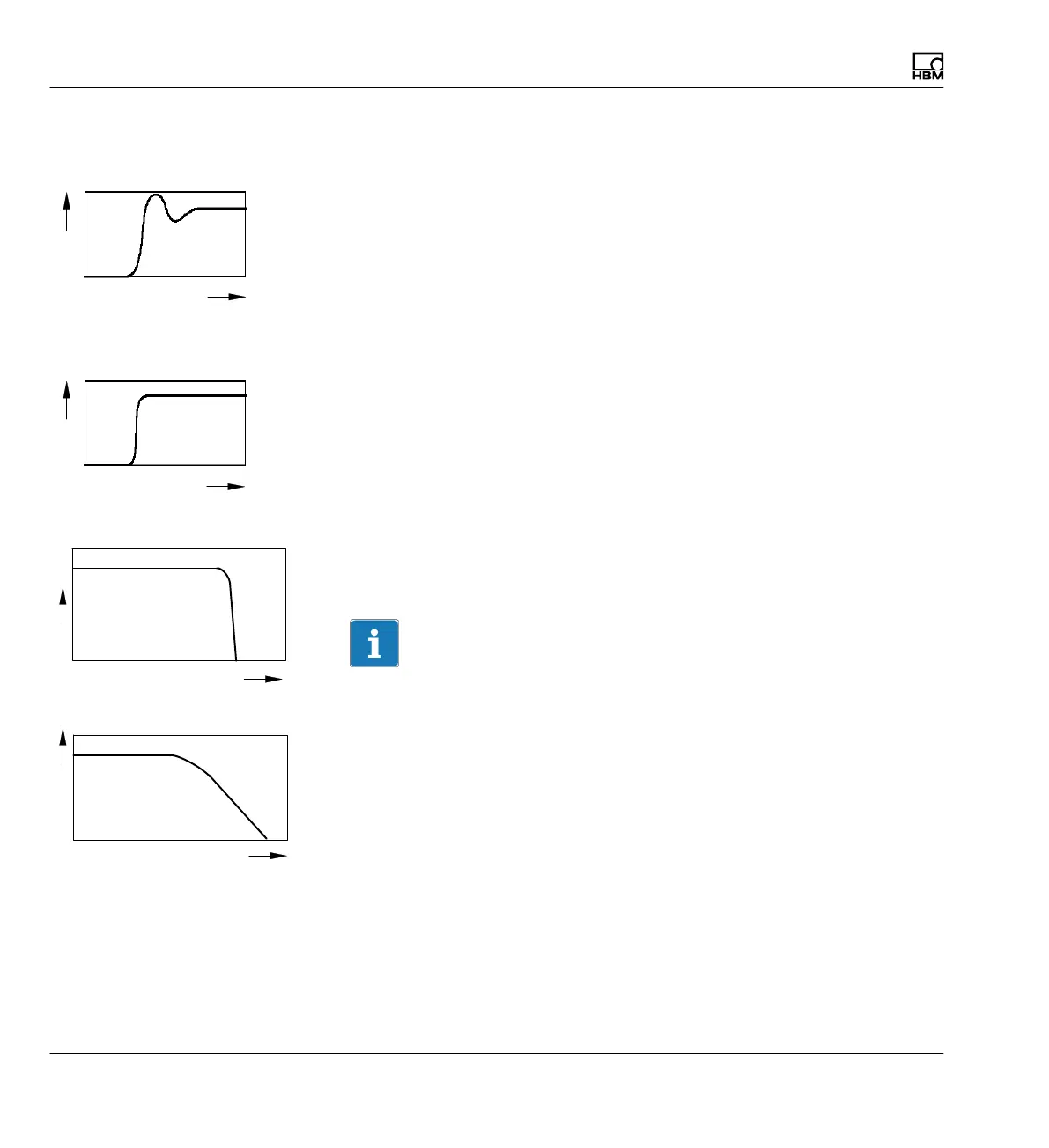
The Butterworth characteristic shows a linear amplitude response with a
steep drop above the cut-off frequency. There is an overshoot of approx.
10%.
The Bessel characteristic shows a step response with very small (<1%) or
no overshooting. The amplitude response drops less steeply.
High pass
High-pass filters are used to suppress unwanted lower frequency
interference that lies below a specific cut-off frequency. With the high-pass
filter you can suppress slow fluctuations, such as those resulting from
temperature influences and time drift.
The high-pass filter has no function when resistance thermometers and
thermocouples are connected.
Important
To ensure that the high pass will function, the low-pass setting must not fall
below the following limits:
Bessel: .5Hz
Butterworth: .10Hz
The nominal (rated) values of the filters provided by the AB22A display and
control unit and by the MGCplus Assistant and catman software are
oriented towards the -1 dB values (see technical data).
Damping
f
u
Damping
f
t
t
Butterworth
Bessel
Butterworth
Bessel
Step response
Step response
u
u u


 To Next Page