209
Measurement Range and Accuracy
Example calculation of basic accuracy
(1) Calculate the basic accuracy for impedance
Z
=50
Ω
.
(If the measurement conditions are a measurement frequency of 10 kHz and a measurement speed
of SLOW2)
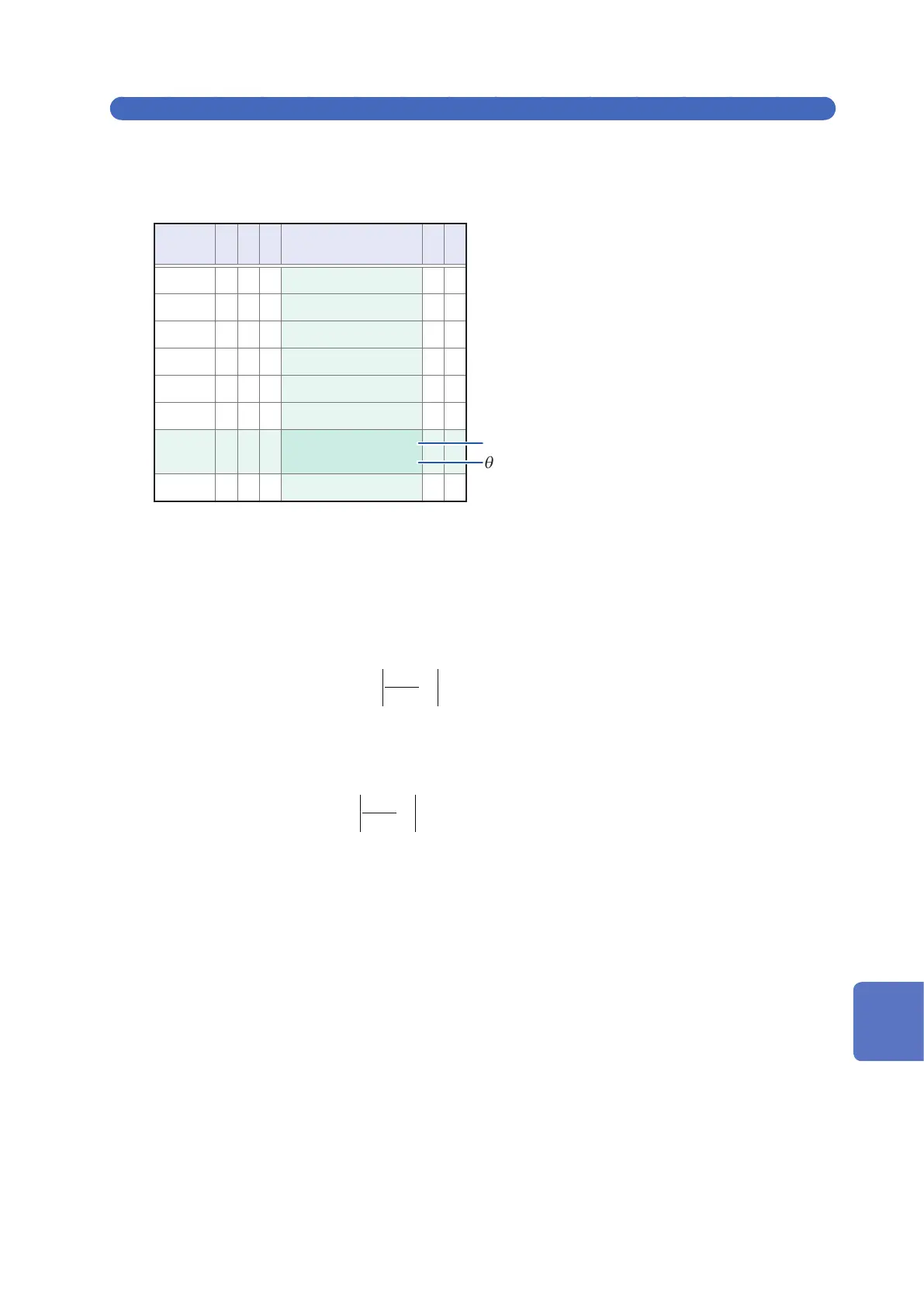
Excerpted from the "Basic accuracy" (p. 207).
Range
1.0000 kHz to
10.000 kHz
1 kΩ
100 Ω A= 0.15
A= 0.1
B= 0.02
B= 0.01
10 Ω
Z
θ
1
Find the cell at the intersection of the row for the 100
Ω
range (since
Z
is 50
Ω
, the 100
Ω
measurement range is used) and the 1.0000 kHz to 10.000 kHz column (since the
measurement frequency is 10 kHz) in the "Basic accuracy" (p. 207).
2
Calculate the basic accuracy for
Z
using the
Z
coefcients A and B.
Based on the accuracy table, coefcient A = 0.15 and coefcient B = 0.02.
Plug in the values for the 100
Ω
range in the "Basic accuracy" (p. 207) into the follow-
ing equation:
Z
accuracy =
100
0.15 0.02 1
50
Ω
± + × −
Ω
=±0.17% rdg.
3
Similarly, calculate the basic accuracy of
θ
.
The accuracy table yields the values A=0.1 and B=0.01
Using the basic accuracy formula of "Basic accuracy" (p. 207) for "100
Ω
or less".
θ
accuray =
100
0.1 0.01 1
50
Ω
± + × −
Ω
=±0.11°
10
Specications


 To Next Page