5 General concepts
When entering values, the following applies correspondingly: Internal value = n
speed
x input value
When outputting values, the following applies correspondingly: Output value = internal value / n
speed
Example
2061
h
is set to the value "1", 2062
h
is set to the value "60" (default). Thus, the user unit is
"revolutions per minute" and n
speed
= 1/60.
If 60FF
h
is written with the value "300", the internal value is set to 300 rpm x 1/60 = 5 rps.
If the motor turns at an internal speed of 5 rps, object 606B
h
is set to a speed of 5 / 1/60 =
300 rpm.
5.3.1.6 Acceleration
The acceleration can also be specified in user units:
Object Mode Meaning
609A
h
Homing Mode Acceleration
6083
h
Profile Position Mode Acceleration
6084
h
Profile Position Mode Braking deceleration
60C5
h
Profile Velocity Mode Acceleration
60C6
h
Profile Position Mode Braking deceleration
6085
h
"Quick stop active" state (CiA 402
Power State Machine)
Braking deceleration
The internal unit is revolutions per second
2
(rps
2
).
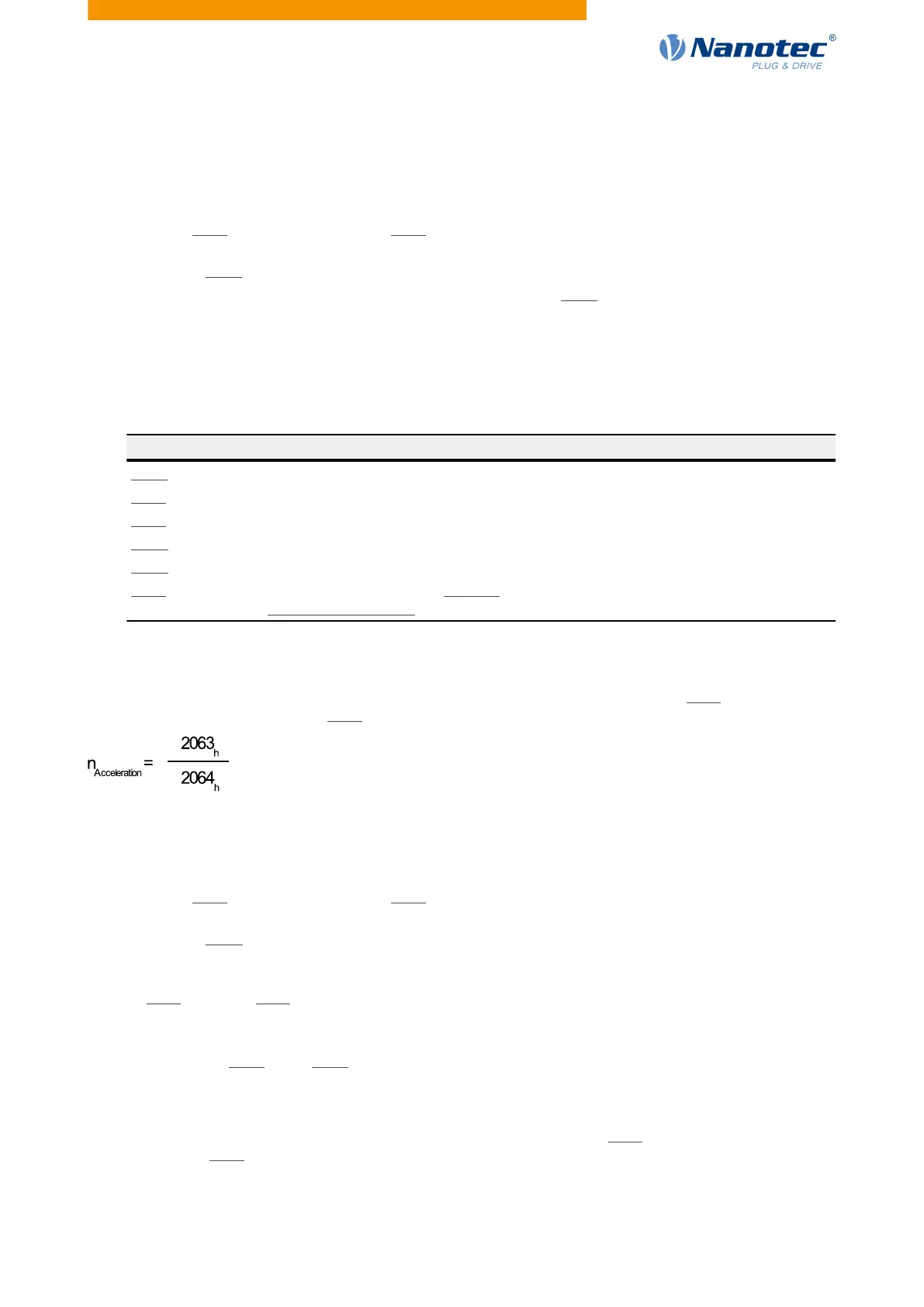
The factor n for the acceleration is calculated from the scaling factor for the numerator (2063
h
) divided by the
scaling factor for the denominator (2064
h
).
When entering values, the following applies correspondingly: Internal value = n
acceleration
x input value
Example
2063
h
is set to the value "1", 2064
h
is set to the value "60". Thus, the user unit is revolutions
per minute per second and n
acceleration
= 1/60.
If 60C5
h
is set to the value "600", the internal value is set to 600 rp(s*min) x 1/60 = 10 rps
2
.
If object 2063
h
or object 2064
h
is set to "0", the firmware sets the value to "1".
5.3.1.7 Jerk
For the jerk, objects 60A4
h
:1
h
to 60A4
h
:4
h
can be specified in user units. These objects only affect Profile
Position Mode and Profile Velocity Mode.
The internal unit is revolutions per second
3
(rps
3
).
The factor n for the acceleration is calculated from the factor for numerator (2065
h
) divided by the factor for
the denominator (2066
h
).
Version: 2.0.1 / FIR-v1650 44



 To Next Page