R&S
®
ZVA / R&S
®
ZVB / R&S
®
ZVT Annexes
Interfaces and Connectors
Operating Manual 1145.1084.12 – 30 1147
The IEC SYSTEM BUS is not fitted. To use the analyzer as a GPIB master and control other
devices, e.g. external generators or power meters, option R&S ZVAB-B44 is required.
Option R&S ZVAB-B44, USB-to-IEC/IEEE Adapter
Option R&S ZVAB-B44 (order no. 1302.5544.02) consists of an adapter and a driver software for
controlling external devices which are equipped with a GPIB bus interface (but do not provide a USB
interface). The driver software is installed on the network analyzer. It includes the VISA library which is a
prerequisite for establishing a connection from the analyzer to an external device.
Connect the USB port of the adapter to any of the master USB connectors on the front or rear panel of the
analyzer. The GPIB port of the adapter is connected to the external device. If hardware detection fails, an
update of the VISA library is recommended. An appropriate NI-VISA 4.6.2 is available free of charge for
download on the internet; refer to the National Instruments web site.
R&S ZVAB-B44 on network analyzers with FMR6/7 and FMR9
The driver software of the USB-to-IEC/IEEE Adapter (option R&S ZVAB-B44) must be installed on the
network analyzer. On analyzers equipped with a CPU board FMR7/6 or FMR9, this installation disables
GPIB control from an external PC. A reinstallation of the NWA firmware (e.g. in repair mode) will resolve
the problem.
Always use a shielded cable to connect the GPIB bus interfaces.
Characteristics of the interface
8-it parallel data transfer
Bidirectional data transfer
Three-line handshake
High data transfer rate of max. 1 MByte/s
Up to 15 devices can be connected
Maximum length of the connecting cables 15 m. The length of a single connecting
cable should not exceed 2 m, if many devices are used, it should not exceed 1 m.
Wired OR if several instruments are connected in parallel
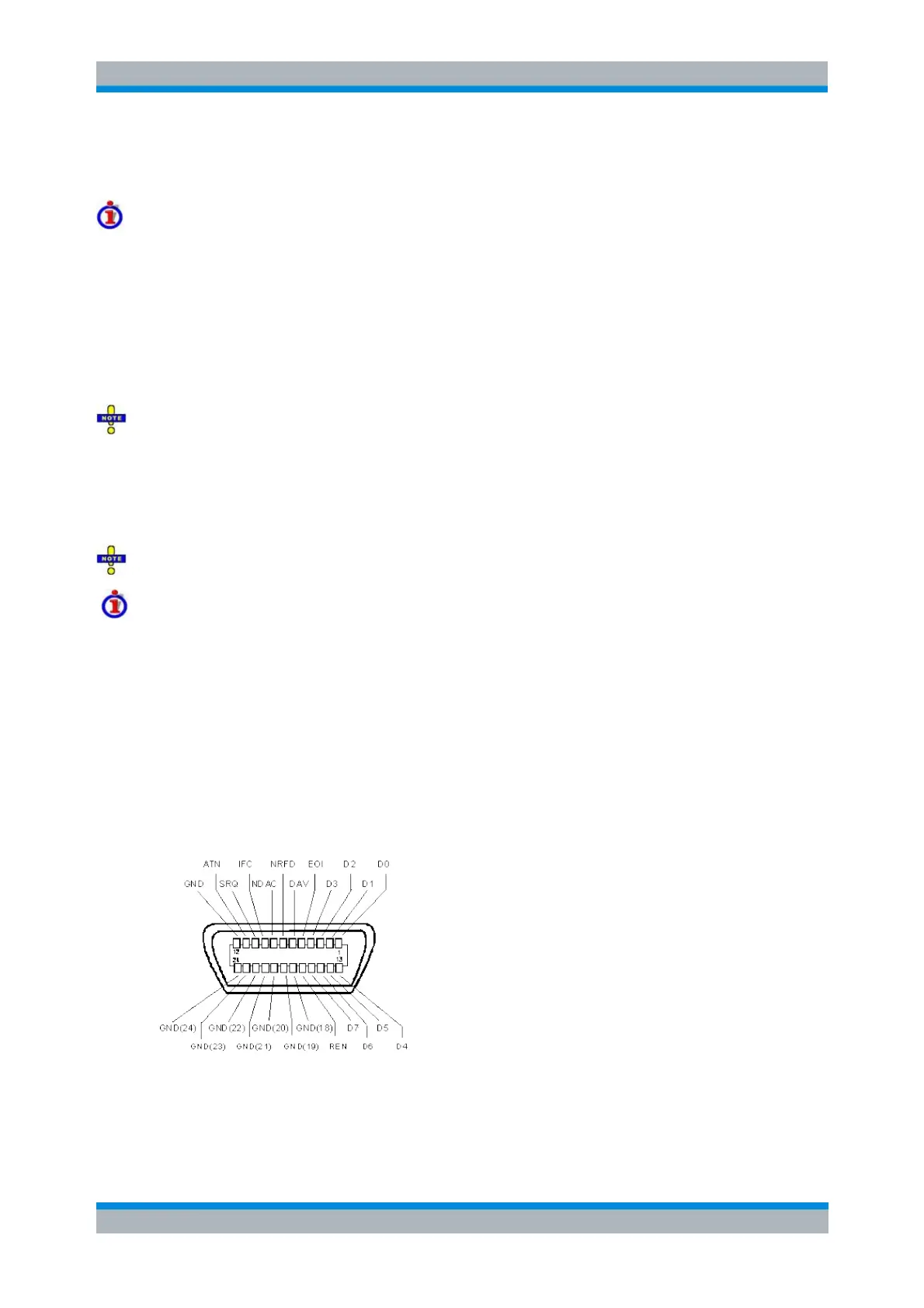
Pin assignment/p>
Bus lines
1. Data bus with 8 lines D0 to D7 The transmission is bit-parallel and byte-serial in
the ASCII/ISO code. D0 is the least significant bit, D7 the most significant bit.


 To Next Page