R&S
®
ZVA / R&S
®
ZVB / R&S
®
ZVT Measurement Examples
Harmonics Measurements
Operating Manual 1145.1084.12 – 30 92
To obtain a harmonic distortion factor...
1. Reset the analyzer to ensure that the following operating mode is set: Sweep Type: Lin.
Frequency, Trace - Meas.: S21, Trace - Format: dB Mag.
2. Open the Channel - Stimulus menu and reduce the Stop frequency to the maximum frequency of
your analyzer divided by n where n is the order of the harmonic distortion factor you want to
measure.
3. Click Channel - Mode - Harmonics - More Harmonics. In the dialog opened select the Harmonic
Order you want to measure.
4. Adjust the Source port and the receive port (Harmonics Measured at) to your test setup (for a
DUT connected between port 1 and 2 of the analyzer you can keep the default settings).
5. Close the More Harmonics dialog to enable the harmonics measurement.
6. Click Relative Measurement and observe the new mathematical trace Trc2.
The trace belongs to a new channel Ch2 and shows the nth harmonic distortion factor as a wave quantity
b
2
. With the default trace format the result is displayed in dB units.
Noise Figure Measurement
The following example outlines the essential steps for a noise figure measurement. The measurement
comprises the following stages:
1. Activating the measurement and basic settings
2. Power and noise figure calibration
3. S-Parameter calibration
4. Measurement
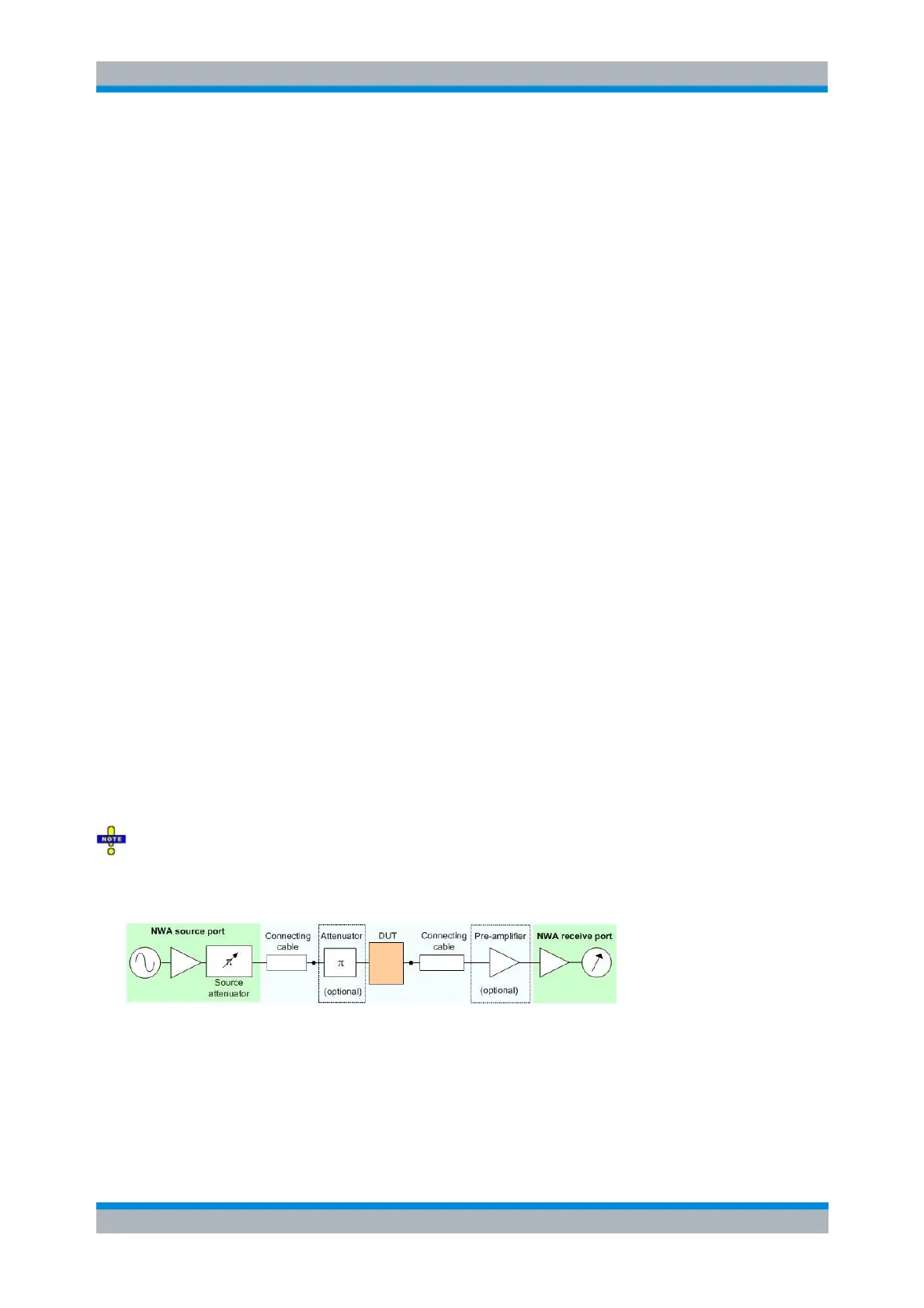
The procedure described below is valid for a test setup with the following external devices:
An attenuator between the NWA source port and the DUT input limits the source power.
A pre-amplifier between the DUT output and the NWA receive port can reduce the noise figure of
the NWA receiver.
The Noise Figure Setup Guide guides you through the measurement procedure outlined below. All
required settings and dialogs are accessible from the setup guide.
Test setup for noise figure measurement
We assume that Port 1 is used as the NWA source port, Port 2 is used as the receive port. Generalization
to other port assignments or to test setups without external attenuator and/or pre-amplifier is self-
explanatory.


 To Next Page