R&S
®
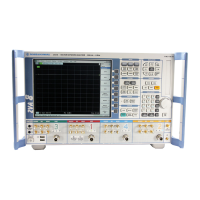
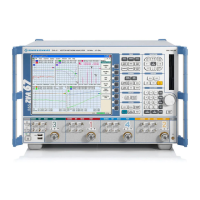
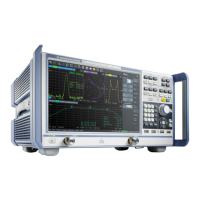
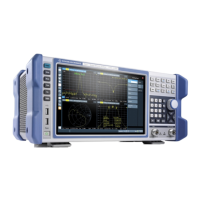
ZVA / R&S
®
ZVB / R&S
®
ZVT System Overview
Optional R&S ZVA Extensions
Operating Manual 1145.1084.12 – 30 62
system error correction described in section Calibration Overview. For best accuracy, a power calibration
should be performed in addition to a system error correction.
In general, a power calibration involves two stages:
1. Source power calibration: An external power meter is connected to the reference plane. The analyzer
modifies its source power until the power meter reading corresponds to the desired source power value.
2. Receiver power calibration: The analyzer uses the calibrated source signal to adjust the power reading
at the receiver port.
The analyzer provides power calibration wizards for various measurement modes.
Offset Parameters
Offset parameters complement the system error correction and power calibration, compensating for the
known length and loss of a (non-dispersive and perfectly matched) transmission line between the
calibrated reference plane and the DUT. The analyzer can also auto-determine length and loss
parameters, assuming that the actual values should minimize the group delay and loss across the sweep
range.
Optional R&S ZVA Extensions
The network analyzer can be upgraded with a number of hardware and software options, providing
enhanced flexibility and an extended measurement functionality. The available options are listed in the
Info – Option Info dialog. The R&S ZVA options listed below are described in detail in the reference
chapters. For a complete list of options, accessories, and extras refer to the R&S ZVA product brochure.
Transformation of the trace to time domain in order to analyze responses,
transformation back to the frequency domain
Arbitrary gen. and rec.
frequencies, includes scalar
Mixer and Harmonics
measurements
Measurements at arbitrary (not necessarily equal) generator and receiver
frequencies; scalar measurements on external RF mixers, harmonic
distortion measurements, intermodulation distortion measurements
Measurement of the parameters of an external mixer including phase,
e.g. the complex conversion loss or reflection coefficients.
Generation of true differential and common mode stimuli at arbitrary
reference planes in the test setup and measurement of the mixed-mode
S-parameters, wave quantities and ratios. Alternatively: Defined
coherence mode, provides several source signals with defined phase and
amplitude relation
Measurements on Pulsed Signals
Pulsed measurements in analogy to a time sweep (i.e. at constant
receiver frequency), but with a much higher sampling rate of 12.5/ns;
includes R&S ZVA-K17.
Measurements at frequencies beyond the analyzer's operating range
Measurement of the absolute or relative group delay of a mixer
Long Distance Mixer Delay
Measurements
Mixer delay measurements with an external receiver
Provides up to 5 MHz IF bandwidth, thus providing shorter measurement
times for frequency, time, or CW sweeps; enhanced performance for
point-in-pulse measurements.
Provides two pulsed control signals to control pulsed measurements.


 To Next Page