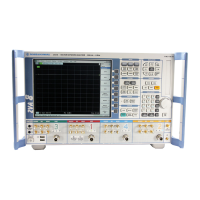
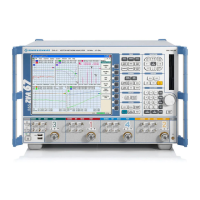
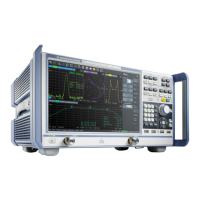
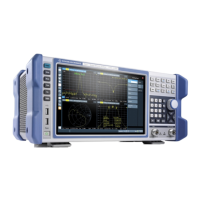
R&S
®
ZVA / R&S
®
ZVB / R&S
®
ZVT Remote Control
Messages
Operating Manual 1145.1084.12 – 30 582
consortium.
The device messages have a characteristic structure and syntax. In the SCPI reference chapter all
commands are listed and explained in detail.
SCPI Command Structure and Syntax
SCPI commands consist of a so-called header and, in most cases, one or more parameters. The header
and the parameters are separated by a "white space" (ASCII code 0 to 9, 11 to 32 decimal, e.g. blank).
The headers may consist of several key words. Queries are formed by directly appending a question mark
to the header.
Common commands and device-specific commands differ in their syntax.
SCPI compatibility
The analyzers are compatible to the final SCPI version 1999.0. Not all of the commands supported by the
instrument are taken from the SCPI standard (Standard Commands for Programmable Instruments),
however, their syntax follows SCPI rules. The SCPI standard is based on standard IEEE 488.2 and aims
at the standardization of instrument-control commands, error handling and the status registers.
The requirements that the SCPI standard places on command syntax, error handling and configuration of
the status registers are explained in detail in the following sections.
Reset values
In contrast to instruments with manual control, which are designed for maximum possible operating
convenience, the priority of remote control is the "predictability" of the device status. This means that
when incompatible settings are attempted, the command is ignored and the device status remains
unchanged, i.e. other settings are not automatically adapted. Therefore, GPIB bus control programs
should always define an initial device status (e.g. with the command *RST) and then implement the
required settings.
Common Commands
Common (=device-independent) commands consist of a header preceded by an asterisk "*" and possibly
one or more parameters.
Examples:
RESET, resets the instrument.
EVENT STATUS ENABLE, sets the bits of the event status enable registers.
EVENT STATUS QUERY, queries the contents of the event status register.
Instrument-Control Commands
Instrument-control commands are based on a hierarchical structure and can be represented in a
command tree. The command headers are built with one or several mnemonics (keywords). The first level
(root level) mnemonic identifies a complete command system.


 To Next Page