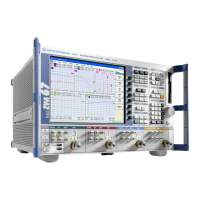
R&S
®
ZVA / R&S
®
ZVB / R&S
®
ZVT System Overview
Calibration Overview
Operating Manual 1145.1084.12 – 30 61
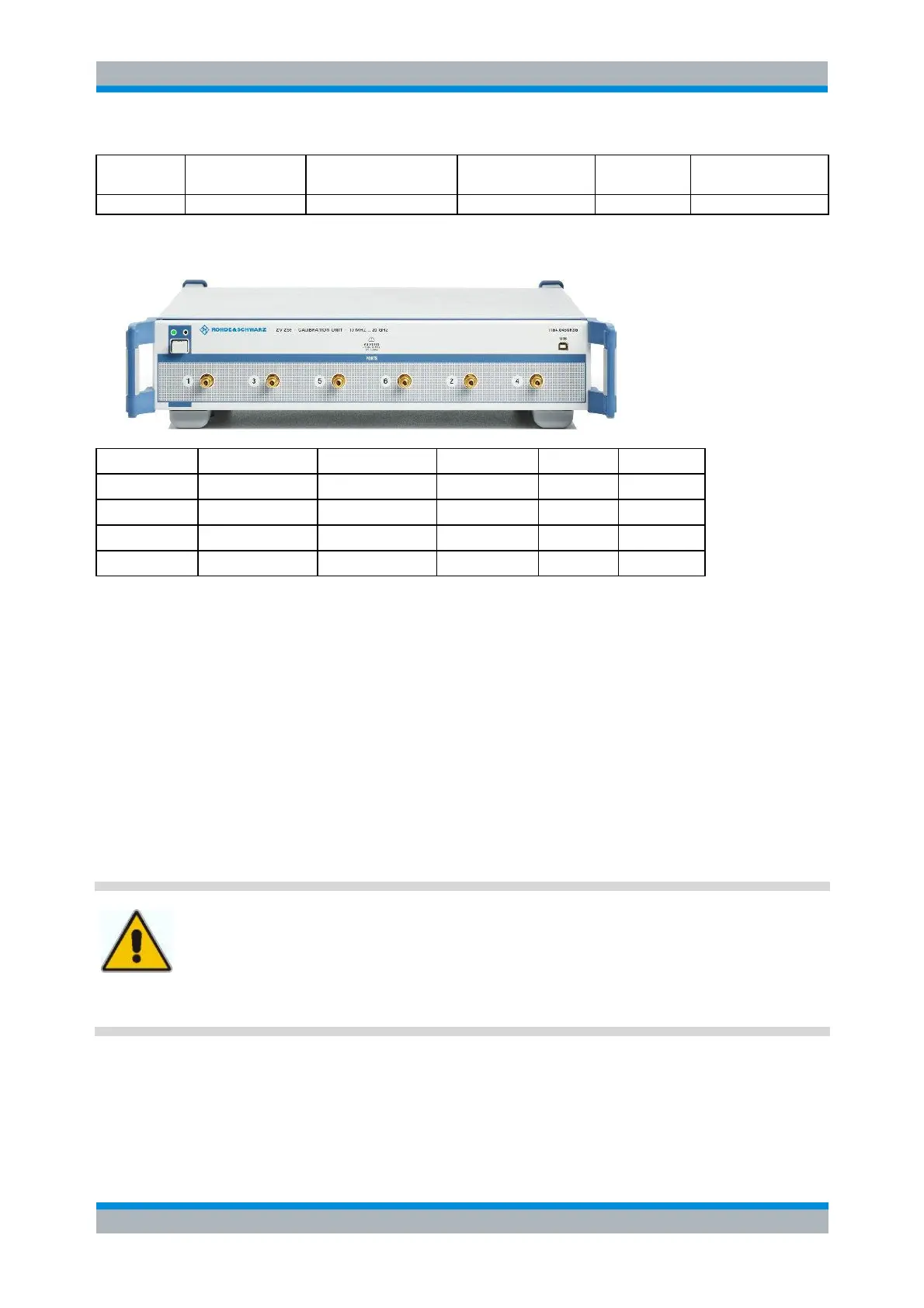
The multiport calibration units R&S ZV-Z58, R&S ZV-Z59 and R&S ZN-Z152 are especially suited
for R&S ZVT vector network analyzers.
The units contain calibration standards that are electronically switched when a calibration is performed.
The calibration kit data for the internal standards are also stored in the calibration unit, so that the analyzer
can calculate the error terms and apply the calibration without any further input.
Advantages of automatic calibration
Automatic calibration is generally faster and more secure than manual calibration, because:
There is no need to connect several standards manually. The number of connections to
be performed quickly increases with the number of ports; see TOSM Calibration.
Invalid calibrations due to operator errors (e.g. wrong standards or improper connections)
are almost excluded.
No need to handle calibration kit data.
The internal standards don't wear out because they are switched electronically.
Limitations: Some calibration types (TOM, TRM, TRL, TNA) are not available.
Attention!
Please observe the safety instructions in the "Technical Information" provided with the
calibration unit to avoid any damage to the unit and the network analyzer. Safety-
related aspects of the connection and operation of the units are also reported in the
sections below.
Power Calibration
The purpose of a power calibration is to ensure accurate source power levels and power readings at a
particular position (reference plane) in the test setup. Power calibration is essentially different from the


 To Next Page