R&S
®
ZVA / R&S
®
ZVB / R&S
®
ZVT Remote Control
Command Processing
Operating Manual 1145.1084.12 – 30 592
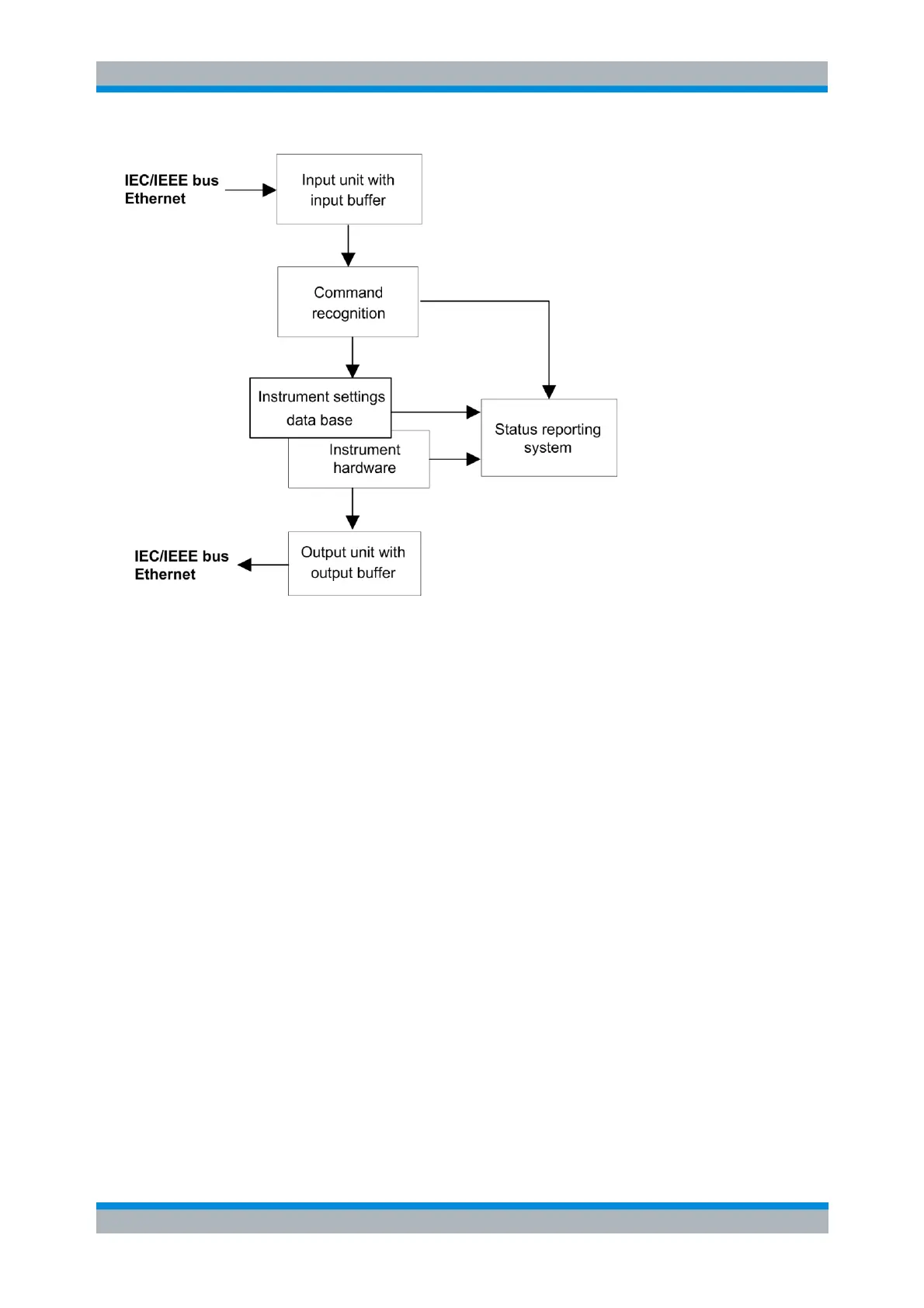
Input Unit
The input unit receives commands character by character from the controller and collects them in the input
buffer. The input unit sends a message to the command recognition as soon as the input buffer is full or as
soon as it receives a delimiter, <PROGRAM MESSAGE TERMINATOR>, as defined in IEEE 488.2, or the
interface message DCL.
If the input buffer is full, the message data traffic is stopped and the data received up to then is processed.
Subsequently the traffic is continued. If, however, the buffer is not yet full when receiving the delimiter, the
input unit can already receive the next command during command recognition and execution. The receipt
of a DCL clears the input buffer and immediately initiates a message to the command recognition.
Command Recognition
The command recognition stage analyzes the data received from the input unit. It proceeds in the order in
which it receives the data. Only a DCL is serviced with priority, e.g. a GET (Group Execute Trigger) is only
executed after the commands received before. Each recognized command is immediately transferred to
the data set but not executed immediately.
The command recognition detects syntax errors in the commands and transfers them to the status
reporting system. The rest of a command line after a syntax error is still executed, if possible. After the
syntax check, the range of the numerical parameters is checked, if required.
If the command recognition detects a delimiter or a DCL, it also requests the data set to perform the
necessary instrument hardware settings. Subsequently it is immediately prepared to process further
commands. This means that new commands can already be serviced while the hardware is still being set
("overlapping execution").


 To Next Page