R&S
®
ZVA / R&S
®
ZVB / R&S
®
ZVT System Overview
Measured Quantities
Operating Manual 1145.1084.12 – 30 48
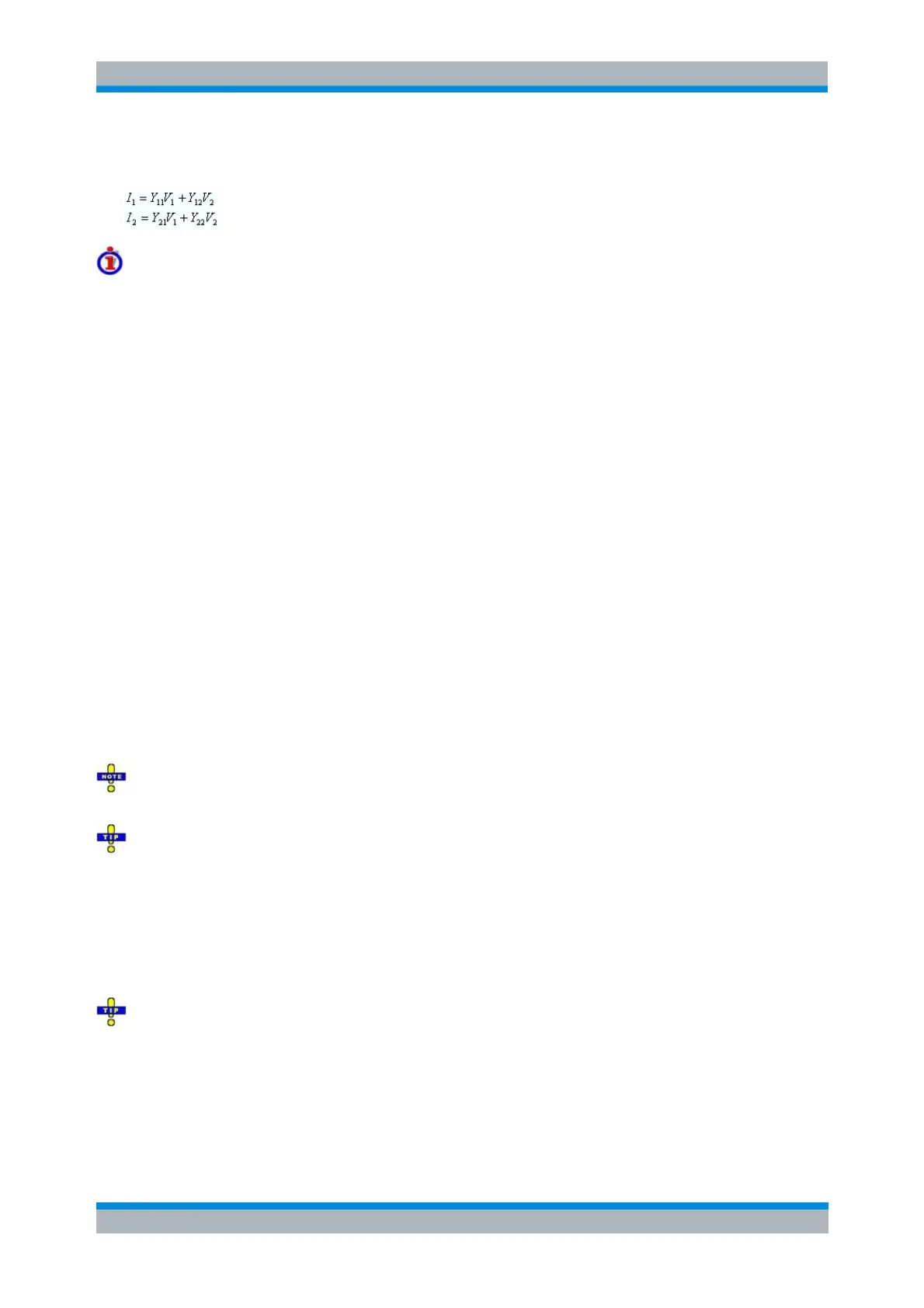
expressed with two linear equations:
Meaning of Y-parameters
The four 2-port Y-parameters can be interpreted as follows:
Y
11
is the input admittance, defined as the ratio of the current I
1
to the voltage V
1
, measured at
port 1 (forward measurement with output terminated in a short circuit, V
2
= 0).
Y
21
is the forward transfer admittance, defined as the ratio of the current I
2
to the voltage V
1
(forward measurement with output terminated in a short circuit, V
2
= 0).
Y
12
is the reverse transfer admittance, defined as the ratio of the current I
1
to the voltage V
2
(reverse measurement with input terminated in a short circuit, V
1
= 0).
Y
22
is the output admittance, defined as the ratio of the current I
2
to the voltage V
2
, measured at
port 2 (reverse measurement with input terminated in a short circuit, V
1
= 0).
Y-parameters can be easily extended to describe circuits with more than two ports or several modes of
propagation.
Wave Quantities and Ratios
The elements of the S-, Z- and Y-matrices represent fixed ratios of complex wave amplitudes. As long as
the assumption of linearity holds, the S-, Z- and Y-parameters are independent of the source power.
The network analyzer provides two additional sets of measurement parameters which have a
unambiguous meaning even if the DUT is measured outside its linear range:
Wave Quantities provide the power of any of the transmitted or received waves.
Ratios provide the complex ratio of any combination of transmitted or received wave quantities.
In contrast to S-, Z- and Y-parameters, wave quantities and ratios are not system-error corrected. A
power calibration can be applied to wave quantities and ratios.
With option R&S ZVA-K6, True Differential Mode, the analyzer can also determine balanced wave
quantities and ratios.
Wave Quantities
A wave quantity measurement provides the power of any of the transmitted or received waves. The power
can be displayed in voltage units (e.g. V or dBmV) or equivalent power units (e.g. W or dBm).
Examples for using wave quantities
The wave quantities provide the power at the different receive ports of the analyzer. This is different from
an S-parameter measurement, where the absolute power of a linear device is cancelled. Wave quantities
are therefore suitable for the following measurement tasks:
Analysis of non-linearities of the DUT.
Use of the analyzer as a selective power meter.


 To Next Page