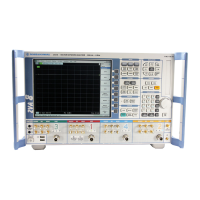
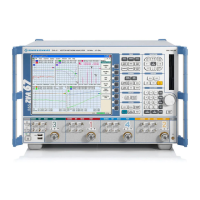
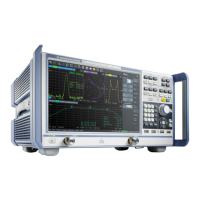
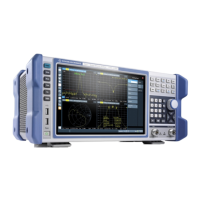
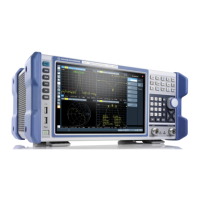
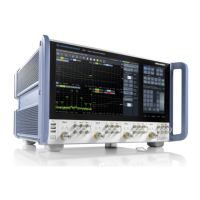
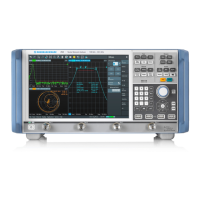
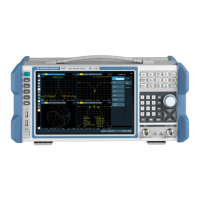
R&S
®
ZVA / R&S
®
ZVB / R&S
®
ZVT System Overview
Optional R&S ZVA Extensions
Operating Manual 1145.1084.12 – 30 64
RF and LO (IF = RF + LO), and another at the frequency difference between the RF and LO (IF = |RF –
LO|). Filtering can be used to select one of these IF outputs and reject the unwanted one.
In the scalar mixer mode the analyzer provides the following functionality:
Configuration of the RF and LO signals and measurement of the generated IF signal.
Power calibration of the signal sources and of the IF receiver.
The mixer mode can be used also to test important performance parameters of RF mixers such as
frequency ranges, conversion loss, compression, and isolation.
Harmonics are signals at an integer multiple of the fundamental frequency. The fundamental is the first
harmonic, the nth harmonic is n times the frequency of the fundamental. The production of harmonic
frequencies by an electronic system when a signal is applied at the input is known as harmonic distortion.
The purpose of the harmonics measurement is to measure the harmonic distortion of a DUT. To this end
the source remains at the fundamental frequency whereas the receiver is set to n times the fundamental
frequency. Two different types of results are provided:
In the direct measurement, the nth harmonic of the stimulus signal is measured.
In the relative measurement, the nth harmonic of the stimulus signal is divided by 1st harmonic
(fundamental) received from the DUT. The result corresponds to the nth harmonic distortion
factor.
Vector Mixer Measurement (R&S ZVA-K5)
Measurement of the parameters of an external mixer including phase, e.g. the complex conversion loss or
reflection coefficients. In contrast to scalar mixer measurements (with option R&S ZVA-K4), vector mixer
measurements provide magnitude and phase information, including group delay, about the mixer under
test (MUT). To assess the phase information, the IF signal at the mixer output is converted back to the
original RF frequency using a second MEAS mixer. A third REF mixer ensures that the reference wave is
converted back to the RF frequency.
True Differential Mode (R&S ZVA-K6)
Differential transmission lines and circuits are widely used, because their characteristics give them a lower
susceptibility to electromagnetic interference. Linear balanced devices can be tested with sufficient
accuracy using the virtual differential mode, where the vector network analyzer generates unbalanced
stimulus signals and uses a mathematical transformation to convert unbalanced wave quantities into
balanced S-parameters. A different behavior is expected for nonlinear balanced devices, where the
transmission characteristics of the DUT may depend on how closely the stimulus signal matches real
operating conditions.
In True Differential Mode, the vector network analyzer generates true differential and common mode
stimuli at arbitrary reference planes in the test setup and determines mixed-mode S-parameters, wave
quantities and ratios. The true differential mode also provides two additional sweep types, the amplitude
imbalance and phase imbalance sweeps.
As an alternative to true differential mode, the Defined Coherence Mode provides several source signals
with defined phase and amplitude relation.


 To Next Page