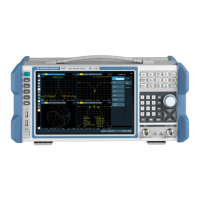
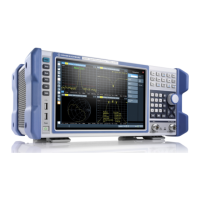
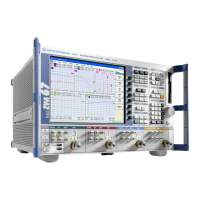
R&S
®
ZVA / R&S
®
ZVB / R&S
®
ZVT Command Reference
Special Terms and Notation
Operating Manual 1145.1084.12 – 30 607
7 Command Reference
This chapter lists all common commands and SCPI commands implemented by the analyzer.
Special Terms and Notation
This section explains the meaning of special syntax elements used in the SCPI command reference
sections. A general description of the SCPI command syntax can be found in section SCPI Command
Structure and Syntax in Chapter Remote Control.
Compatibility with ZVR and other instruments
The SCPI command set for the R&S ZVA vector network analyzer has been designed for compatibility
with older R&S network analyzers of the ZVR type. A special class of commands, marked with the symbol
, has been implemented primarily for compatibility reasons. Use these commands if you want to
maintain compatibility with ZVR analyzers. If you want to make full use of the ZVA features and don't need
ZVR compatibility, you should use the generalized, R&S ZVA-specific commands. A link to a generalized
command is provided in the description of each ZVR-specific command.
Similar considerations also hold for other commands that have been "implemented for compatibility
reasons".
Information in the command tables
All commands are described according to the same scheme. The following information is
provided:
1. Complete command syntax and parameter list
2. Description of the command and its relationship with other commands
3. List and description of the parameters with their numerical ranges, default values and
default units
4. SCPI conformance information, supported command types (setting command, query)
5. Program example
Order of commands
The commands are arranged in alphabetical order. SCPI systems or subsystems are arranged in
one topic.
Parameters
Many commands are supplemented by a parameter or a list of parameters. Parameters either
provide alternative options (setting a or setting b or setting c ..., see special character "|"), or they
form a list separated by commas (setting x,y).
1. <Par_Name> In the command tables and lists, parameters are generally described by a
name (literal) written in angle brackets (<>). This literal merely serves as a parameters
description; in an application program it must be replaced by one of the possible settings
reported in the detailed parameter description.
Example: CONTrol:AUXiliary:C[:DATA] <numeric_value>
with <numeric_value> = 0 to 15
possible command syntax: CONT:AUX:C 1
2. NAN (Not A Number) is generally used to represent missing data, e.g. if a portion of a
trace has not been acquired yet. It is also returned after invalid mathematical operations


 To Next Page