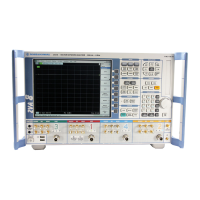
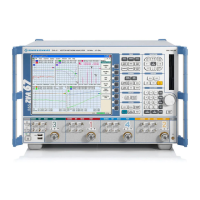
R&S
®
ZVA / R&S
®
ZVB / R&S
®
ZVT System Overview
Optional R&S ZVA Extensions
Operating Manual 1145.1084.12 – 30 63
Provides the noise figure of a DUT which operates in its linear range.
Provides the noise figure of a frequency-converting DUT which operates
in its linear range.
The R&S ZVA can optionally be equipped with a 10 MHz oven-controlled
crystal oscillator (OCXO) to enhance the frequency accuracy of the
internal generators.
Provides digital control signals for an external part handler; see .
Direct Generator/Receiver
Access
Give direct access to various RF input and output signals, e.g. to insert
external components into the signal path or develop custom
measurements.
Internal Generator Step
Attenuator for port x = 1,2,3,4
Control the source power, e.g. to protect sensitive DUTs from excess
input levels
Internal Receiver Step
Attenuator for port x = 1,2,3,4
Control the received power, e.g. to avoid damage to the analyzer
The following sections provide a short introduction to the software options.
Time Domain (R&S ZVAB-K2)
The network analyzer measures and displays complex S-parameters and other quantities as a function of
the frequency. The measurement results can be filtered and mathematically transformed in order to obtain
the time domain representation, which often gives a clearer insight into the characteristics of the DUT.
Time domain transforms can be calculated in bandpass or lowpass mode. For the latter the analyzer
offers the impulse and step response as two alternative transformation types. A wide selection of windows
can be used to optimize the time domain response and suppress sidelobes due to the finite sweep range.
Moreover, it is possible to eliminate unwanted responses by means of a time gate and transform the gated
result back into the frequency domain.
Arbitrary Generator and Receiver Frequencies (R&S ZVA-K4)
Measurements at arbitrary (not necessarily equal) generator and receiver frequencies provide a wealth of
applications, e.g. intermodulation measurements vs. frequency and power, hot S-parameter
measurements.
For intermodulation distortion measurements, the analyzer provides a measurement and calibration
wizard. Intermodulation products and intercept points of order 3, 5, 7, 9 can be measured at the input and
at the output of the DUT.
The frequency conversion option also includes Mixer and Harmonics measurements.
Scalar Mixer and Harmonics (R&S ZVA-K4)
RF mixers convert an RF signal at one frequency into a signal at another frequency. The frequency that is
to be shifted is applied at the RF input and the frequency shifting signal (from a local oscillator, LO) is
applied to the RF mixer's LO port, resulting in an output signal at the mixer's Intermediate Frequency (IF)
port.
For a given RF signal, an ideal mixer would produce only two IF outputs: one at the frequency sum of the


 To Next Page