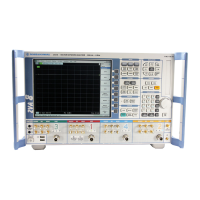
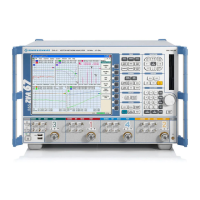
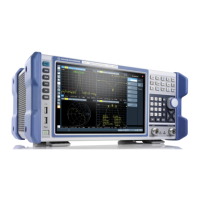
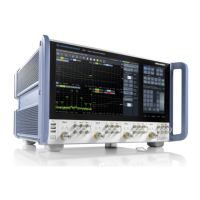
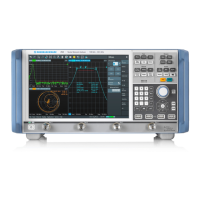
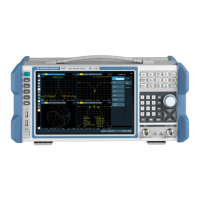
R&S
®
ZVA / R&S
®
ZVB / R&S
®
ZVT System Overview
Optional R&S ZVA Extensions
Operating Manual 1145.1084.12 – 30 65
Measurements on Pulsed Signals (R&S ZVA-K7)
Measurements on pulsed RF signals are required in many areas of RF and microwave technology. Pulsed
signals are used in mobile phone applications and radar systems, and amplifiers are typically designed for
pulsed rather than continuous wave (CW) conditions.
The analyzer performs pulsed measurements in analogy to a time sweep (i.e. at constant receiver
frequency), but with a much higher sampling rate of 12.5/ns. The raw I/Q amplitudes are written into a ring
buffer and processed at the end of each sweep. The buffer size allows for a maximum recording time
(sweep time) of 3 ms. Due to the high sampling rate and the large IF bandwidths available, it is possible to
obtain profiles for pulse widths from approx. 200 ns to the maximum recording time. Of course it is also
possible to measure a sequence of pulses up to the maximum recording time.
Converter Control (R&S ZVA-K8)
Measurements at frequencies beyond the analyzer's operating range (mm-wave measurements) are
achieved by combining a frequency-converting measurement with an external test set (frequency
converter). The frequency converters use frequency multipliers to transform the RF source signal from one
of the network analyzer ports into a high-frequency stimulus signal. A dual directional coupler separates
the reference and measurement channels from the waveguide test port. A second signal (Local Oscillator,
LO) is used for down-conversion of the reference and measurement channels. The LO signal can be
provided either by a second analyzer port or by an external generator. The down-converted signals are
fed to the REF IN and MEAS IN input connectors of the analyzer port providing the RF source signal.
Option R&S ZVA-K8 also comprises option ZVA-K4, Frequency Conversion.
Mixer Delay Measurements (R&S ZVA-K9 / -K10)
Measurement of a mixer's absolute or relative group delay. The mixer delay measurement is an extension
of the scalar mixer measurement: The network analyzer generates a two-tone RF signal as a mixer input
signal and measures the converted IF signal at the mixer output. The mixer delay is derived from the
relative phases of the two-tone signals at the mixer input and the mixer output.
Compared to conventional measurement methods, the mixer delay measurement offers several additional
advantages.
No external mixers are needed.
A network analyzer with standard functionality is sufficient.
Easy calibration using a calibration mixer.
An additional option R&S ZVA-K10, Long Distance Mixer Delay, enables mixer delay measurements with
an external receiver.
Pulse Generator (R&S ZVA-K27)
Provides two independent control signals at the CASCADE output connector on the rear panel of the
network analyzer. The signals can be used to control a R&S ZVAX24 or R&S ZVAX-TRM Extension Unit
equipped with a pulse modulator option.


 To Next Page