Glossary: Frequently Used Terms
R&S
®
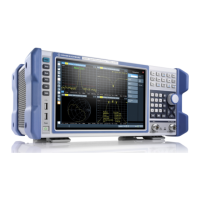
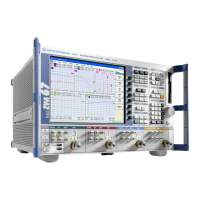
ZVA / R&S
®
ZVB / R&S
®
ZVT
7Operating Manual 1145.1084.12 ─ 30
Harmonic distortion: The production of harmonic frequencies (harmonics) by an elec-
tronic system when a signal is applied at the input.
Harmonic grid: A set of equidistant frequency points fi (i = 1...n) with spacing Delta(f)
and the additional condition that f1 = Delta(f). A harmonic grid is required for low pass
time domain transforms.
I
Intercept point: Fictitious lower-tone DUT input/output level where the intermodulation
suppression (-->) for a given intermodulation product reaches 0 dB
Intermodulation measurement: Measurement where the DUT is supplied with two
RF signals of equal power but different frequencies termed the upper and lower tone.
The analyzer measures the frequency-converting behavior of the DUT (--> intermodu-
lation product).
Intermodulation product: Special type of emissions of a nonlinear DUT that is sup-
plied with a two-tone RF signal (--> intermodulation measurement). The intermodula-
tion products occur at frequencies which correspond to sums and differences of the
upper and lower tone frequencies and their integer multiples.
Intermodulation suppression: The ratio of the power of an --> intermoulation product
to the power of the lower tone fundamental wave.
Isolation error: Measurement error caused by a crosstalk between the source and
receive port of the analyzer.
L
Limit check: Comparison of the measurement results with the limit lines and display of
a pass/fail indication. An acoustic warning can be generated in addition if a limit is
exceeded.
Limit line: A limit line is a set of data to specify the allowed range for some or all
points of a trace. Typically, limit lines are used to check whether a DUT conforms to
the rated specifications (conformance testing).
Load match error: Measurement error caused by a mismatch of the analyzer's
receive (load) port causing part of the signal transmitted through the DUT to be reflec-
ted off the receive port so that it is not measured there. The load match error can be
corrected by means of a two-port calibration (except normalization).
M
Marker: Tool for selecting points on the trace and for numerical readout of measured
data. A marker is displayed with a symbol (a triangle, a crossbar or a line) on the trace;
its coordinates are shown in the marker info field.


 To Next Page