R&S
®
ZVA / R&S
®
ZVB / R&S
®
ZVT GUI Reference
Channel Menu
Operating Manual 1145.1084.12 – 30 361
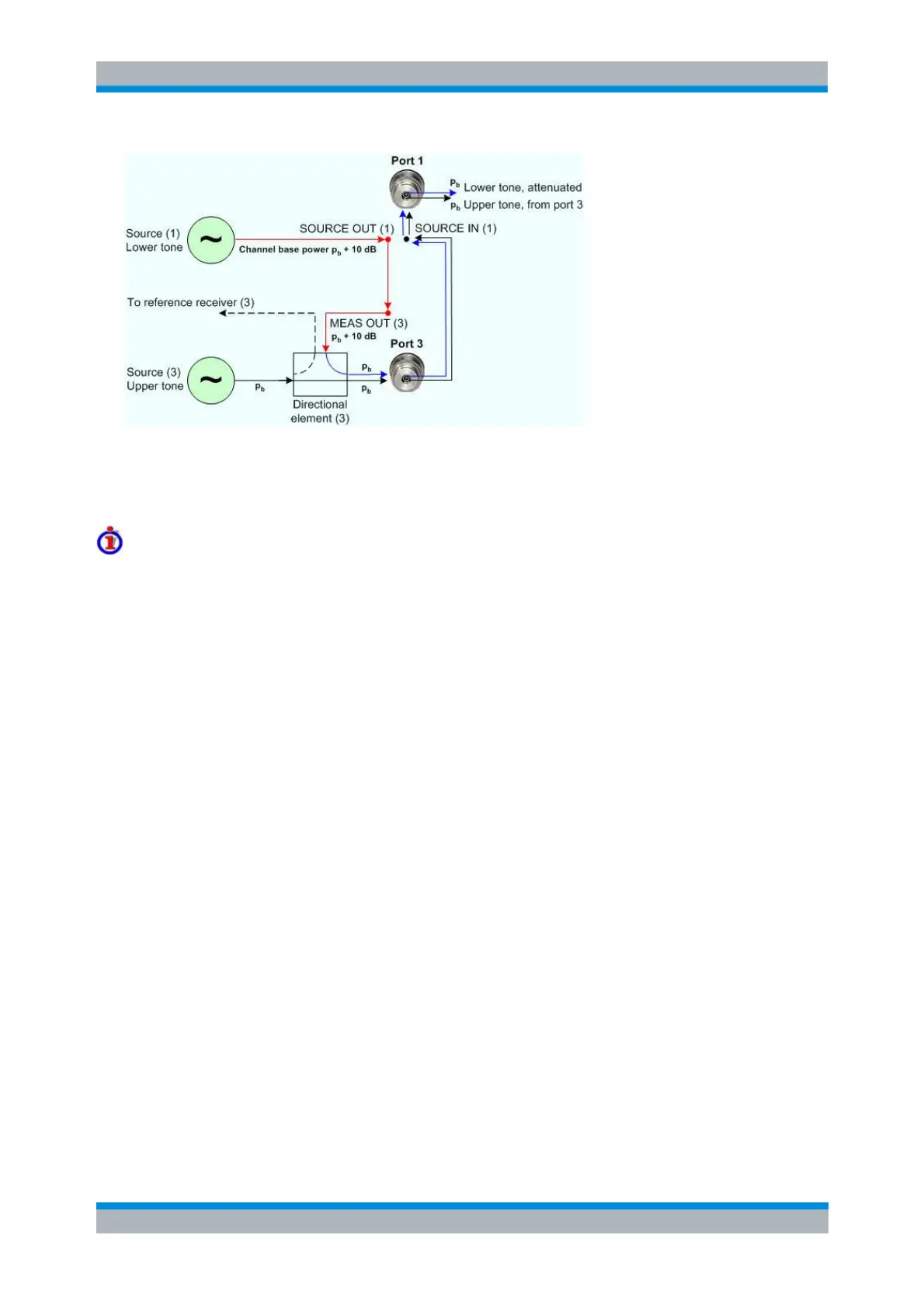
Larger Port Power Offset values (and hence smaller compensating Cal Power Offset values) may be
required e.g. to account for an additional cable loss in the test setup. The maximum source power
(depending on the analyzer model and the frequency; see data sheet) must not be exceeded. If
necessary, reduce the channel base power (and thus the Cal Power).
Coupling loss for microwave analyzers
Please note that the directional couplers in network analyzers which cover the microwave range (R&S
ZVA/ZVT20 and above) have a larger coupling loss, especially at very low frequencies (e.g. 20 dB loss at
10 MHz).
In a test setup with external coupler, the NWA settings should account for the coupling loss in an
analogous way.
Intermodulation System Error Correction
The Intermod Dist Meas Cal softkey opens a submenu to perform a system error correction for the
intermodulation measurement – using either a calibration unit (softkey Calibration Unit) or a manual
calibration (softkeys in submenu Manual).
Together with an Intermodulation Distortion Measurement Power Calibration the system error correction
allows for an enhanced wave correction which can be switched on via Channel - Cal - Enhanced Wave
Corr.
If the Two Tone Output is set to Ext. Dev. in the Define Intermod Dist Meas dialog, an Enhanced Wave
Correction is only possible at the DUT output. If the Two Tone Output is set to Port 1, an Enhanced Wave
Correction is possible both at the DUT output and input. In the first case, the calibration unit will perform a
full one port calibration at the receiving port, in the second case the calibration unit will perform a full two
port calibration between port 1 and the receiving port. Accordingly, in the first case a full one port
calibration is available in the submenu for manual calibration, while in the second case any full two port
calibration method may be chosen from this submenu.
The system error correction will be performed at the following frequency ranges:
The lower tone frequency range (the base frequency range)
The upper tone frequency range (the base frequency range plus the two tone distance)
The frequency range for all lower and upper intermodulation products which have been selected
via Prepare Measurement of IM Order in the Define Intermod Dist Meas dialog.
If in addition to the intermodulation measurement a mixer measurement is set up as well, all frequency


 To Next Page