R&S
®
ZVA / R&S
®
ZVB / R&S
®
ZVT GUI Reference
Channel Menu
Operating Manual 1145.1084.12 – 30 370
Define Noise Figure Meas...
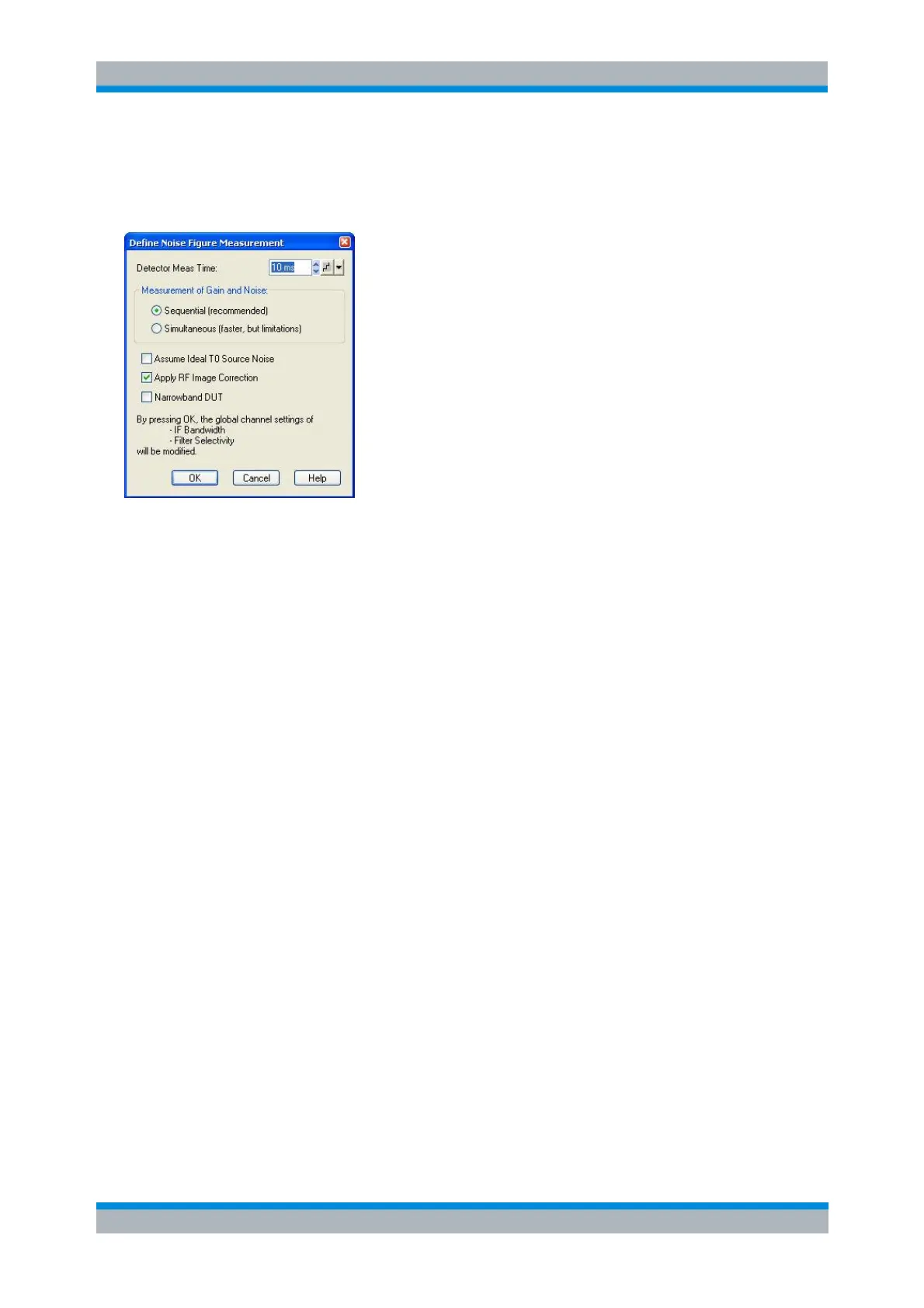
Provides basic parameters for the noise figure measurement.
Detector Meas Time sets the time that the analyzer uses to acquire data with each of the detector
settings (Avg, RMS; see Detector). The two detectors are used to separate the CW signal and the
noise signal at the output of the DUT. A smaller measurement time enhances the total
measurement speed, possibly at the expense of accuracy. With the default measurement time,
the great majority of noise power levels should be measured correctly. If you reduce the detector
measurement time, ensure that the variation of the measurement results does not increase
significantly.
Measurement of Gain and Noise selects a measurement procedure for maximum flexibility
concerning the signal levels or maximum speed; see background information below.
Assume Ideal T0 Source Noise causes the analyzer to discard the source noise determined
during calibration and use the noise figure of an ideal 50 Ω resistor instead. You can use this
setting in case the source noise is very small compared to the receiver noise so that the source
noise figure calibration may become inaccurate. The recommended alternative is to use a
preamplifier in order to reduce the receiver noise figure.
Apply RF Image Correction is relevant for mixer noise figure measurements only (with option R&S
ZVA-K31): The noise figure measurement accounts for the noise contribution originating from the
RF image frequencies. To obtain consistent results, Prepare Measurement of RF Image must be
enabled in the Define Mixer Measurement dialog, and a source and receiver calibration must be
performed in the RF image range.
If the DUT suppresses the RF image frequencies, Apply RF Image Correction can be unchecked
to speed up the measurement. In this case, you can also skip the calibration steps for the RF
image frequencies.
Narrowband DUT should be checked if the bandwidth of the DUT is smaller than approx. 50 MHz:
Such small bandwidths suppress the noise contributions in the RF image band of the internal
mixer in the analyzer's receiver path. Consequently, the analyzer detects the noise contribution
from a single sideband of its internal mixer only (instead of both sidebands, if a broadband DUT is
measured). The calculation of the receiver noise figure during the calibration and the
measurement is modified accordingly.
OK activates the noise figure measurement using the current settings. Note that the filter settings
are automatically adjusted to the requirements of the noise figure measurement: An IF bandwidth
of 5 MHz and a filter with high selectivity is activated. The filters are available if option R&S ZVAB-
K30, Noise Figure Measurement, is installed.


 To Next Page