selected calibration.
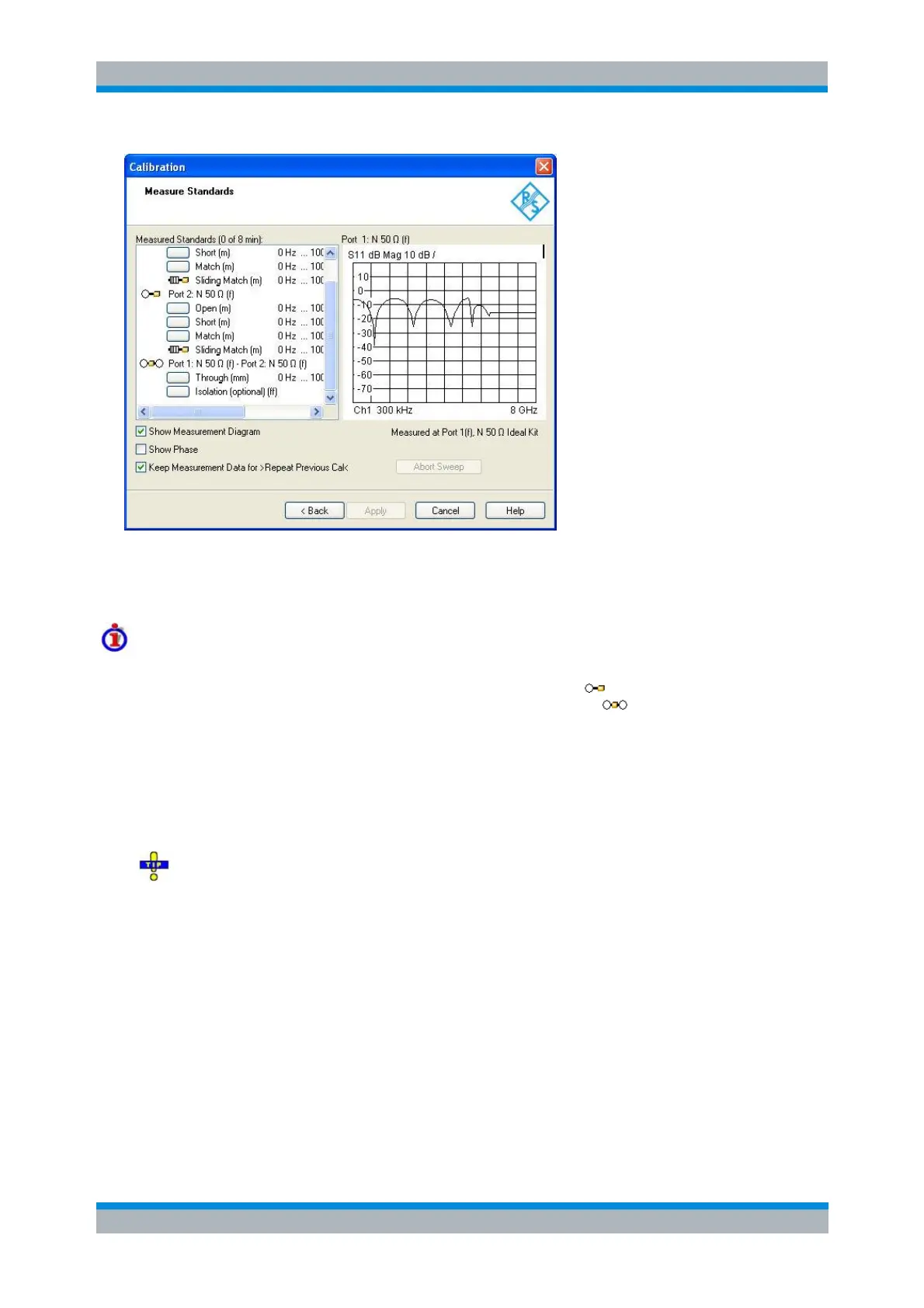
Structure of the Measured Standards list
The list of measured standards has a tree structure.
The first level contains all physical ports where one-port (reflection) measurements are
required and all physical port combinations where two-port (transmission)
measurements must be performed.
The second level contains check boxes for the standards to be measured at each port or
port combination. The frequency range for each standard is also displayed. A red line
indicates that the sweep range exceeds the frequency range of the standard.
For a sliding match, a third level contains check boxes for the different positions of the
sliding element.
Double-click a physical port symbol to expand or collapse the list.
Through connections for full n-port calibrations and n ≥ 3
The list of Measured Standards for the full n-port calibration types (TOSM, UOSM, TOM, TRM,
TRL, MTRL, TNA) contains all n!/(2*(n – 2)!) possible Through connections between the calibrated
analyzer ports. The analyzer can calculate the error terms after (n – 1) Through measurements,
provided that the Throughs connect all analyzer ports. As soon as a sufficient set of Through
measurements is available, you can Apply the calibration and close the wizard. You can also
measure additional Through connections in order to improve the accuracy of the calibration.
To establish a sufficient set of Through connections, you can select an arbitrary analyzer port as a
node port and measure all Through connections to this port. You can also connect all ports in
increasing order, e.g. 1 --> 2, 2--> 3, 3--> 4.
For more information refer to section Full n-Port Calibration with Reduced Number of Through
Connections.


 To Next Page