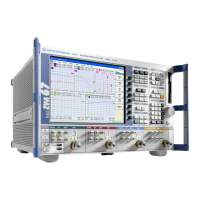
R&S
®
ZVA / R&S
®
ZVB / R&S
®
ZVT Command Reference
SCPI Command Reference
Operating Manual 1145.1084.12 – 30 727
channel bits is started. They are changed whenever a channel with different channel bits becomes
the measuring channel.
The signals at the USER CONTROL connector are maintained after the analyzer enters the hold
state. This happens if all channels use single sweep mode and if all sweep sequences have been
terminated.
A simple application consists of selecting the channel numbers as parameters for
CONTrol:AUXiliary:C[:DATA] and monitor the activity of up to 256 different channels at the USER
CONTROL connector; see example below. You can also use the USER CONTROL output signals as
channel-dependent trigger signals for external devices. Use OUTPut<Ch>:UPORt[:VALue] to transfer the
four bit value for an arbitrary channel <Ch> in binary representation.
0 to 255 [–]
The transferred values correspond to the following states of the USER
CONTROL connector:
0 – no signal at any of the pins
1 – output signal at pin 8
2 – output signal at pin 9
3 – output signal at pin 8 and 9
...
255 – output signal at pins 8 to 11 and 16 to 19
If pins 16 to 19 are not used as channel bits, only the four least significant bits
of the value's binary representation are considered.
Device-specific, command or query
*RST; :CONT:AUX:C 1
Assign the channel bit value 1 to the active channel no. 1. The analyzer
performs a measurement in channel no. 1, therefore the output signal at pin 8
is switched on.
CONF:CHAN2:STAT ON; :CONT:AUX:C 2
Create channel no. 2, causing it to become the active channel, and assign the
channel bit value 2. The analyzer performs no measurement in channel no. 2,
therefore the output signal is not changed.
CALC2:PAR:SDEF 'Ch2Tr1', 'S11'
Create a trace named 'Ch2Tr1' and assign it to channel 2. While the analyzer
measures in channel 2, the output signal changes from pin 8 to pin 9.
CONTrol:HANDler...
This subsystem provides device-specific commands to control the "Universal Interface", option R&S
ZVAB-B14. For a detailed description refer to section Universal Interface.


 To Next Page