Rolls- Royce Silver Shadow
B
Bent/ey
T
Series
Workshop
Manua/
Rear tyres
The rear tyres tend to wear in
a
tapered form from
the outer shoulder across to the inner shoulder; the
centre and inside shoulder showing most wear.
.An
example of a normally worn rear tyre is shown in
Figure
R11.
When assessing tyre wear the following points
should also be considered.
1.
The wear rate on the outer shoulders of the
front and rear tyres which run on the kerb side of
the road will be slightly greater than the other outer
shoulders, particularly if the car is driven on roads
with a pronounced camber.
2.
Tyre wear is critical to tyre inflation pressures,
particularly with respect to under-inflation. There-
fore, it is imperative that the recommended tyre
pressures are maintained.
3.
The higher the speed at which a car is driven
through corners, the more the rear tyres will wear
on the inner shoulders. The effects of hard
cornering will be shown also by the 'feathering'
which occurs on the rib edges as shown in Figure
R11. Do not change the position of a partially worn
set of tyres as the subsequent rate of wear will be
increased.
Tread wear indicators
To provide a visual indication that the depth of
tread remaining on a tyre is 1,6 mm.
($
in.) or less,
tread wear indicators are incorporated into the
construction of the tyres.
These
indicators
are Integrally moulded ribs
located in the tread grooves. The ribs are spaced at
frequent intervals around the circumference of the
tyre and at each point they extend across the full
width of the tyre tread in all primary grooves.
When a tyre has worn so that one or more of the
indicators are flush with the tread (1.6 mm.
(hin.) or less, tread depth)
a
new tyre
is
required.
Remould tyres
In cases where new tyres fail to meet the overall
quality standards laid down by the manufacturers,
but remain structurally sound and are suitable for
sale as a remoulded tyre, the sidewalls will bear
one of the following markings,
'
Regraded Quality',
'Remould Quality' or ~econds'. In addition the
speed rating of the tyre
(e.g. the
H
in HR15) will
be obliterated.
Under no circumstances
should any tyres be
fitted which have
bcen branded 'Regraded Quality',
'
Remould Quality' or "econds', or those which
have had the speed rating removed or altered.
Spare wheel-To remove
1.
Turn the bolt in the luggage
con~partment
anti-clockwise, using the box spanner and tommy
bar provided in the tool kit. This operation lowers
the carrier and facilitates removal of the spare
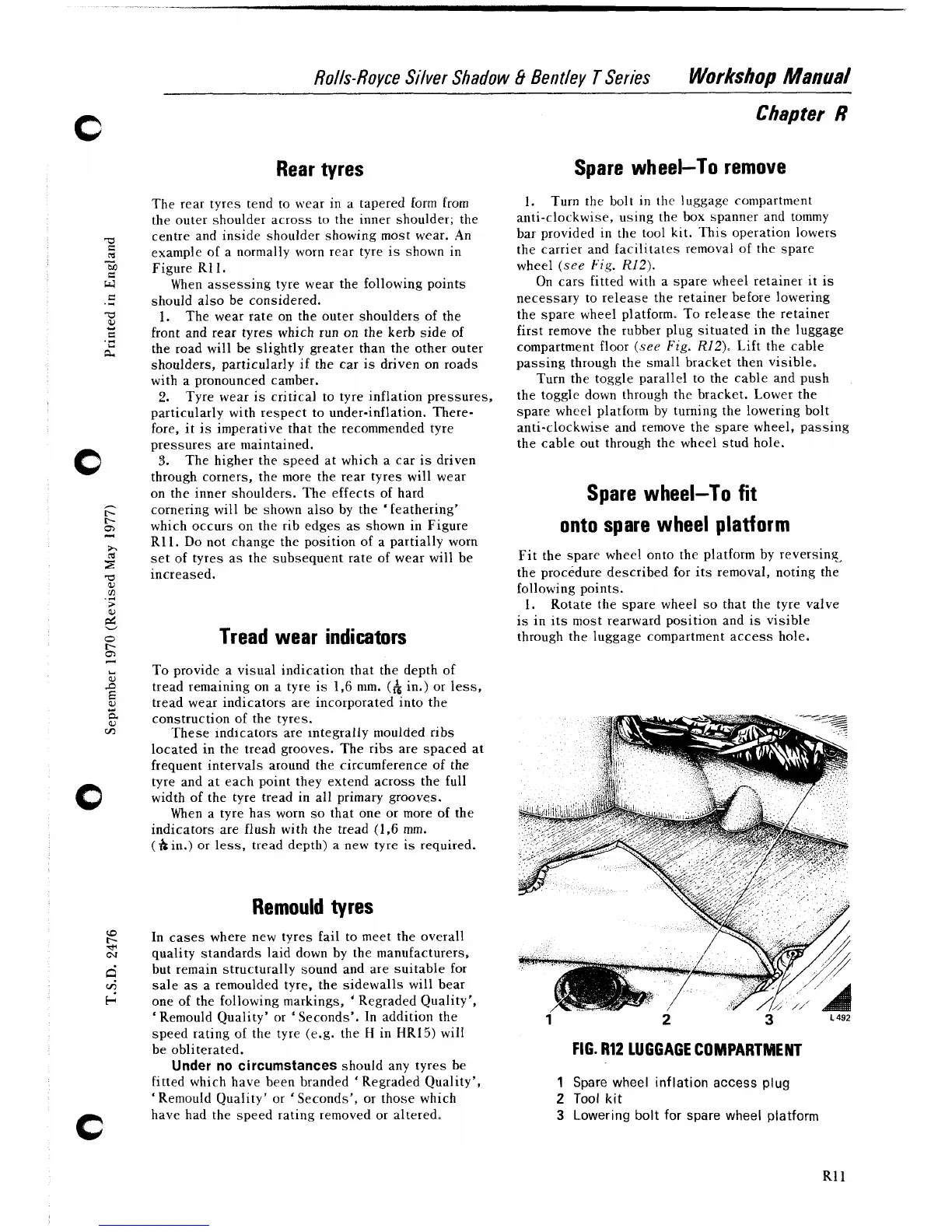
wheel (see
Fig.
K12).
On cars fitted with a spare wheel retainer it is
necessary to release the retainer before lowering
the spare wheel platform. To release the retainer
first remove the rubber plug situated in the luggage
compartment floor (see
Fig.
R12).
Lift the cable
passing through the small bracket then visible.
Turn the toggle parallel to the cable and push
the toggle down through the bracket. Lower the
spare wheel
platforn~ by turning the lowering bolt
anti-clockwise and remove the spare wheel, passing
the cable out through the wheel stud hole.
Spare wheel-To fit
onto spare wheel platform
Fit the spare wheel onto the platform by reversing-
the procedure described for its removal, noting the
following points.
1.
Rotate the spare wheel so that the tyre valve
is in its most rearward position and is visible
through the luggage compartment access hole.
1
2
3
L
492
FIG.
R12
LUGGAGE
COMPARTMENT
1
Spare wheel inflation access
plug
2
Tool
kit
3
Lowering bolt
for
spare wheel platform



 To Next Page