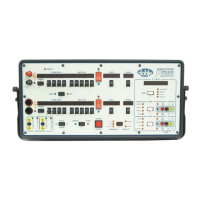
TDR9000
™
Circuit Breaker Test System User’s Guide
72A-1898 Rev. A 11/01 I-29
Monday, November 26, 2001 1:09 pm
AN9: Use of the Auxiliary Wet/Dry Contact Monitor
The Auxiliary Wet/Dry Contact Monitor is used to obtain the times from
Close Coil energization to Resistor Switch and Main Contact Closing. The
Close Parameters has a Timing Event entry in addition to the Close Pulse
duration entry. One of the following channels can be used for the T=O
time: the Close circuit current as measured by the current shunt in the
TDR9000, a Wet/Dry Contact channel, or a current or voltage channel.
The current and voltage channels have an adjustable trigger level that is
settable in 10% increments. These increments are a percentage of the
selected full scale of the channel. This enables the user to measure the
time between the energization of the closing coil and the desired event.
The Instrument monitors three states – Dry Contact Closed, Dry Contact
Open, Wet Contact Open. To use this feature, connect the two leads from
the Contact Monitoring channel across the circuit breaker's closing coil
(observing lead polarity). Select Analog as the timing event and enter the
channel number in the Timing Channel.
Prior to closing coil energization the Instrument considers the closing coil
as a Dry Contact Open. When the closing coil is energized, the
Instrument considers it a Wet Contact Open.
Using this procedure, the times obtained are compared to the
specifications for closing time that were entered in the Breaker Test Plan.
AN10: Contact Sensing and Test Lead Connections
EHV Main Contact sensing circuitry of the TDR9000 applies a low DC
voltage across the common lead at each contact lead. The actual voltage
is dependent upon the Resistor Range selected. The EHV Contact Module
applies 15 VDC when the 200 Ohm to 500 Ohm range is used and
7.5 VDC when the 100 Ohm to 300 Ohm range is used.
OCB Main Contact sensing circuitry in the TDR9000 applies 20 or
65 Volts DC across the common lead and the three contact leads. The
Dead Tank/OCB Contact Module applies 48 VDC when the 300 Ohm to
7,000 Ohm range is used and 15 VDC when the 10 Ohm to 400 Ohm
range is used.
The low sensing voltages are used to minimize the amount of cross talk
and still maintain an adequate signal to noise ratio in areas where there
may be up to 10 mA of interfering noise.


 To Next Page