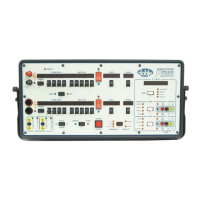
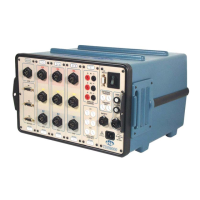
TDR9000
™
Circuit Breaker Test System User’s Guide
72A-1898 Rev. A 11/01 I-31
Monday, November 26, 2001 1:09 pm
Travel and velocity measurements on the new vacuum circuit breakers
which have very short travel and high velocities are adversely affected by
the slower sampling rates.
In a circuit breaker that has a velocity of 20 ft/sec in the arcing zone, the
following calculations are appropriate:
• 20 ft/sec x 12 in/ft = 240 in/sec
• or 24 thousandths of an inch every 100 µsec.
For a sampling rate of 10 kHz (one sample every 100 µSec) and a Main
Contact closing just after the sample period, the Main Contacts travel
0.024" before the next sample period begins.
If the sample rate is 5 kHz (one sample every 200 µSec) with a Main
Contact closing just after the sample period, the Main Contacts travel
0.048" before the next sample period begins.
If the specified Contact Wipe is 0.5", then an error of 0.048" approaches
a 10% error. Although Contact Closure is an asynchronous event with
respect to the instruments sample period, higher sampling rates minimize
these errors.
AN13: Safety Grounds, Close Connected Transformers,
and the Use of the TDR9000
™
OCB/Dead Tank Contact Monitors
The power supplies used for the Doble TDR9000 Contact Monitors do
not have a ground reference. However, since this is the source of voltage,
it is necessary that the common lead of the Contact Monitor cable be
connected to the side of the breaker that has the circuit breaker bushings
tied together and has the safety ground.
When testing a circuit breaker that is close connected, there is no
disconnect switch between the circuit breaker and the transformer, to the
Y winding of a transformer whose neutral is grounded or to an
Autotransformer. Therefore, the safety ground must be placed between
the transformer and the circuit breaker.
In substations where one circuit breaker disconnect switch is adjacent to
the circuit breaker to be tested and the other disconnect is physically
separated from the circuit breaker, place the safety ground on the poles of
the circuit breaker that is farthest from the disconnect switch.


 To Next Page