R&S
®
ZVA / R&S
®
ZVB / R&S
®
ZVT GUI Reference
Channel Menu
Operating Manual 1145.1084.12 – 30 248
The characteristics of the high selectivity filter makes it particularly suitable for isolating unexpected
spurious responses or known mixer products.
Bandwidth reduction at low frequencies
To reduce the trace noise at small frequencies, the analyzer adjusts the IF bandwidths when its receiver
frequency falls below a threshold value. A suitable bandwidth reduction also ensures accurate time
domain transforms.
The bandwidth reduction depends on the dynamic bandwidth setting in the Bandwidth Fine Adjust dialog.
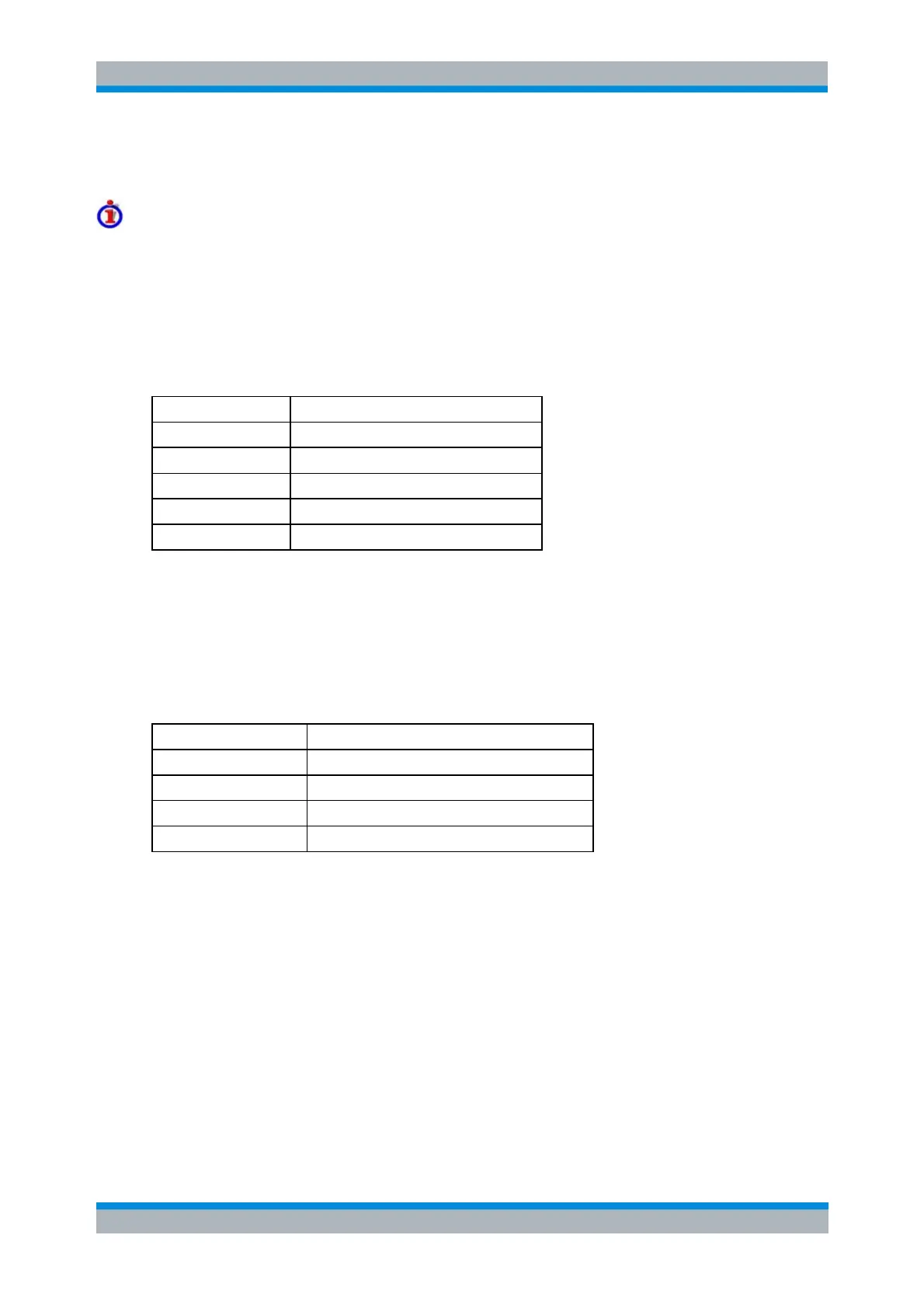
If Dynamic Bandwidth at Low Frequencies is disabled ("static" correction), the bandwidth at
frequencies below 25 MHz is limited by the values shown in the following table. At each sweep
point, the analyzer uses the static limit or the Meas Bandwidth setting, whichever is lower.
Static upper limit for Meas Bandwidth
n/a (analyzer uses Meas Bandwidth setting)
Example: The default sweep range of an R&S ZVA8 is 300 kHz to 8 GHz. After a preset, the
analyzer replaces the default Meas Bandwidth of 10 kHz at the first sweep point (300 kHz) by 100
Hz. At frequencies of 2 MHz and above, the 10 kHz Meas Bandwidth setting applies.
If Dynamic Bandwidth at Low Frequencies is enabled, the analyzer divides the Meas Bandwidth
setting at each sweep point by the frequency-dependent correction factors listed below ("dynamic"
correction). If the result is not equal to a selectable Meas Bandwidth value, the next lower Meas
Bandwidth is used. The actual measurement bandwidth corresponds to the result of the static
correction or to the dynamic value, whichever is lower.
Receiver frequencies f
rec
Dynamic correction factor for Meas Bandwidth
1 (analyzer uses Meas Bandwidth setting)
Example 1: The default sweep range of an R&S ZVA8 is 300 kHz to 8 GHz. The static upper limit
for the bandwidth at the first sweep point (300 kHz) is 100 Hz. With a default Meas Bandwidth of
10 kHz, the dynamic correction at the first sweep point is equal to the static upper limit (10 kHz /
100 = 100 Hz).
If the Meas Bandwidth setting is reduced to 200 Hz, the dynamic correction replaces the
bandwidth at the first sweep point by 200 Hz / 100 = 2 Hz (selectable Meas Bandwidth value). In
the receiver frequency range between 50 MHz and 100 MHz, the dynamically corrected
bandwidth is calculated as 200 Hz / 50 = 4 Hz, which is also replaced by the selectable value of 2
Hz. The dynamically corrected bandwidth at receiver frequencies between 100 MHz and 500 MHz
is 20 Hz. At receiver frequencies of 500 MHz and above, the Meas Bandwidth setting of 200 Hz
applies.
Example 2: An R&S ZVA8 is preset. A harmonic grid is calculated in order to obtain a lowpass
time domain transform. This yields a start frequency of f
start
≈ 39.8 MHz. The static bandwidth
correction does not affect the time domain transform, however, a dynamic correction can affect
harmonic frequency points up to 500 MHz.


 To Next Page