R&S
®
ZVA / R&S
®
ZVB / R&S
®
ZVT GUI Reference
Channel Menu
Operating Manual 1145.1084.12 – 30 247
Meas. Bandwidth
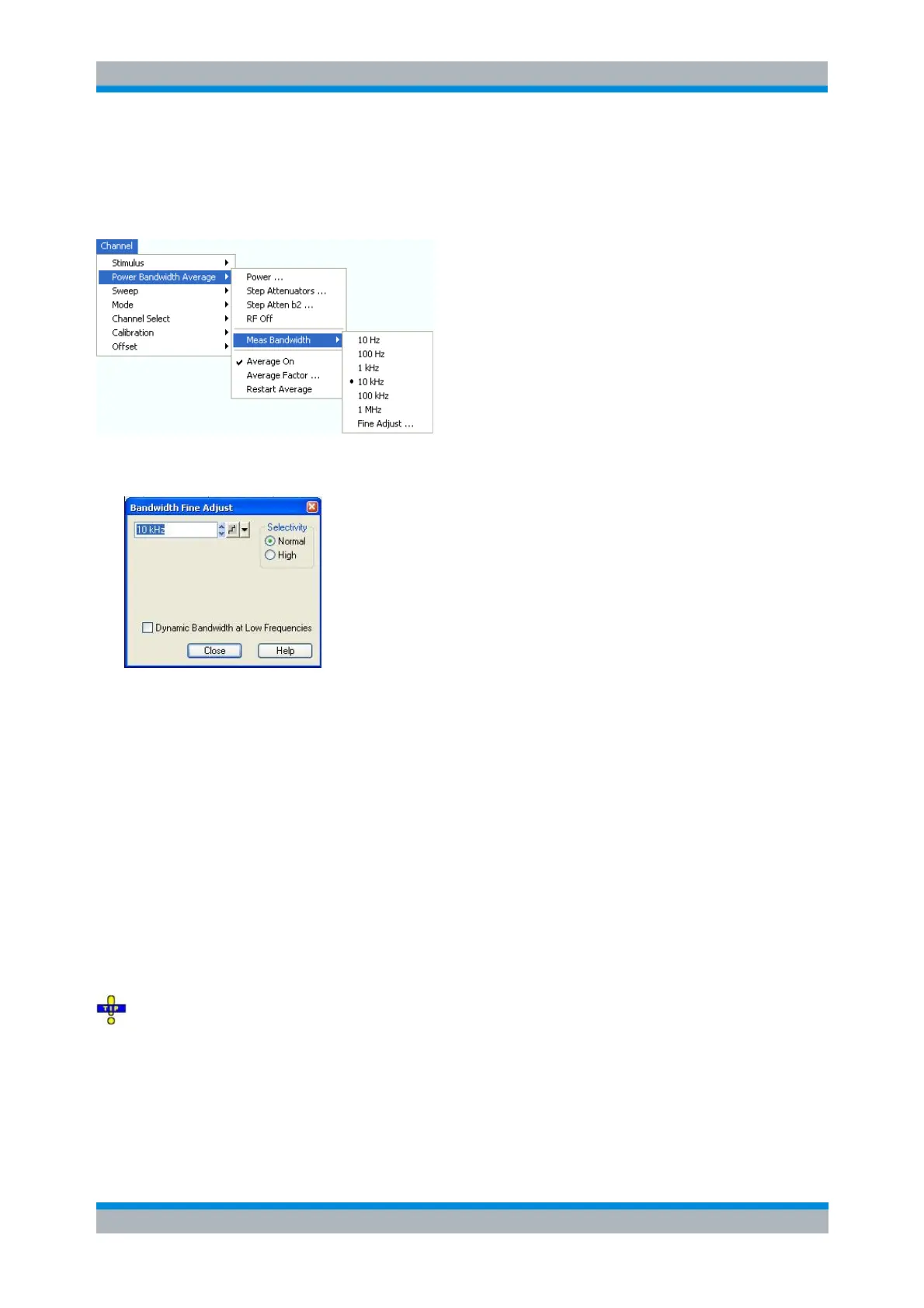
Sets the measurement bandwidth of the IF filter. Meas Bandwidth opens a submenu to select bandwidths
between 10 Hz and 1 MHz:
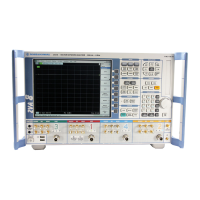
Fine Adjust... opens a dialog where you can modify the selected measurement bandwidth and the
selectivity of the IF filter.
The numeric entry field shows the last IF filter bandwidth selected. The arrow buttons increment
and decrement the bandwidth in 1-2-5 steps for each decade. Entered values between the steps
will be rounded up, values exceeding the maximum bandwidth rounded down.
Selectivity selects between two types of IF filters: Filters with Normal selectivity and short settling
time, and filters with High selectivity but larger settling time. This functionality is available on R&S
ZVA and R&S ZVT network analyzers.
If Dynamic Bandwidth at Low Frequencies is enabled, the analyzer reduces the IF bandwidths at
receiver frequencies below 500 MHz by a frequency-dependent (dynamic) factor. This setting
complements the automatic bandwidth reduction for frequency sweeps with small start
frequencies; see Bandwidth reduction at low frequencies below.
The bandwidth reduction reduces the trace noise at small frequencies and improves the accuracy
of the time domain transform.
The selected bandwidth and selectivity applies to all filters used in the current channel. This makes sense
because the measurement speed is limited by the slowest filter in the channel. In Segmented Frequency
sweeps, the bandwidth and selectivity can be set independently for each segment; see Define Segments.
Optimizing the filter settings
A high selectivity and a small filter bandwidth both suppress the noise level around the measurement
frequency and thus increase the dynamic range. On the other hand the time needed to acquire a single
measurement point increases for small filter bandwidths and high selectivity. For small bandwidths, the
filter settling time, which is inversely proportional to the bandwidth, is responsible for the predominant part
of the measurement time.


 To Next Page