R&S
®
ZVA / R&S
®
ZVB / R&S
®
ZVT GUI Reference
Channel Menu
Operating Manual 1145.1084.12 – 30 481
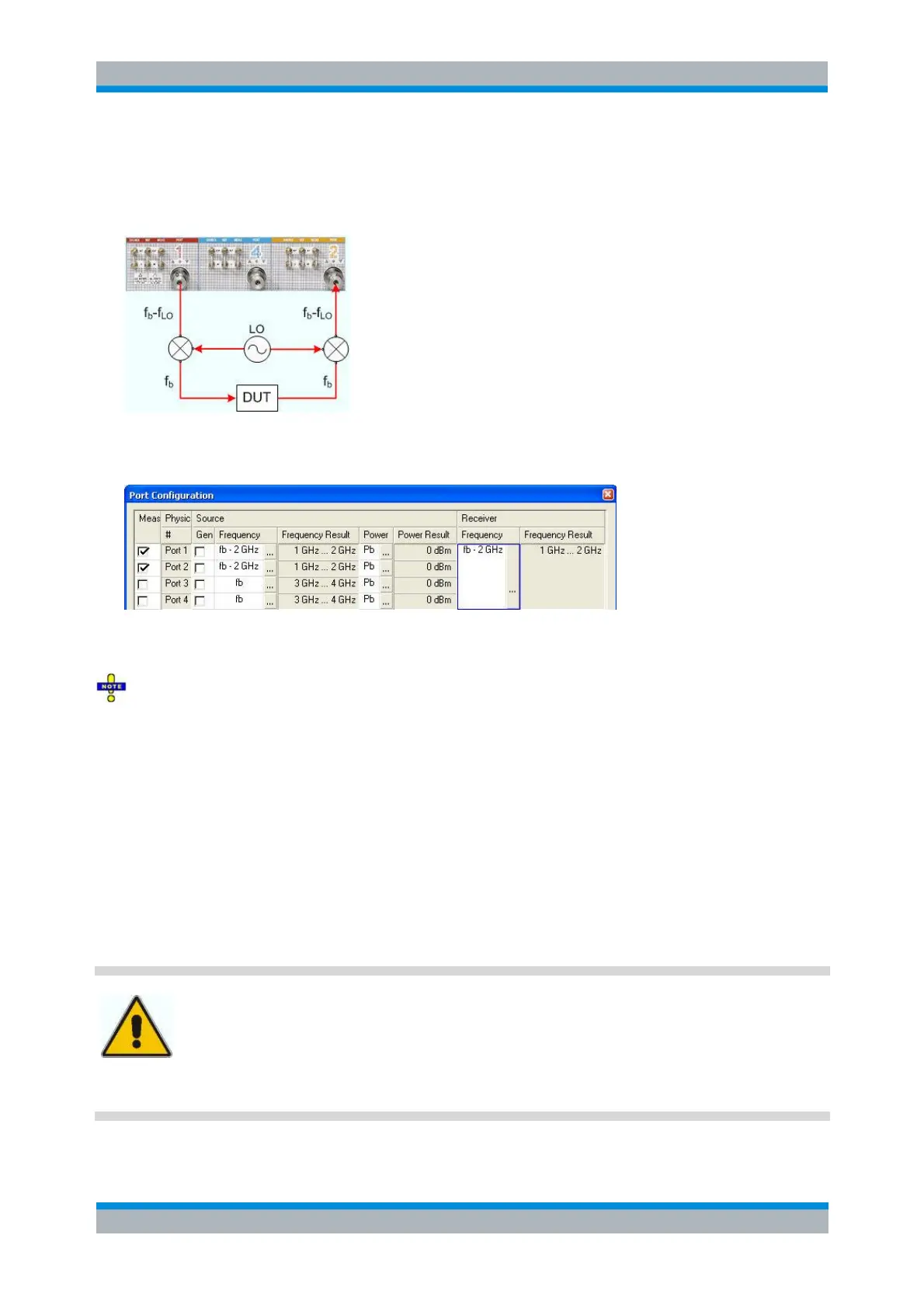
conversion where the frequency at the DUT input/output ports differs from the analyzer port frequencies.
Example: The signal from the analyzer source port 1 is up-converted to the channel base frequency f
b
;
the output signal of the DUT is down-converted and measured at port 2.
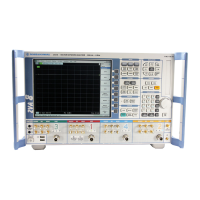
With a channel base frequency in the range 3 GHz ... 4 GHz and an LO frequency of 2 GHz, the port
configuration table could look like this:
Enable Cal and Corr at Base Frequency to ensure that the calibration is referenced to the channel base
frequency.
Cal and Corr at Base Frequency is also effective in special frequency conversion modes. E.g. in a
scalar mixer measurement, the frequency range for the mixer calibration will be restricted to the frequency
range of the RF source port (Port 1) and no longer cover the complete frequency range of the IF receive
port (Port 2). Always ensure that Cal and Corr at Base Frequency is in accordance with your test setup
and measurement task to avoid inconsistencies.
[SENSe<Ch>:]CORRection:CBFReq[:STATe]
Automatic Calibration
A Calibration Unit is an integrated solution for automatic system error correction of vector network
analyzers of the R&S ZVAB family. Rohde & Schwarz provides different types of calibration units; for an
overview refer to the System Overview chapter. The use of the calibration units is described below.
Attention!
Please observe the safety instructions in the "Technical Information" provided with the
calibration unit to avoid any damage to the unit and the network analyzer. Safety-
related aspects of the connection and operation of the units are also reported in the
sections below.


 To Next Page