R&S
®
ZVA / R&S
®
ZVB / R&S
®
ZVT System Overview
Calibration Overview
Operating Manual 1145.1084.12 – 30 57
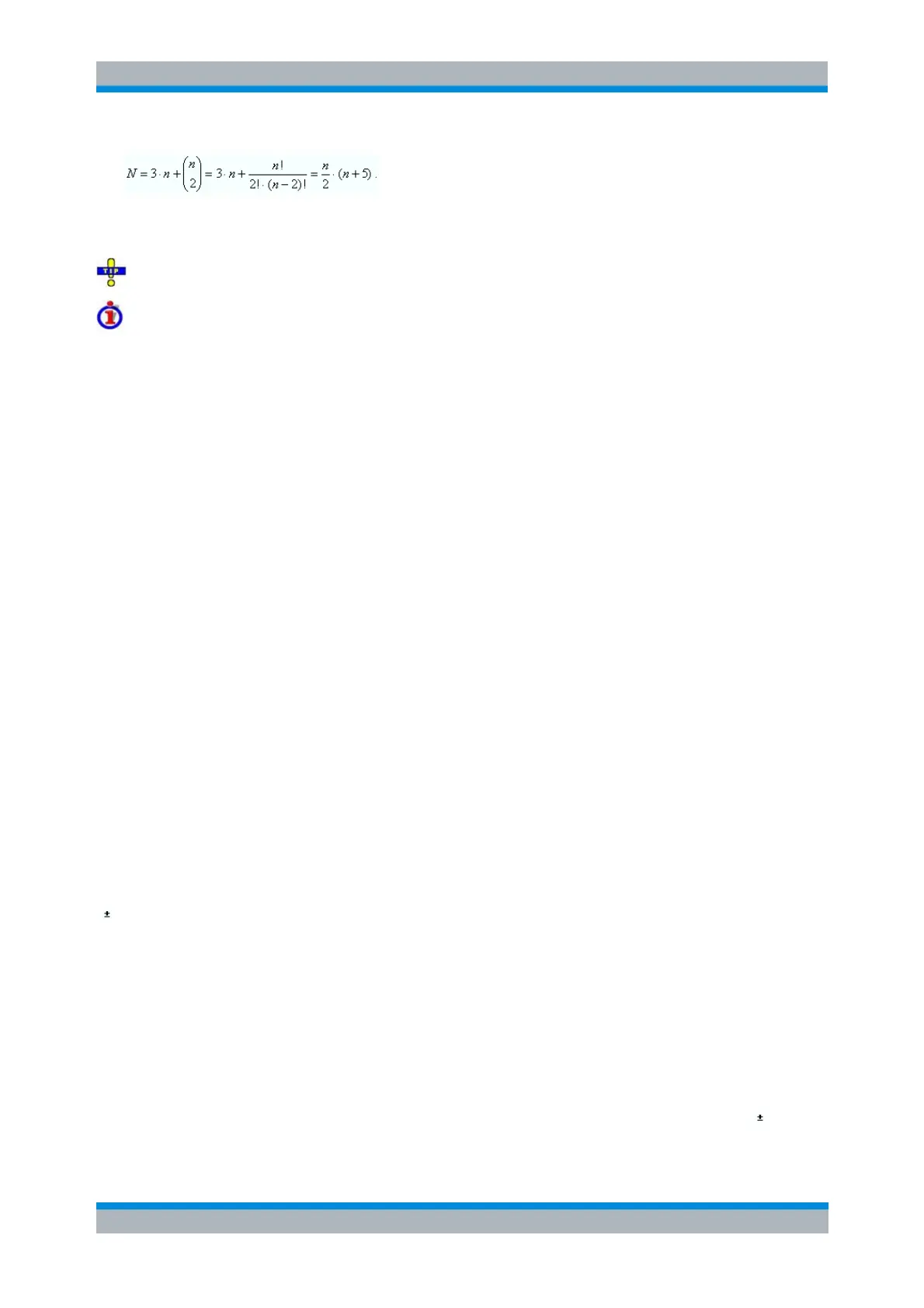
The analyzer automatically performs each through measurement in both directions, so the number of
connected standards is smaller than the number of measurements.
See also Full n-port Calibration with Reduced Number of Through Connections below.
TOSM with unknown Through, UOSM
The network analyzer supports different connector types at its test ports in order to measure DUTs with
different port connectors. To perform a TOSM calibration, the DUT must be replaced by a through
connection, which generally involves an adapter between the two connector types.
An adapter represents a through standard with unknown characteristics (in particular, with unknown delay
time/transmission phase). The analyzer can perform a TOSM calibration with an unknown through,
provided that it is reciprocal (S
21
= S
12
). The modified TOSM calibration is referred to as UOSM (Unknown
through – Open – Short – Match) calibration. It can be selected as follows:
If different connector types are assigned to the test ports, the analyzer automatically replaces
TOSM –> UOSM.
If the same connector types are used but the appropriate through standard is not defined, the
analyzer also replaces TOSM –> UOSM.
UOSM can be selected explicitly using Channel – Calibration – Start Cal – Other....
After acquiring the calibration sweep data for the unknown through, the analyzer automatically determines
its delay time/transmission phase; see Unknown Through Standard.
TOM Calibration
A TOM (Through – Open – Match) calibration requires a low-reflection, low-loss through standard with an
electrical length that may be different from zero, an open, and a match. The characteristics of all
standards must be fully known; the match may have non-ideal characteristics.
TRM Calibration
A TRM (Through – Reflect – Match) calibration requires a low-reflection, low-loss through standard with an
electrical length that may be different from zero, a reflect, and a match. The magnitude of the reflection
coefficient of the reflect standard can be unknown but must be nonzero; its phase must be roughly known
( 90 deg). The magnitude and phase of the reflection coefficient must be the same at both test ports.
TRM calibration is especially useful for DUTs in test fixtures.
TRL Calibration
A TRL (Through – Reflect – Line) calibration requires the two-port standards through and line, which are
both assumed to be ideally matched. Beyond that, the through must be lossless, and its length must be
exactly known. The length of the line standard must be known approximately.
Furthermore, a reflecting one-port standard (reflect) is needed. The magnitude of the reflection coefficient
of the reflect standard can be unknown but must be nonzero; its phase must be roughly known ( 90 deg).
The magnitude and phase of the reflection coefficient must be the same at both test ports.


 To Next Page