First, Previous, Next and Last navigation buttons at the bottom of the
screen.
2.8.11.5 Restoring the Default NTP Configuration
The VersaSync default NTP configuration can be restored at any time. It com-
prises basic settings such as Stratum1 operation with no other servers or peers,
no broadcasting and no access restrictions. External queries or modifications are
not permitted, while generally all IPv4 and IPv6 client connections are allowed.
To restore VersaSync to its default NTP configuration:
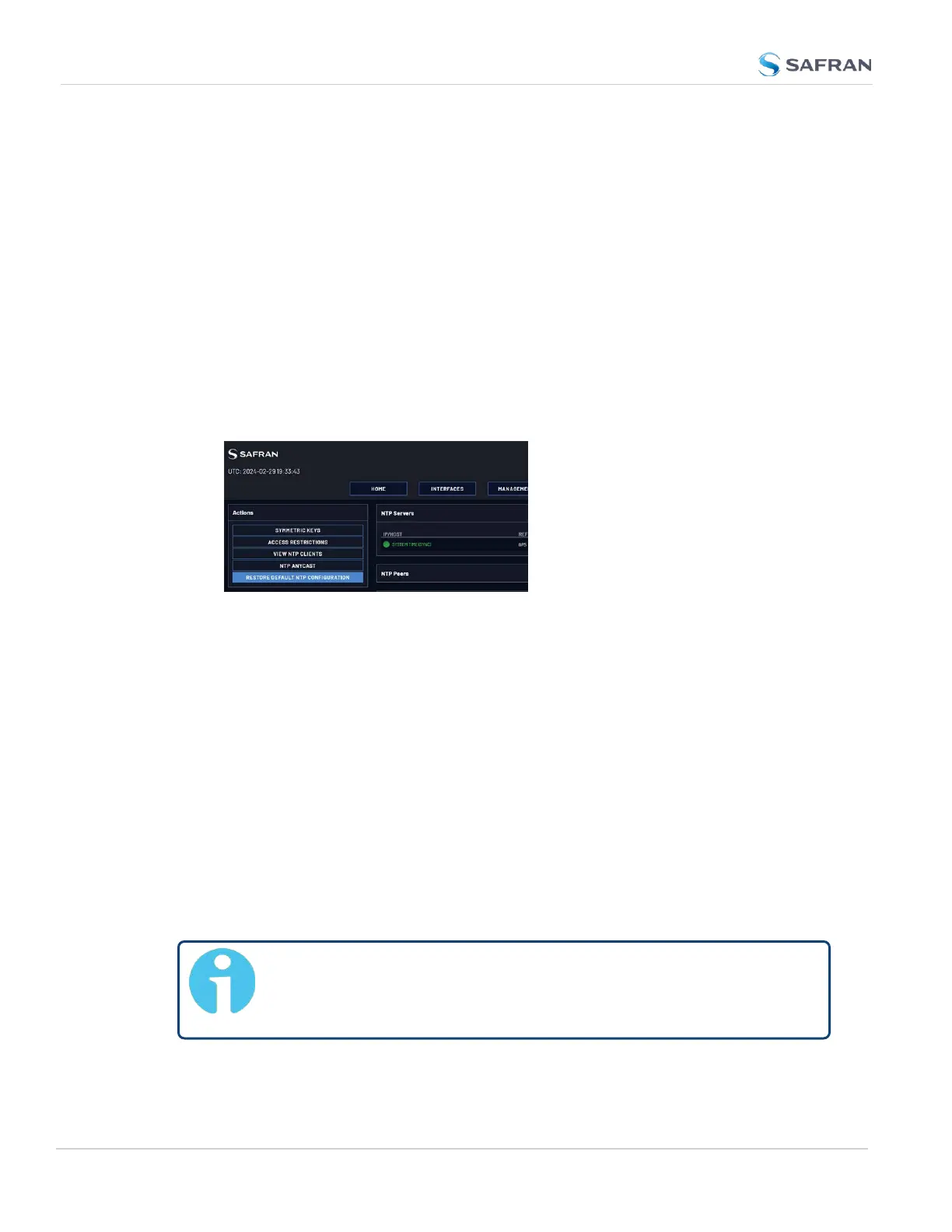
1. Navigate to MANAGEMENT > NETWORK: NTP Setup.
2. In the NTP Actions panel, click Restore Default NTP Configuration.
3. In the dialog window that displays, click OK.
2.8.11.6 NTP Output Timescale
You can choose the timescale VersaSync will use for the time stamps it sends out
to its NTP clients and network nodes. This is done by setting VersaSync
SystemTime timescale. The options are UTC, TAI and GPS. Typically, UTC is used
for network synchronization.
Note that the System Time affects not only NTP output, but also all other aspects
of time management e.g., time distributed via channels other than NTP, logging,
and time displayed in the Web UI.
If VersaSync is operated as a Stratum2 server, i.e. as a client to a Stratum1 server
(see "Configuring "NTP Stratum Synchronization"" on page117), the other server
will override VersaSync's System Timescale, should it be different.
Note: IMPORTANT: Make sure you select your desired timescale!
Using the wrong timescale will inevitably result in an undesired time
error in your NTP clients.
114
CHAPTER 2 • VersaSync User Manual Rev. 12
2.8 Configuring Network Settings



 To Next Page