If a more exact altitude is desired, the use of a topographical map is recom-
mended. Applying the WGS 84 standard will likely yield the most accurate elev-
ation.
3.3.3.10 GNSS Constellations
VersaSync allows you to select which GNSS constellations can be tracked. For
example, you can determine if you want GLONASS satellites to be tracked
(besides GPS).
Selecting GNSS Constellations
Your VersaSync is capable of tracking multiple GNSS constellations sim-
ultaneously.
To verify if satellite signals for the selected GNSS constellations are currently
received, see "Determining Which GNSS Satellites Are Received" on the next
page.
Configuring GNSS Constellations
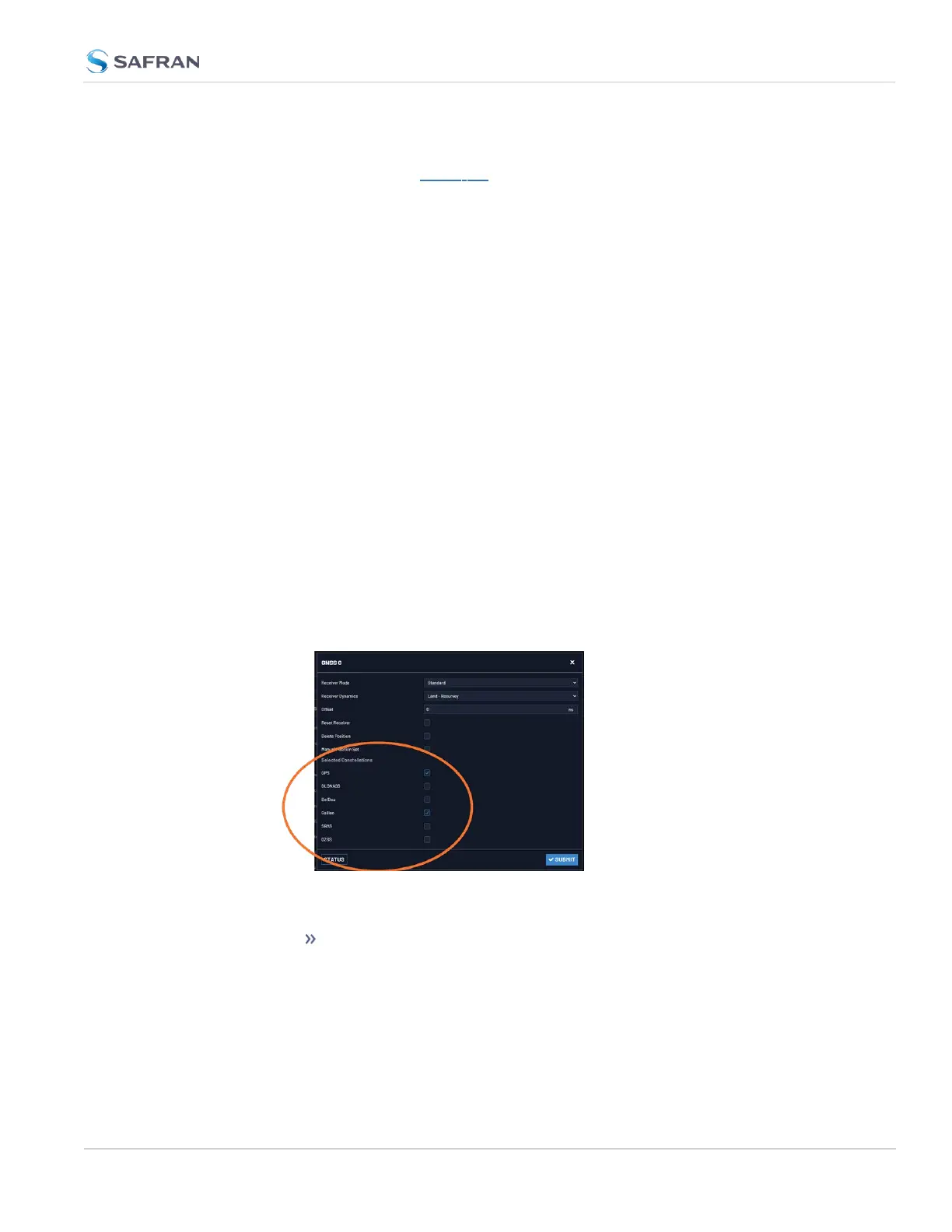
To configure which GNSS constellations VersaSync's GNSSreceiver shall track:
1. Navigate to INTERFACES > REFERENCES: GNSS Reference.
2. Click the GEAR button next to GNSS 0. The GNSS0 window will open:
3. Under Selected Constellations, review which constellations are currently
tracked, and apply your changes. Note the following:
The u-blox M8T receiver is capable of receiving multiple GNSS con-
stellations simultaneously; the table below shows which combinations
are possible:
3.3 Managing References
CHAPTER 3 • VersaSync User Manual Rev. 12
213



 To Next Page