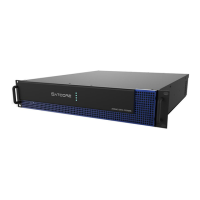
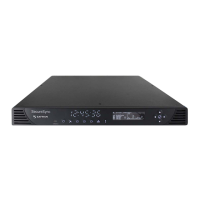
Time Set). See "System Time" on page158 for more information. VersaSync
will go into synchronization using this set time once you click the Submit
button.
Note: You will need to repeat this procedure each time VersaSync is
power-cycled (with no other references available), unless you
enabled the feature Synchronize to Battery Backed Time on Startup.
Example 5—Time at power-up ("Local System Time") to be considered
"Valid". GNSS input to serve as 1PPS reference
The objective of this use case is to allow VersaSync to use itself as a valid ref-
erence. This is referred to as “Local System” time.
In order for this to happen, VersaSync requires an external Time, or 1PPS ref-
erence. In other words, "Local System" cannot be both Time, and 1PPS. This
makes "Local System" a legitimate, traceable reference.
Therefore the "Local System" does not have to be manually set ("validated") by
the User after VersaSync was power cycled (as would be the case with a “User-
/User” reference).
Since “Local System” cannot be both Time, and 1PPS input together, in this
example the GNSS input will be set as the 1PPS reference (other use cases may
require using different references, e.g. IRIG.)
As there is no default entry for “Local System” and “GPS”, a new entry needs to
be added to the Reference Priorities table in order to use this combination of ref-
erences.
Step-by-step procedure:
1. Add a reference to the Reference Priority by clicking the PLUS icon. Use the
following settings, then click Submit:
In the Priority Level text box, enter 1. This will give this reference the
highest priority.
In the Time field, select “Local System”.
In the PPS field, select “GPS”.
Check the Enabled checkbox.
2. Confirm that the first reference in the Reference Priority table has “Local
System” as the Time input and "GNSS" as the 1PPS input.
182
CHAPTER 3 • VersaSync User Manual Rev. 12
3.3 Managing References



 To Next Page