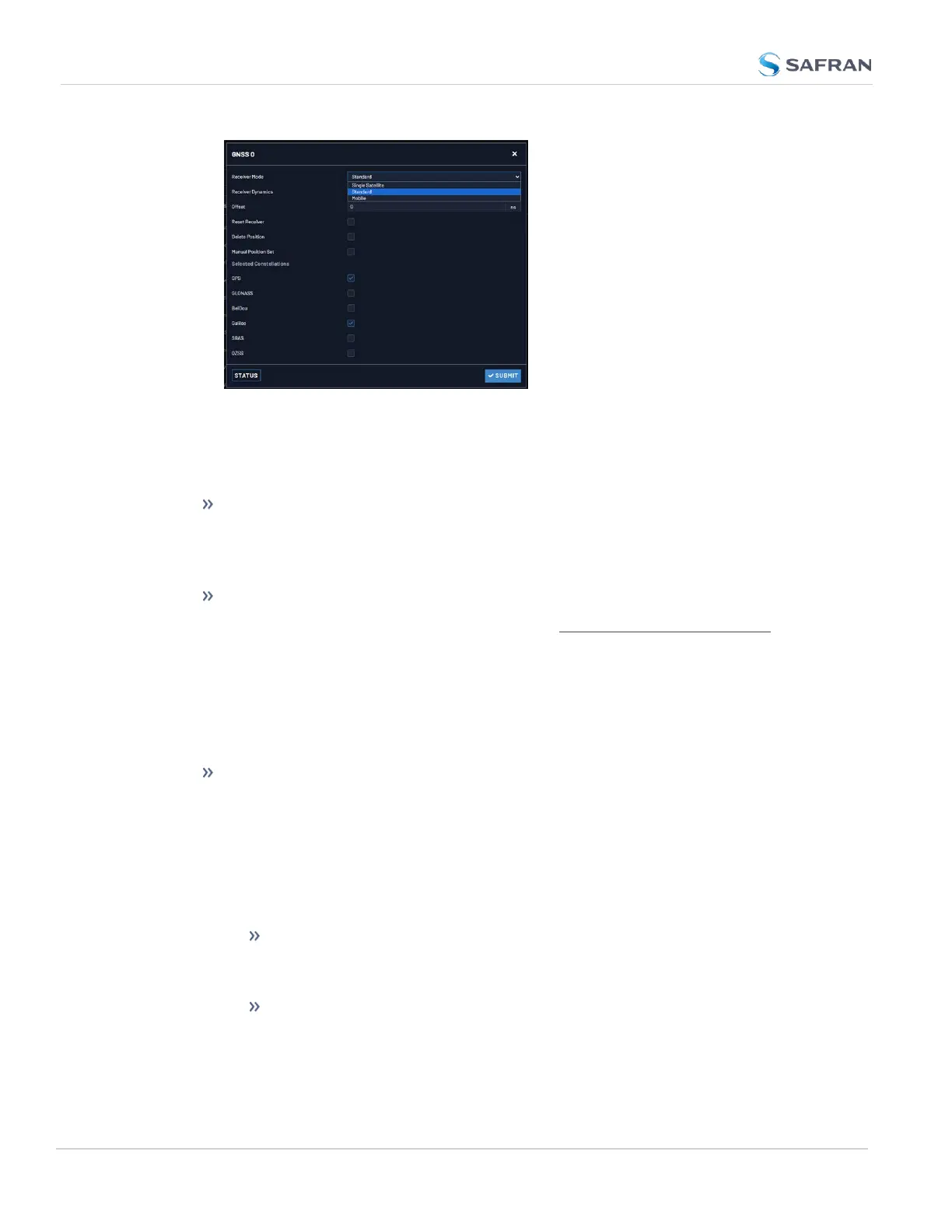
3. Select the desired Receiver Mode, and click Submit.
GNSS Receiver Modes
The receiver modes are:
Mobile Mode: This is the default mode for VersaSync. In Mobile Mode, GNSS
surveys (see below) will NEVER be carried out since the position status is
updated in near real-time. VersaSync will go into synchronization shortly
after beginning to track satellites.
Standard Mode: While the Standard Mode tends to be the most accurate
GNSS Receiver Mode, it can only be used for stationary applications, i.e. the
VersaSync unit must not be moved. In Standard Mode the so-called GNSS
survey will be performed as soon as at least four GNSS satellites become
available and no previously carried out survey was found. Upon completion
of the survey the GNSS receiver will lock-in the calculated position and will
enter Standard Mode. Once the survey is completed, less than four satel-
lites will provide a valid Time and 1PPS signal.
Single Satellite Mode: This mode is designed for stationary applications
which cannot track at least four GNSS satellites for at least 33minutes con-
tinuously in a 12-hour time window so as to complete the GNSS survey. This
occurs frequently in areas with limited view of the sky (e.g., "urban
canyons").
In Single Satellite Mode, the GNSS receiver will be considered a valid input
reference as long as:
you have manually entered a valid position for your antenna location
(instructions can be found under "Manually Setting the GNSS Pos-
ition" on page210 and "Determining Your Position" on page212).
the GNSS receiver continues to track at least one qualified satellite.
202
CHAPTER 3 • VersaSync User Manual Rev. 12
3.3 Managing References



 To Next Page