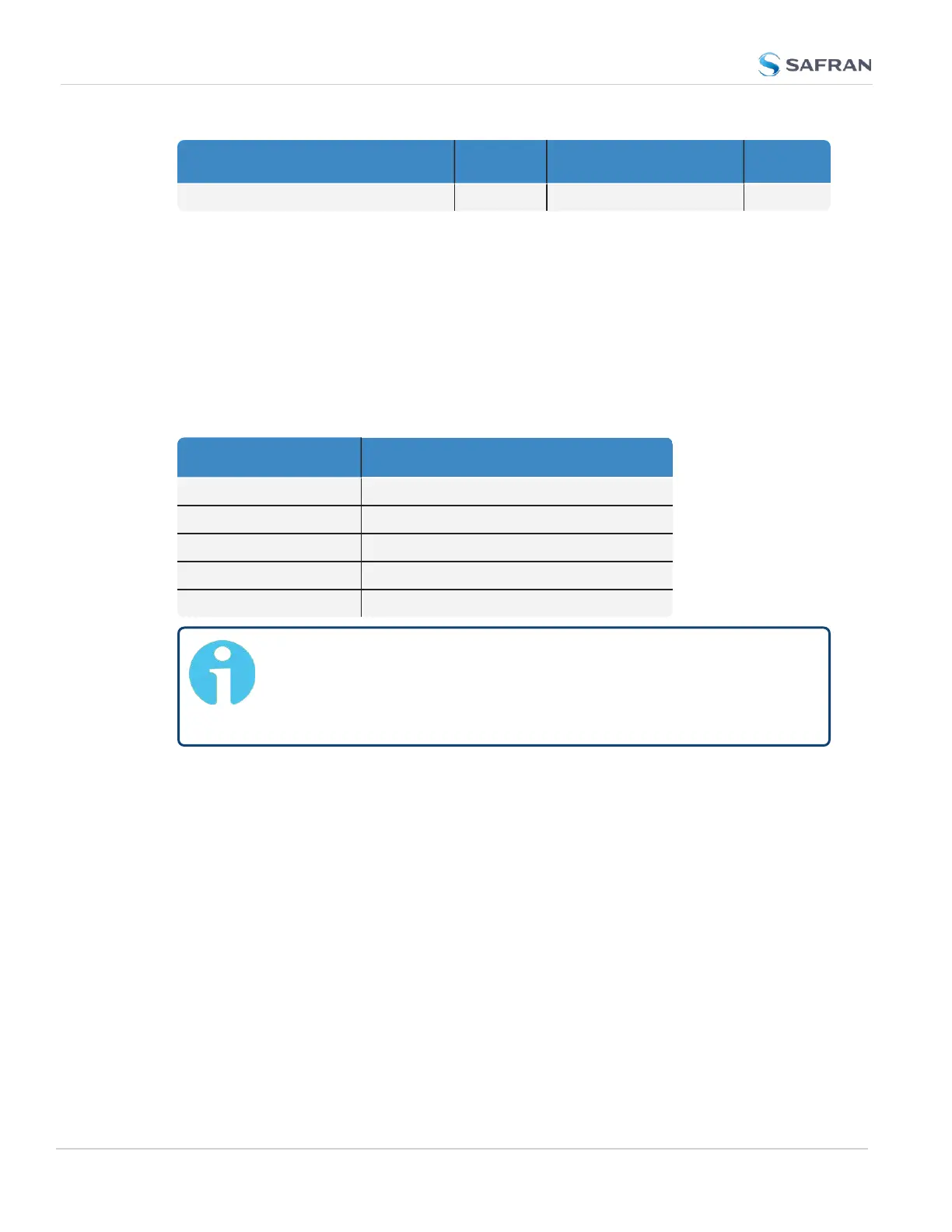
1PPS Phase Drift in Holdover
(no reference available)
OCXO
OCXO
(high performance)
CSAC
- 7 days 1.2 ms 0.6 ms 100 µs
To find out which type of oscillator is installed in your VersaSync, navigate to
MANAGEMENT > OTHER: Disciplining, and look for the line item Oscillator Type
in the Status panel.
Typical Holdover lengths
The length of the allowed Holdover Timeout period is displayed and configured
in seconds. The table below provides example conversions for typically desired
Holdover periods.
Table 3-4:
Typical Holdover lengths in seconds
Desired Holdover Length Holdover Length (in seconds) to be entered
2 hours 7200 seconds (default value)
24 hours 86 400
7 days 604 800
30 days 2 419 200
1 year 29 030 400
Note: Due to Leap Seconds that are periodically inserted into the
UTC and Local timescales, it is not normally recommended to
exceed 30 days of Holdover without an external reference that can
supply Leap Second information being applied (such as GNSS).
Configuring a Holdover value exceeding 30 days could result in a one-second
time error in the UTC or Local timescales until an external reference (GNSS or
IRIG input) is restored or a manually configured Leap Second is asserted by a
user (leap seconds do not affect the GPS and TAI time scales).
If no external references (such as GNSS or IRIG) are available when a Leap
Second is scheduled to occur, manual Leap Seconds can also be applied to the
UTC or Local time base; see "Leap Seconds" on page165.
If the Holdover Timeout has expired, do I need to reset the clock once
GPS becomes available again?
No, the Holdover timer is automatically reset as soon as at least one reference
has been restored/returned for at least one second. If GPS is restored and then
222
CHAPTER 3 • VersaSync User Manual Rev. 12
3.3 Managing References



 To Next Page