1. Navigate to MANAGEMENT > OTHER: Disciplining.
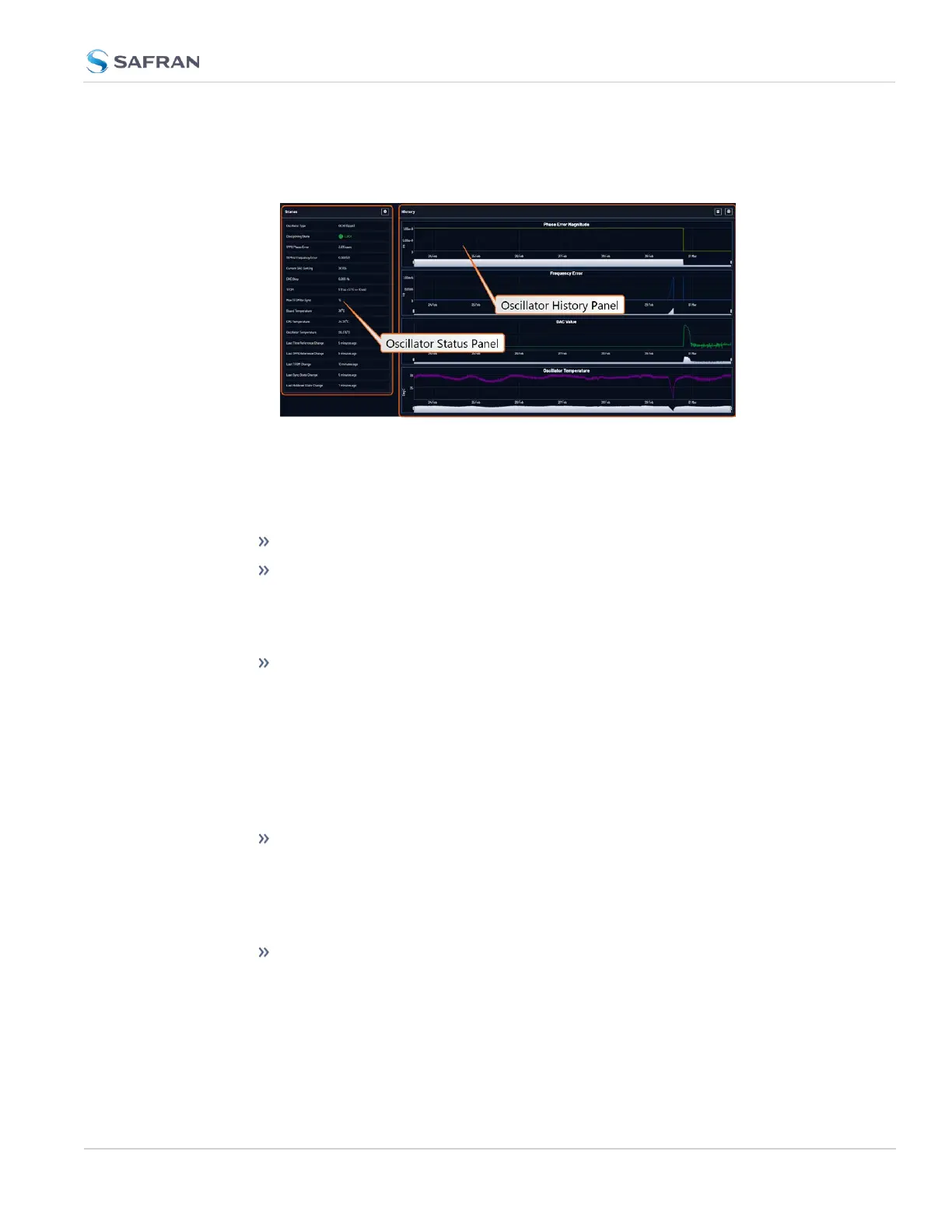
2. The Oscillator Management screen will display. It consists of two panels:
The Oscillator Status Panel
This panel provides comprehensive information on the current status of Ver-
saSync's timing state.
Oscillator Type: Type of oscillator installed in the unit.
Disciplining State: State of oscillator control and disciplining; indicates
whether or not the internal oscillator is currently being disciplined (steered
to an input reference). The states are: "Warm up", "Calibration", "Tracking
Setup", "Lock State", "Freerun", and "Fault".
1PPS Phase Error: A tracking measurement [scaled time, in ns, or ms] of the
internal 1PPSs' phase error with respect to the selected input reference.
Long holdover periods or an input reference with excessive jitter will cause
the phase error to be high. The oscillator disciplining control will gradually
reduce the phase error over time. Alternatively, restarting the tracking
manually (see "Restart Tracking" under "Configuring the Oscillator" on
page223), or automatically via a pre-set Phase Error Limit, will quickly
reduce the phase error.
10 MHz Frequency Error: An internal estimated calculation (in Hertz) of the
internal oscillator's frequency error, based on the phase accuracy error at
the beginning and end of a frequency measurement window (the length of
this window will vary depending upon the type of oscillator installed and
the oscillator adjustment algorithm).
Current DAC Setting: Current DAC value, as determined by the oscillator
disciplining system. The value is converted into a voltage that is used to dis-
cipline the oscillator. A stable value over time is desirable and suggests
steady oscillator performance (see also the graph in the History Panel).
3.4 Managing the Oscillator
CHAPTER 3 • VersaSync User Manual Rev. 12
227



 To Next Page