ENGINE GENERAL INFORMATION AND DIAGNOSIS (M13 ENGINE) 6-2-113
DTC Confirmation Procedure
1) With ignition switch turned OFF, connect scan tool.
2) Turn ON ignition switch and clear DTC using scan tool.
3) Crank engine for 3 – 5 sec.
4) Check DTC and pending DTC.
Troubleshooting
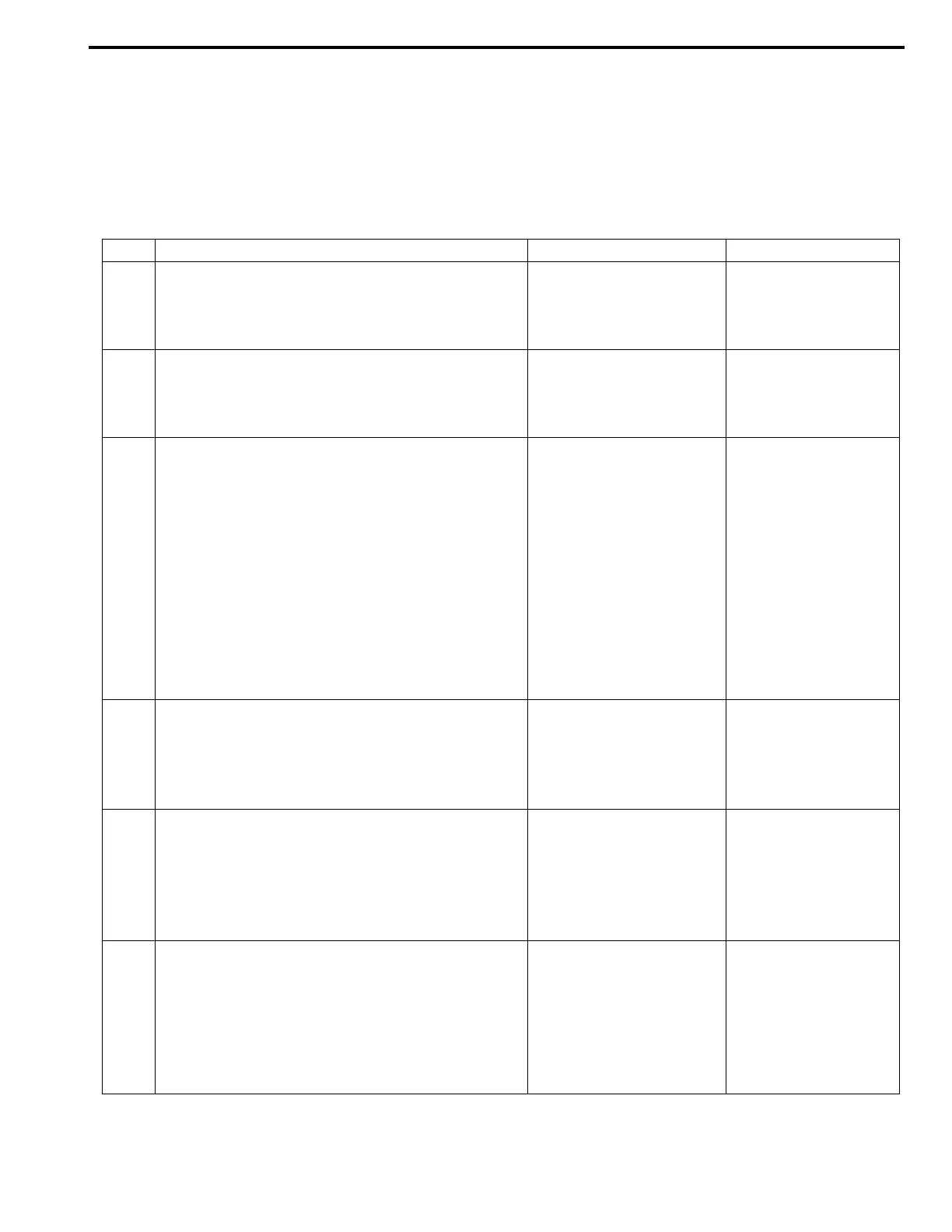
Step Action Yes No
1Was “Engine and Emission Control System
Check” performed?
Go to Step 2. Go to “Engine and
Emission Control Sys-
tem Check” in this sec-
tion.
2 Check CKP sensor and connector for proper
installation.
Is CKP sensor installed properly and connector
connected securely?
Go to Step 3. Correct.
3 Check Wire Harness and Connection.
1) Disconnect connector from CKP sensor.
2) Check for proper connection to CKP sensor at
“BLK/RED”, “PNK” and “BLK” wire terminals.
3) If OK, turn ignition switch ON and check for
voltage at “BLK/RED”, “PNK” and “BLK” wire
terminals of disconnected CKP sensor con-
nector. See fig. 1.
Te r m i n a l “B+”: 10 – 14 V
Te r m i n a l “Vout”: 4 – 5 V
Te r m i n a l “GRD”: 0 V
Is check result satisfactory?
Go to Step 5. Go to Step 4.
4Was terminal “Vout” voltage in Step 3 out of speci-
fication?
“PNK” wire open, short or
poor connection.
If wire and connection are
OK, substitute a known-
good ECM and recheck.
“BLK/RED” and “BLK”
wire open, short or
poor connection.
5 Check Ground Circuit.
1) Turn ignition switch to OFF position.
2) Measure resistance between “BLK” wire termi-
nal of CKP sensor connector and engine
ground.
Is resistance below 5
Ω
?
Go to Step 6. “BLK” wire open or
high resistance.
6 Check Engine Start Signal.
1) Check voltage between “E22-35” wire terminal
of ECM connector and engine ground with
engine cranking.
Does it voltage more than 6 V?
Go to Step 7. “BLK/YEL” wire circuit
open, high resistance
or shorted to ground.
If wire are OK, check
starting motor refer-
ring to “Performance
Test” in Section 6G.









 To Next Page