R&S
®
ZVA / R&S
®
ZVB / R&S
®
ZVT GUI Reference
Trace Menu
Operating Manual 1145.1084.12 – 30 119
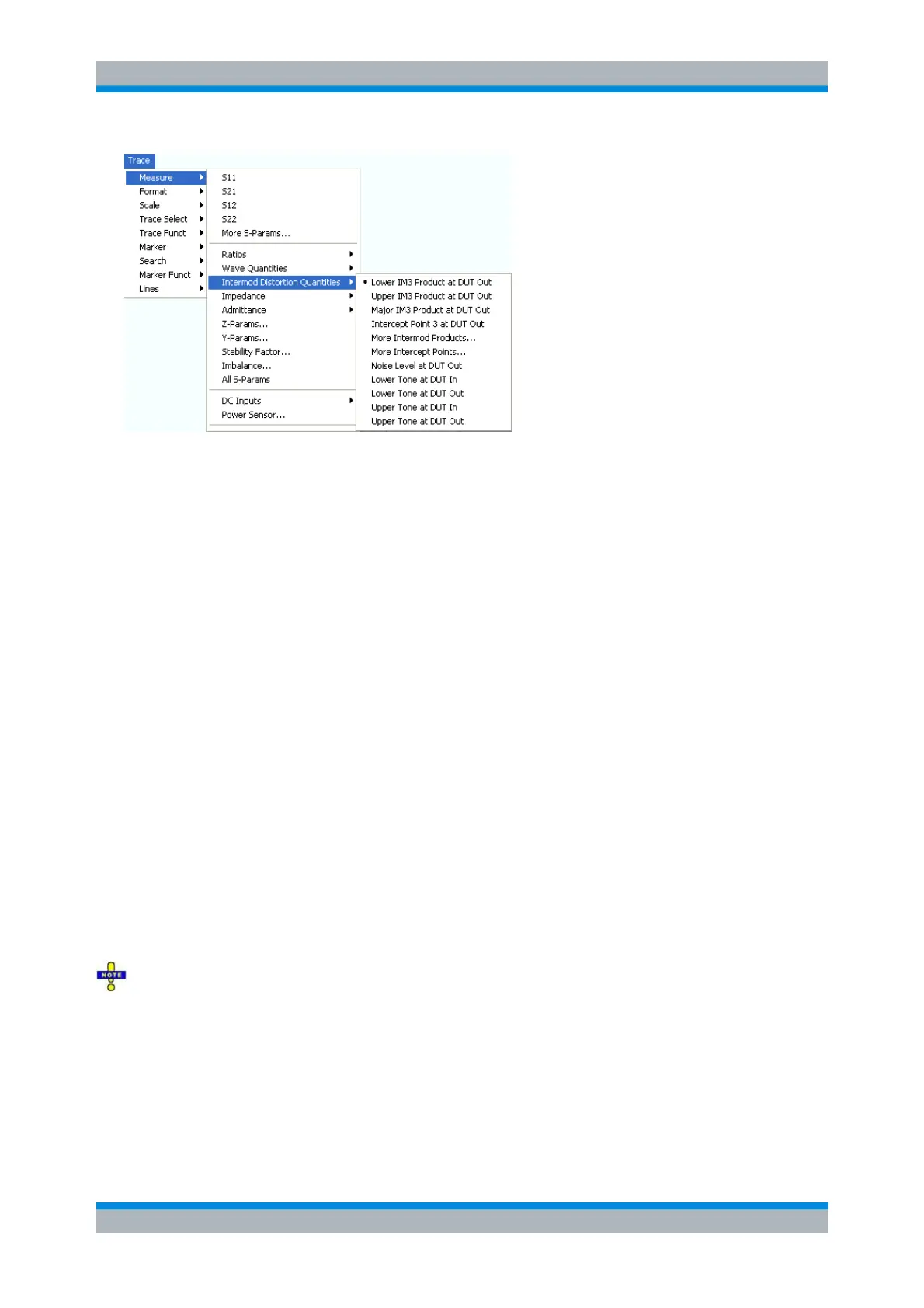
The Lower IM3 Product at DUT Out is the third-order lower intermodulation product at the output
of the DUT. This quantity corresponds to the outgoing wave quantity (b wave) at the output of the
DUT, measured at the frequency of the lower tone minus the tone distance. The lower IM3
frequency is also displayed in the Set Frequencies and Powers dialog.
The Upper IM3 Product at DUT Out is the third-order upper intermodulation product at the output
of the DUT. This quantity corresponds to the outgoing wave quantity (b wave) at the output of the
DUT, measured at the frequency of the upper tone plus the tone distance.
The Major IM3 Product at DUT Out is the lower or upper IM3 product at DUT out, whichever is
larger. The Major IM3 Product reveals the worst-case performance of the DUT.
The Intercept Point 3 at DUT Out is the third-order intercept point at the output of the DUT. This
quantity corresponds to the fictitious DUT output level (Lower Tone at DUT Out), measured at the
lower tone frequency, where the major third-order intermodulation suppression (the ratio of the
Major IM3 Product at DUT Out to the Lower Tone at DUT Out) reaches 0 dB (see background
information above).
More Intermod Products opens a dialog to select intermodulation products of higher order and
intermodulation products which are measured at the input of the DUT.
More Intercept Points opens a dialog to select intercept points of higher order and intercept points
which are measured at the input of the DUT.
Noise Level at DUT Out is a measure for the noise level and therefore the dynamic range of the
intermodulation distortion measurement. The noise level is measured at the frequency of the
lower tone minus 4/9 times the tone distance.
Lower Tone at DUT In, Lower Tone at DUT Out, Upper Tone at DUT In, Upper Tone at DUT Out
is a measurement of the two fundamental waves that are used for the intermodulation
measurement either at the DUT input or the DUT output.
The measurement of higher-order intermodulation products should be enabled explicitly in the Define
Intermodulation Distortion Measurement dialog, otherwise no calibration will be performed for these
products.
The labels for the intermodulation quantities in the trace list are identical to the parameters used for
remote control; see CALCulate<Ch>:PARameter:SDEFine "<Trace_Name>", "IP3LI" |
"IM3LI" | "LTI" | ....


 To Next Page