R&S
®
ZVA / R&S
®
ZVB / R&S
®
ZVT GUI Reference
Trace Menu
Operating Manual 1145.1084.12 – 30 123
measurements.
Z <– S11, Z <– S12, Z <– S21, Z <– S22
Select the 2-port converted impedance parameters. The parameters describe the impedances of a 2-port
DUT, obtained in forward and reverse transmission and reflection measurements:
Z
11
is the input impedance at port 1 of a 2-port DUT that is terminated at port 2 with the reference
impedance Z
0
(matched-circuit impedance measured in a forward reflection measurement).
Z
22
is the input impedance at port 2 of a 2-port DUT that is terminated at port 1 with the reference
impedance Z
0
(matched-circuit impedance measured in a reverse reflection measurement).
Z
12
and Z
21
denote the forward and reverse converted transfer impedances, respectively.
The analyzer also provides converted impedances for more drive ports or balanced port configurations;
see More Impedances.
Use the More Z-Parameters dialog to measure Z-parameters including the transfer parameters. Use
the Smith chart to obtain an alternative, graphical representation of the converted impedances in a
reflection measurement.
CALCulate<Ch>:PARameter:MEASure "<Trace_Name>", "Z-S11" | "Z-S12"
| "Z-S21" | "Z-S22"
[SENSe<Chn>:]FUNCtion[:ON] "...:POWer:Z<11 | 12 | 21 | 22>"
Create new trace and select name and measurement parameter:
CALCulate<Ch>:PARameter:SDEFine "<Trace_Name>", "Z-S11" | "Z-S12"
| "Z-S21" | "Z-S22"
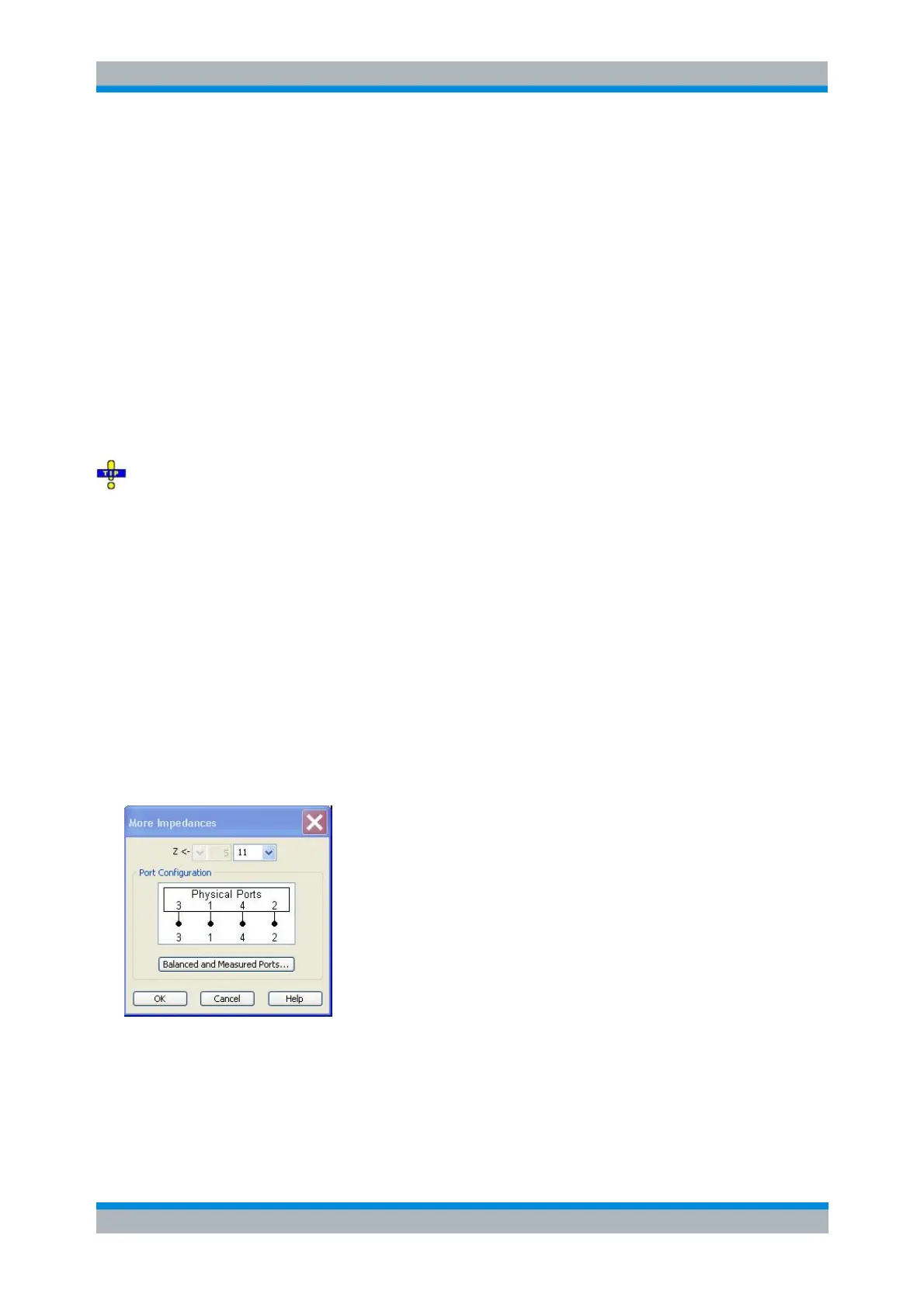
More Impedances
Opens a dialog to select converted impedance parameters for more ports or balanced port
measurements.
The notation for converted impedance parameters and the functionality of the More Impedances dialog is
analogous to the definition of S-parameters.
Z<— selects the type (left pull-down list) and the port number assignment (right pull-down list) of
the impedance parameter. Mixed mode parameters are only available if a balanced port
configuration is active. They are expressed as Y
<mout><min>
, where <mout> and <min> denote the
output and input port modes. The port numbers are assigned in the order Y
<out>< in>
, where <out>


 To Next Page