R&S
®
ZVA / R&S
®
ZVB / R&S
®
ZVT GUI Reference
Trace Menu
Operating Manual 1145.1084.12 – 30 143
Calculation of Δf and ΔΦ
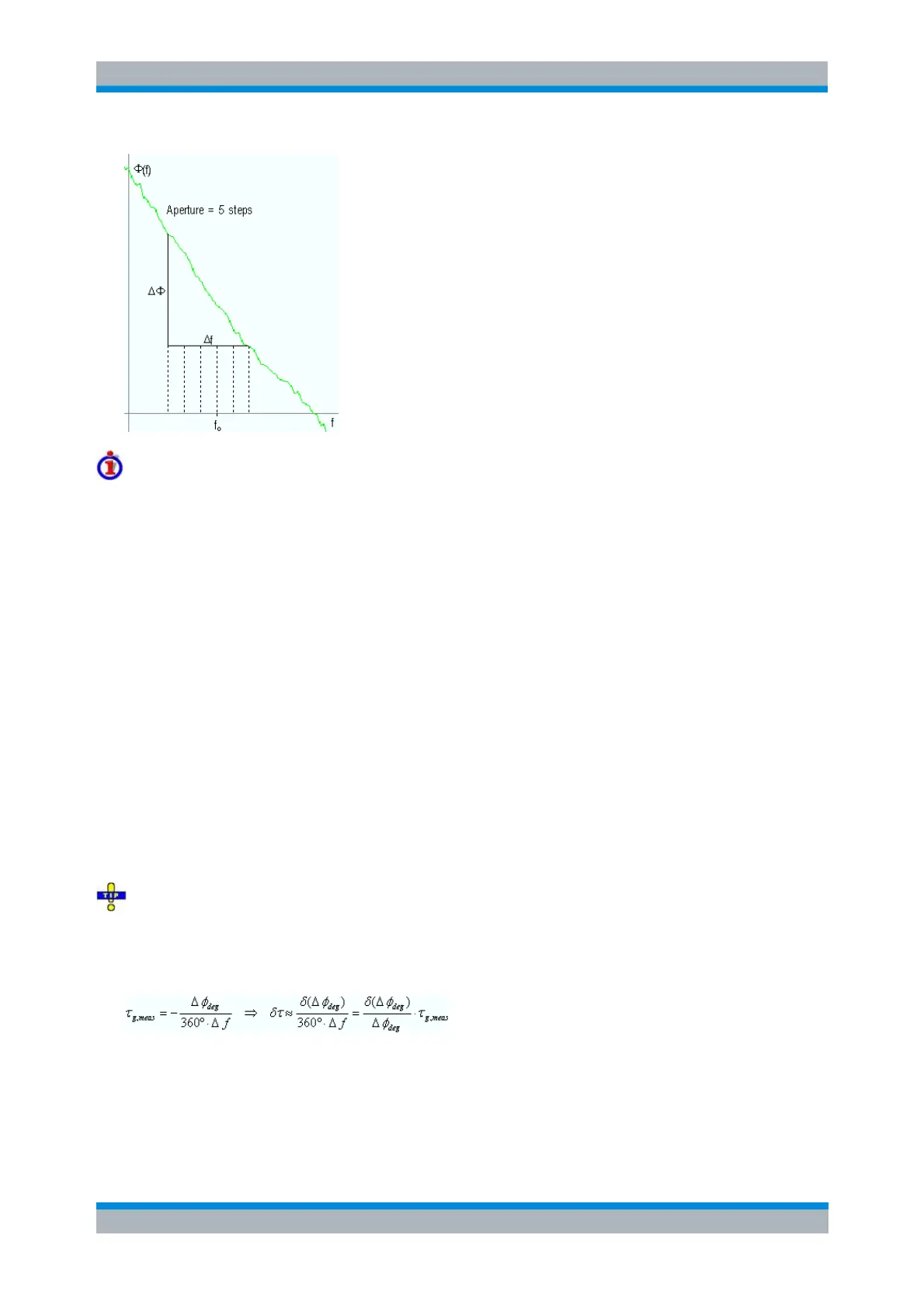
With a given number of aperture steps n the delay at sweep point no. m is calculated as follows:
If n is even (n = 2k), then Δf (m) = f (m+k) – f (m–k) and ΔΦ(m) = ΔΦ (m+k) – ΔΦ (m–k).
If n is odd (n = 2k+1), then Δf (m) = f (m+k) – f (m–k–1) and ΔΦ (m) = ΔΦ (m+k) – ΔΦ (m–k–1).
The calculated phase difference (and thus the group delay) is always assigned to the frequency point no.
m. For linear sweeps and odd numbers of aperture steps, the center of the aperture range is [f (m+k) + f
(m–k–1)] / 2 = f (m–1/2), i.e. half a frequency step size below the sweep point f (m). This is why toggling
from even to odd numbers of aperture steps and back can virtually shift the group delay curve towards
higher/lower frequencies. It is recommended to use even numbers of aperture steps, especially for large
frequency step sizes.
The delay calculation is based on the already measured sweep points and does not slow down the
measurement.
Δf is constant over the entire sweep range, if the sweep type is a Lin. Frequency sweep. For Log.
Frequency and Segmented Frequency sweeps, it varies with the sweep point number m.
Application The aperture must be adjusted to the conditions of the measurement. A small aperture
increases the noise in the group delay; a large aperture tends to minimize the effects of noise and phase
uncertainty, but at the expense of frequency resolution. Phase distortions (i.e. deviations from linear
phase) which are narrower in frequency than the aperture tend to be smeared over and cannot be
measured.
Finding an optimum aperture
The measurement uncertainty δτ of the delay τ is essentially due to the uncertainty of the phase
measurement. Other effects, such as the frequency uncertainty of the analyzer, are negligible. From the
definition of the measured delay:
From this equation, we can draw the following conclusions:
The accuracy of the group delay measurement is proportional to the aperture Δf; the uncertainty
of the delay due to phase uncertainties increases when the aperture is reduced.
If the aperture Δf approaches a value of δ(ΔΦ)/(360° . τ
g,meas
), then the delay uncertainty is


 To Next Page