R&S
®
ZVA / R&S
®
ZVB / R&S
®
ZVT GUI Reference
Channel Menu
Operating Manual 1145.1084.12 – 30 255
[SENSe<Ch>:]SWEep:TYPE LINear
[SENSe<Chn>:]FUNCtion[:ON] "XFRequency:..."
Log. Frequency
In a Log. Frequency sweep the stimulus frequency is swept on a logarithmic scale over the continuous
frequency range. The frequency range (sweep range) is defined with the Stimulus settings. The sweep
points are calculated from the Span and the specified Number of Points (n > 1) with the condition that the
step width is constant on the logarithmic scale. The internal generator power can be set, if so desired, in
the Power Bandwidth Average submenu.
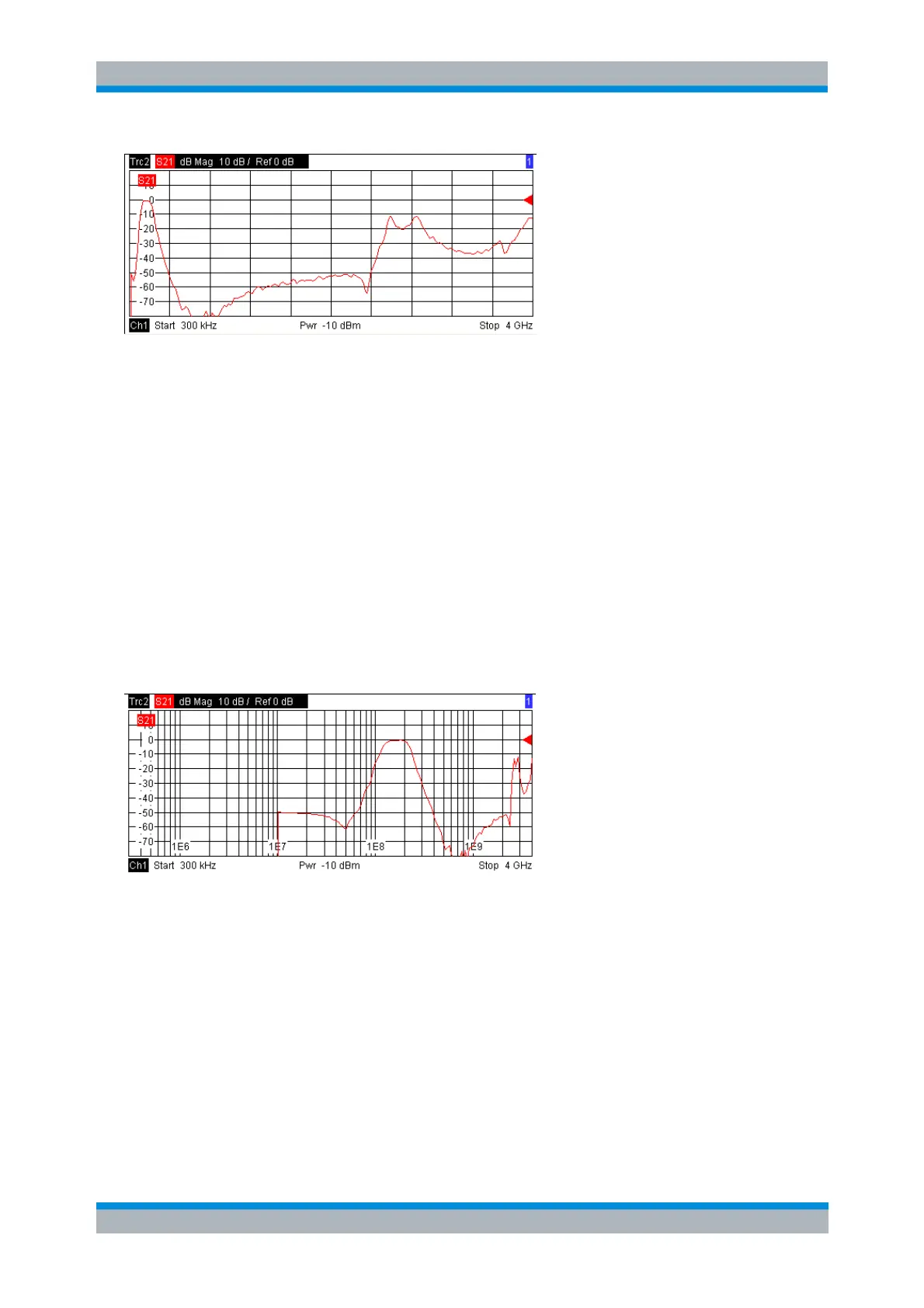
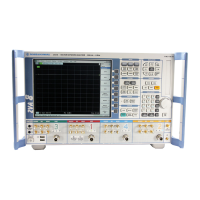
Log Frequency sweeps are suitable for the analysis of a DUT over a large frequency range, e.g. over
several octaves. In a Cartesian diagram the measurement result is displayed as a trace over a logarithmic
frequency scale. The following example shows a Log. Frequency sweep with a stimulus range between 50
MHz and 6 GHz, the forward transmission parameter S
21
as measured quantity, and a dB Mag scaled y-
axis.
[SENSe<Ch>:]SWEep:TYPE LOGarithmic
[SENSe<Chn>:]FUNCtion[:ON] "XFRequency:..."
Segmented Frequency
In a Segmented Frequency sweep the sweep range can be composed of several continuous frequency
sub-ranges or single frequency points. The sub-ranges are termed sweep segments and defined in the
Define Segments dialog. Sweep segments may overlap. The segment list must contain at least 2 distinct
frequency points before a Segmented Frequency sweep can be started.
Instrument settings such as the internal generator power, the measurement (IF) bandwidth, the selectivity
of the measurement filter, the frequency band of the local oscillator, and the measurement time can be set


 To Next Page