R&S
®
ZVA / R&S
®
ZVB / R&S
®
ZVT GUI Reference
Trace Menu
Operating Manual 1145.1084.12 – 30 146
schwarz.com/en/products/test_and_measurement/network_analysis/?_view=downloads&downloadtype=2
0&type=20&downid=1550
CALCulate<Chn>:GDAPerture:SCOunt
SWR
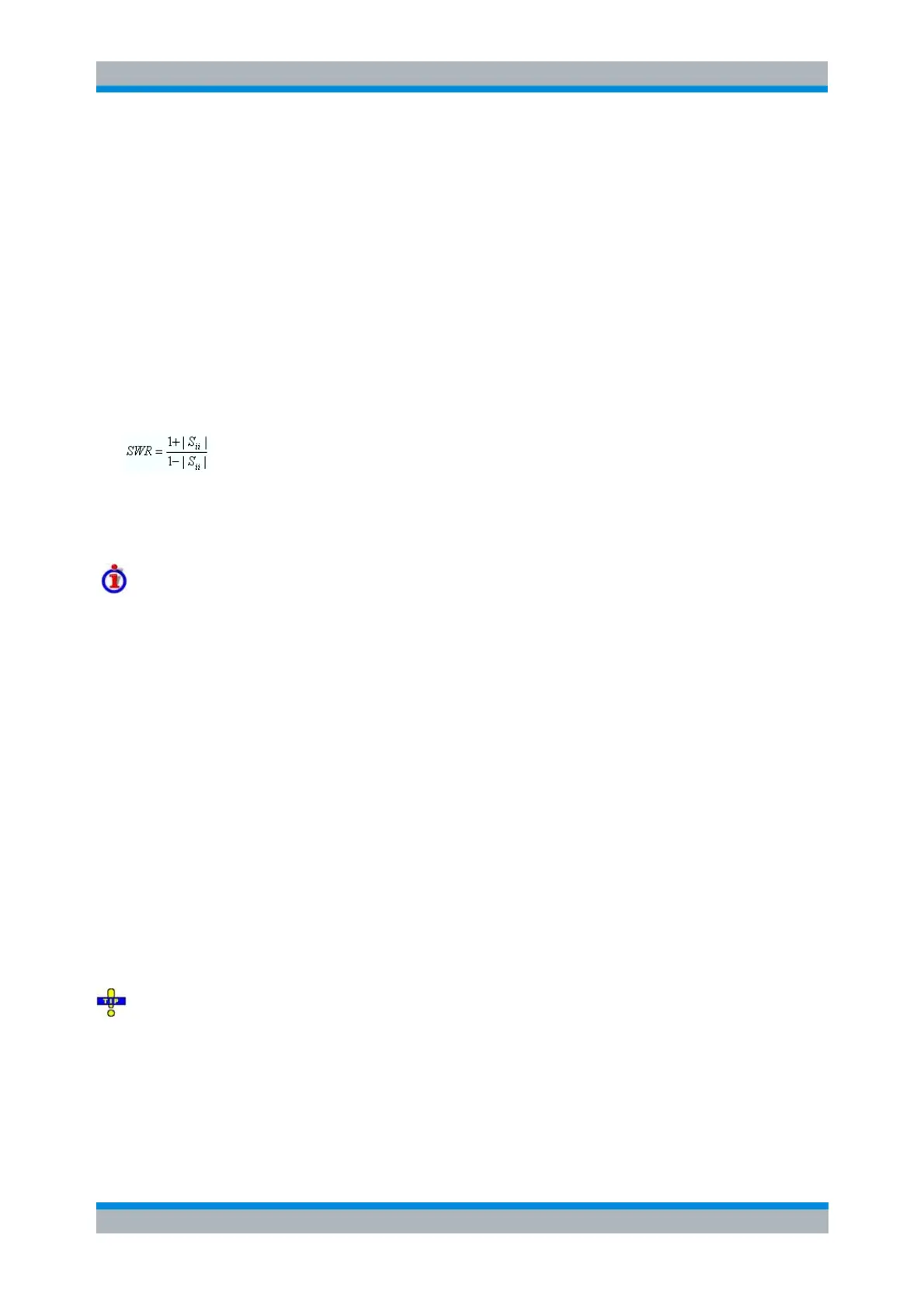
Calculates the Standing Wave Ratio (SWR) from the measured quantity (primarily: from a reflection S-
parameter) and displays it in a Cartesian diagram.
Properties: The SWR (or Voltage Standing Wave Ratio, VSWR) is a measure of the power reflected at
the input of the DUT. It is calculated from the magnitude of the reflection coefficients S
ii
(where i denotes
the port number of the DUT) according to:
The superposition of the incident and the reflected wave on the transmission line connecting the analyzer
and the DUT causes an interference pattern with variable envelope voltage. The SWR is the ratio of the
maximum voltage to the minimum envelope voltage along the line.
Interpretation of the SWR
The superposition of the incident wave I and the reflected wave R on the transmission line connecting the
analyzer and the DUT causes an interference pattern with variable envelope voltage. The SWR is the ratio
of the maximum voltage to the minimum envelope voltage along the line:
SWR = V
Max
/V
Min
= (|V
I
| + |V
R
|) / (|V
I
| – |V
R
|) = (1 + |S
ii
|) / (1 – |S
ii
|)
Application: Reflection measurements with conversion of the complex S-parameter to a real SWR.
CALCulate<Chn>:FORMat SWR
Lin Mag
Selects a Cartesian diagram with a linear vertical axis scale to display the magnitude of the measured
quantity.
Properties: The stimulus variable appears on the horizontal axis, scaled linearly. The magnitude of the
complex quantity C, i.e. |C| = sqrt ( Re(C)
2
+ Im(C)
2
), appears on the vertical axis, also scaled linearly.
Application: Real measurement data (i.e. the Stability Factors, DC Input 1/2, and the PAE) are always
displayed in a Lin Mag diagram.
Alternative Formats
The magnitude of each complex quantity can be displayed on a logarithmic scale. It is possible to view the
real and imaginary parts instead of the magnitude and phase.
CALCulate<Chn>:FORMat MLINear


 To Next Page