R&S
®
ZVA / R&S
®
ZVB / R&S
®
ZVT GUI Reference
Trace Menu
Operating Manual 1145.1084.12 – 30 183
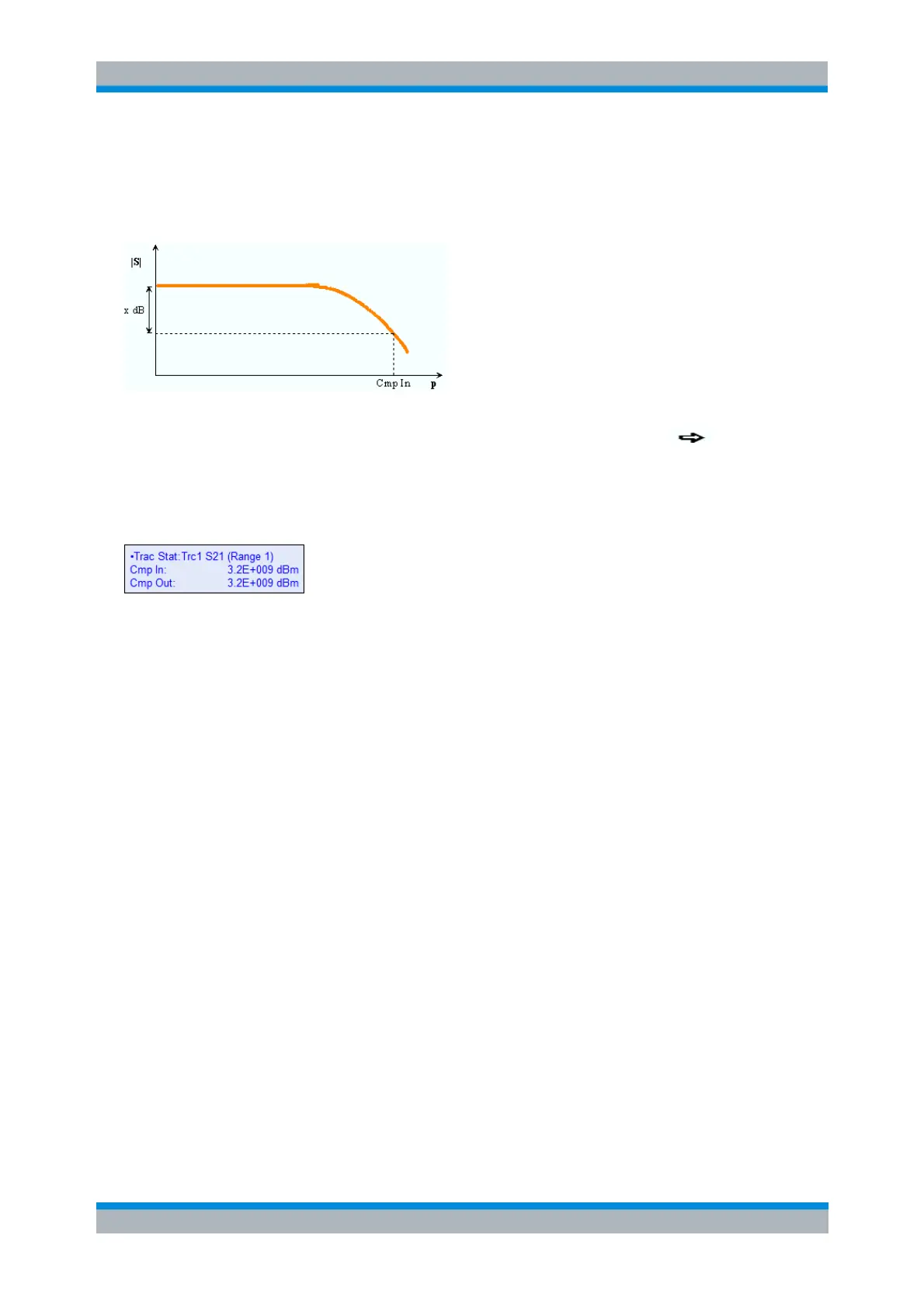
The x-dB compression point of an S-parameter or ratio is the stimulus signal level where the magnitude of
the measured quantity has dropped by x dB compared to its value at small stimulus signal levels (small-
signal value). As an approximation for the small-signal value, the analyzer uses the value at the start level
of the evaluation range.
The compression point is a measure for the upper edge of the linearity range of a DUT. It is close to the
highest input signal level for which the DUT shows a linear response (|a
n
| —> x*|a
n
| |b
n
| —> x*|b
n
|,
so that the magnitude of all S-parameters remains constant).
When Compression Point is activated, a marker labeled Cmp is placed to compression point with the
smallest stimulus level. Moreover the Trace Statistics info field shows the numerical results of the
compression point measurement:
Cmp In is the stimulus level at the compression point in units of dBm. Cmp In always corresponds
to the driving port level (e.g. the level from port no. j, if a transmission parameter S
ij
is measured).
Cmp Out is the sum of the stimulus level Cmp In and the magnitude of the measured response
value at the compression point.
The magnitude of a transmission S-parameter S
ij
is a measure for the attenuation (or gain) of the
DUT, hence: Cmp Out = Cmp In + <Attenuation>. The example above is based on an attenuation
of –14 dB, hence Cmp Out = –39.4 dB – 14 dB = –53.4 dBm.
The info field shows invalid results ('---') if the wrong sweep type or trace format is selected, or if the trace
contains no x-dB compression points in the selected evaluation range.
CALCulate:STATistics:NLINear:COMP[:STATe]
CALCulate:STATistics:NLINear:COMP:RESult?
Define Compression Value
Opens the numeric entry bar to define the compression value x (in dB) for the compression point
measurement.
CALCulate:STATistics:NLINear:COMP:LEVel
Gain/Slope/Flatness
Displays or hides trace parameters that the analyzer calculates for the current evaluation range. If no
evaluation range is defined, the parameters apply to the sweep range.


 To Next Page