R&S
®
ZVA / R&S
®
ZVB / R&S
®
ZVT GUI Reference
Trace Menu
Operating Manual 1145.1084.12 – 30 182
Definition of phase parameters
The phase parameters are obtained from an approximation to the derivative of the phase with respect to
frequency in the selected evaluation range.
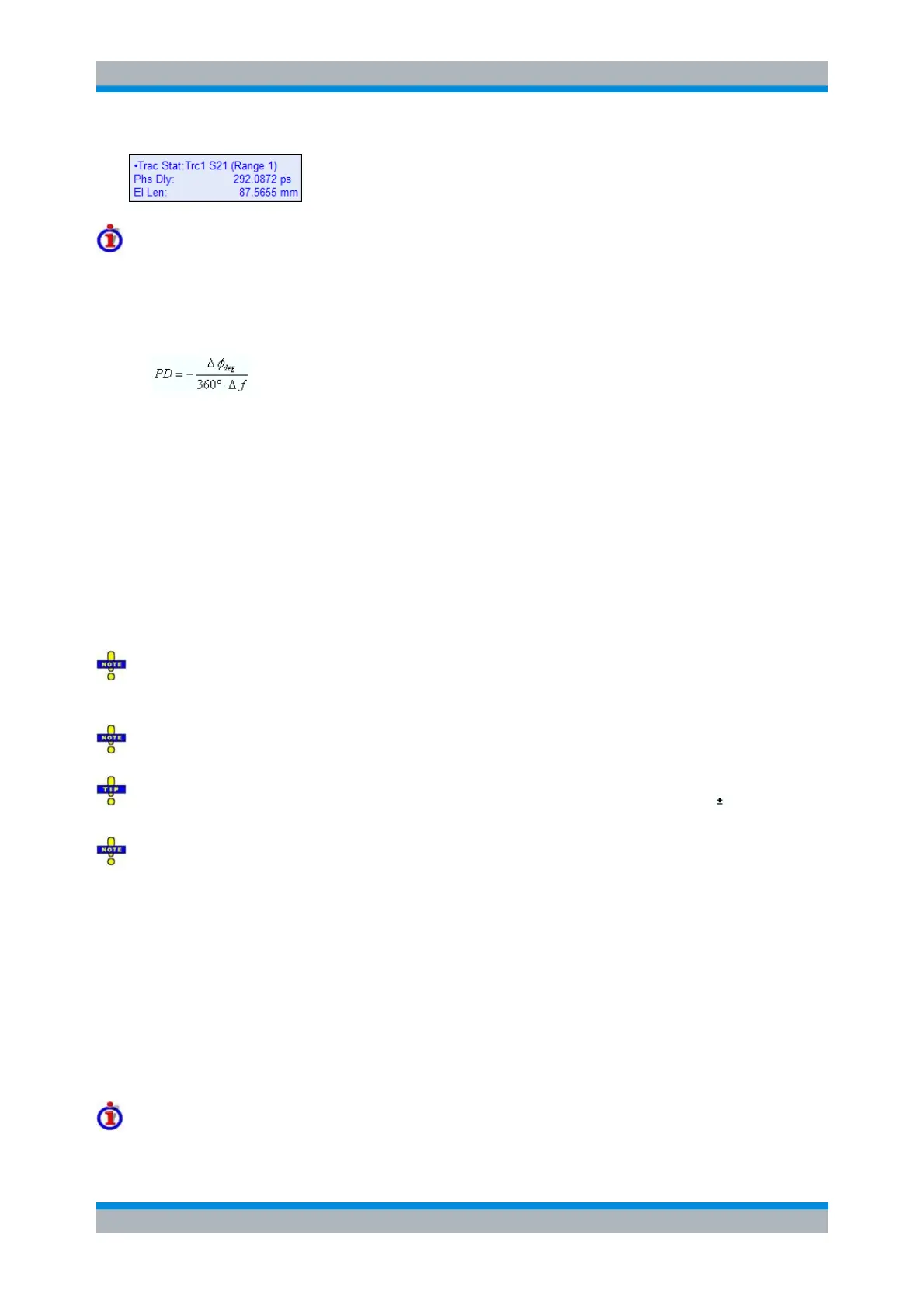
Delay is the phase delay, which is an approximation to the group delay and calculated as follows:
,
where Δf is the width of the evaluation range and is the corresponding phase change.
Rather than calculating Δf from the unwrapped phase values at the start and stop frequency, a
regression line is fitted to the unwrapped phase trace and the slope of this regression line is used
instead.
EL is the electrical length, which is the product of the phase delay times the speed of light in the
vacuum.
If no dispersion occurs the phase delay is equal to the group delay. For more information see
mathematical relations.
If a dispersive connector type (i.e. a waveguide; see Offset Model dialog) is assigned to a test port related
to a particular quantity, then the dispersion effects of the connector are taken into account for the
calculation of the phase delay and the electrical length.
To account for the propagation in both directions, the delay and the electrical length of a reflection
parameter is only half the delay and the electrical length of a transmission parameter. The formula for PD
above is for transmission parameters. See also introduction to section Channel – Offset.
The phase parameters are available only if the evaluation range contains at least 3 measurement
points.
The phase evaluation can cause misleading results if the evaluation range contains a 360 deg phase
jump. The trace format Unwrapped Phase avoids this behavior.
The delay for reflection factors corresponds to the transmission time in one direction; see Offset –
Auto Length – Length and Delay Measurements.
CALCulate<Chn>:STATistics[:STATe]
CALCulate<Chn>:STATistics:RESult? ELENgth | PDELay
CALCulate<Chn>:STATistics:EPDelay[:STATe]
Compression Point
Displays or hides all results related to the x-dB compression point of the trace, where x is the selected
compression value. To obtain valid compression point results, a power sweep must be active, and the
trace format must be dB Mag.
Compression point


 To Next Page