R&S
®
ZVA / R&S
®
ZVB / R&S
®
ZVT GUI Reference
Trace Menu
Operating Manual 1145.1084.12 – 30 190
The network analyzer tries to ensure consistency of the exported data sets. The following conditions must
be met for a Touchstone file export:
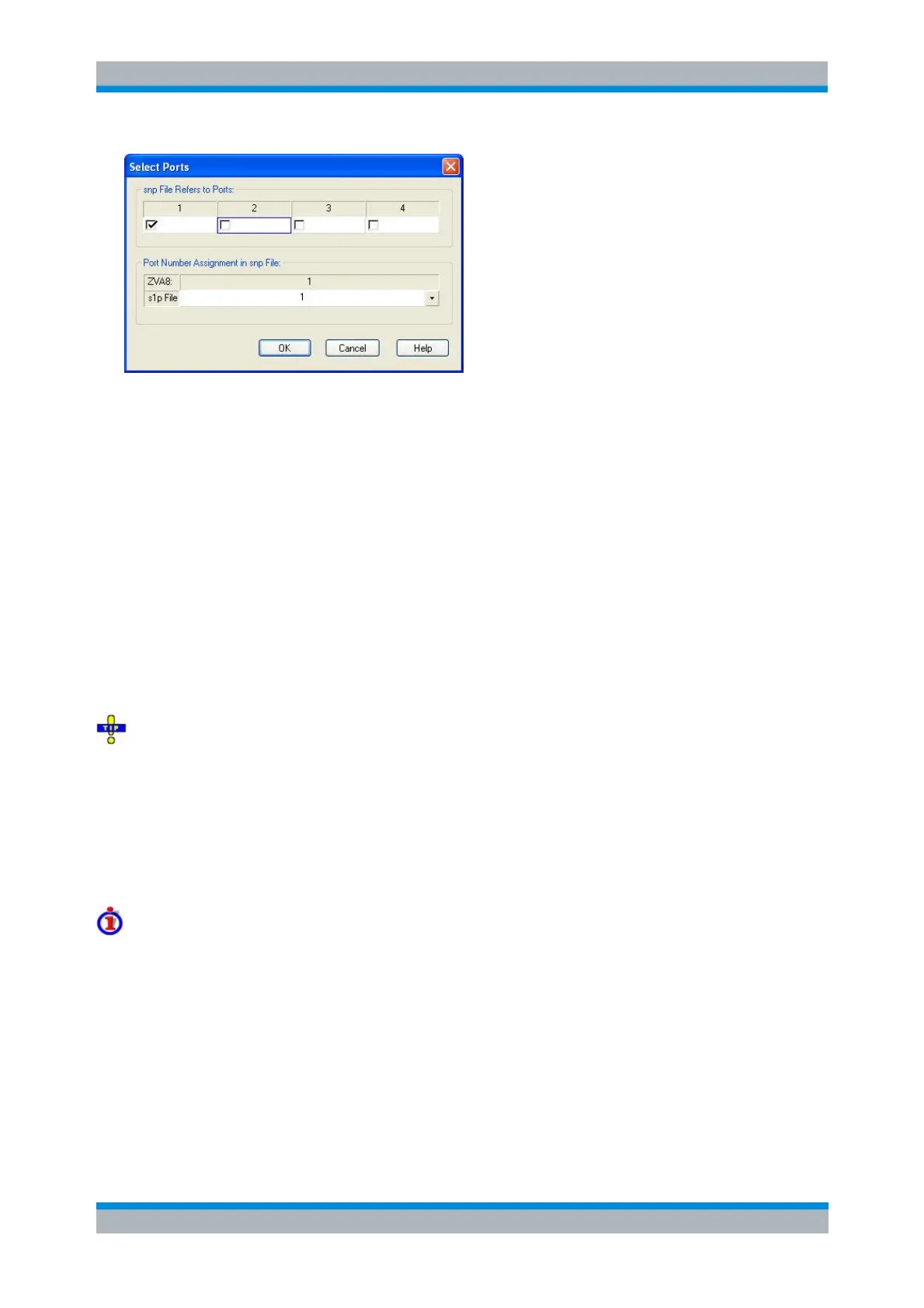
For a one-port Touchstone file *.s1p, the reflection coefficient for the specified port (e.g. S
11
for
port no. 1) must be measured. Use Export Complex Data to export an arbitrary S-parameter to a
*.s1p file.
For a multiport Touchstone file *.s<n>p, either a full multiport system error correction or a
complete set of <n>
2
S-parameters must be available. Export of system error corrected,
incomplete S-parameter sets is possible, too. If the port configuration contains balanced ports, the
Touchstone file will contain the corresponding single-ended S-parameters before mixed-mode
converion.
By enabling Replace Missing Values by 0 in the Export S-Parameters dialog, incomplete, uncalibrated S-
parameter sets can be exported.
MMEMory:STORe:TRACe:PORTs
MMEMory:STORe:TRACe:PORTs:INComplete
It should be noted that there is no dual import function for Export S-Matrix. This means that data that
have been exported in this way cannot be re-imported and e.g. used as memory trace, if data processing
steps between data access points 1 and 2 (see data flow diagram) are active.
Export Complex Data...
Calls up a dialog to store the active data or memory trace to a trace file. Trace files are ASCII files with
selectable file format.
Complex vs. Formatted Data
Complex and formatted data is tapped at different stages of the trace data flow.
Complex trace values are the raw values at the beginning of the channel data flow (data access
point 1). None of the following stages (trace mathematics, shift response, time domain gate, and
smoothing) affects the complex data. Export Complex Data writes the raw stimulus values
(frequency/power/time, according to the sweep type) and the raw, complex measurement points
to a file.
Formatted trace values are the fully processed trace values displayed on the analyzer
screen (data access point 2). All possible stages of the trace data flow (trace mathematics, shift
response, time domain gate, and smoothing) are taken into account. Export Formatted Data
writes the displayed stimulus values (e.g. a time scale if a time domain transformation is used)


 To Next Page